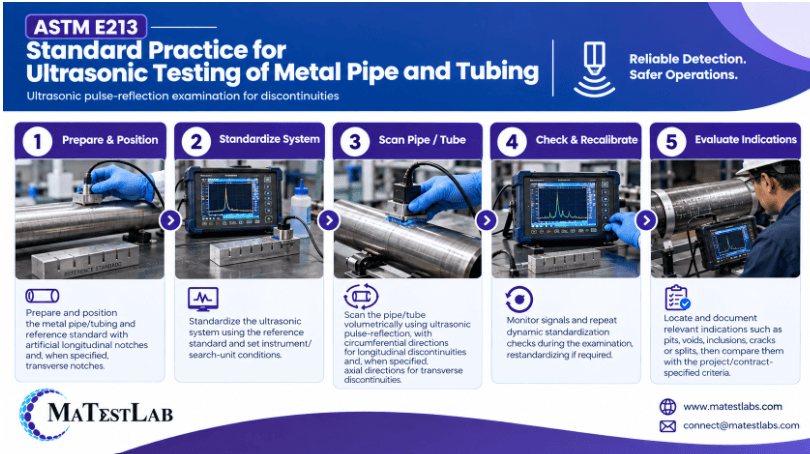
ASTM E213 Standard Practice for Ultrasonic Testing of Metal Pipe and Tubing
The Standard Practice for Ultrasonic Testing provides a standard approach for detecting internal and surface flaws in metal pipes and tubing using ultrasonic waves. This non-destructive testing method is crucial in industries such as aerospace, oil and gas, and construction, ensuring materials meet quality and safety standards. The test method involves generating high-frequency sound waves, interpreting their reflections to identify flaws, and assessing material integrity. Proper specimen preparation, equipment calibration, and skilled operators are essential for accurate results. This method plays a key role in maintaining reliability and preventing structural failures in critical applications.
Read More
GET STARTED
ASTM E213 Introduction
This test method establishes a standardized approach for performing ultrasonic testing on metal pipes and tubing to detect internal and surface flaws. It ensures that materials meet quality and safety standards, making it essential in industries such as construction, aerospace, and oil and gas. By using high-frequency sound waves, this method identifies discontinuities like cracks, voids, and inclusions, preventing structural failures. The process is non-destructive, allowing manufacturers to assess material integrity without causing damage. This test method is widely used to maintain reliability in critical applications where material performance is crucial.
ASTM E213 Test Method
Specimen Preparation
Proper specimen preparation and equipment setup are essential for accurate ultrasonic testing.
Ultrasonic Flaw Detector
Generates and receives high-frequency sound waves.
Calibration Standards
Reference samples with known flaws for equipment accuracy.
Scanning Process
A transducer is applied to the specimen, transmitting ultrasonic waves through the material.
Signal Interpretation
Reflections from flaws are analyzed to determine size and location.
ASTM E213 Equipment and Sample Preparation
Specimen Details
The test is performed on metal pipes and tubing, which must be free of defects such as rust, dirt, or coatings that could interfere with ultrasonic wave transmission.
Specimen Dimensions
The size of the specimen varies depending on the industry application, but uniform thickness is necessary for accurate testing.
Specimen Preparation
The specimen is thoroughly cleaned, and a couplant is applied to enhance wave transmission. Proper alignment and positioning of the transducer are critical for detecting flaws effectively.
Results and Interpretation ASTM E213
The results of this test method help determine the integrity of metal pipes and tubing. Reflections from ultrasonic waves indicate flaws, which are analyzed based on their size, depth, and location. A defect-free specimen confirms material reliability, while detected flaws may require further inspection or corrective action. This method plays a vital role in quality control, ensuring that pipes and tubing meet industry standards for durability and safety. Acceptance criteria are typically associated with comparing the amplitude of reflections against those of known reference reflectors. Discontinuities that exceed specific amplitude levels are rejected or undergo additional tests, such as radiographic, metallographic, or dimensional testing. It is important to perform proper calibration to obtain the accuracy and repeatability of results.
Service Name
Remarks
ASTM E213 Testing
Contact US
Tests Related to ASTM E213
Several tests complement this method to ensure comprehensive material evaluation. ASTM E273 is used in Ultrasonic testing for seamless and welded tubing, while ASTM E587 is used in a standard for ultrasonic angle-beam examination. The other applicable techniques are ASTM E114 to provide ultrasonic pulse-echo direct-beam analysis of wrought metals and ASTM E309 to provide examination of steel plates by immersion ultrasonic examination.
Use of ASTM E213 Testing in Various Industries
This test method is widely applied in industries where material integrity is critical. In the oil and gas sector, it helps ensure pipeline safety by detecting internal defects that could lead to failures. The aerospace industry relies on this method to verify the structural integrity of aircraft tubing, preventing potential weaknesses that may compromise safety. In construction, ultrasonic testing is used to assess metal pipes in buildings and infrastructure, ensuring they meet durability standards. By identifying flaws early, this method plays a key role in preventing structural failures and ensuring compliance with industry safety regulations.
Materials Commonly Tested with ASTM E213
This method is used to evaluate a variety of metallic materials, including carbon steel pipes, stainless steel tubing, and aluminum or titanium alloys. These materials are tested to detect internal or surface defects that could compromise their performance in demanding environments. By ensuring material integrity, this test method helps maintain the reliability and safety of components used in critical industries such as aerospace, construction, and energy.
Common Challenges and Troubleshooting in ASTM E213 Testing
Challenges in this method include inconsistent coupling, variations in material thickness, and misinterpretation of results. Proper calibration, surface preparation, and skilled operators help minimize errors and ensure reliable flaw detection. Troubleshooting will include the preparation of surfaces, similar couplant methods, periodic calibration of equipment against reference standards, and consistent scanning rates in automated checks.
Safety and Best Practices in ASTM E213 Testing
Safety measures include wearing protective equipment, following proper handling procedures, and ensuring equipment calibration. Adhering to best practices, such as thorough specimen cleaning and precise transducer positioning, enhances accuracy and efficiency in ultrasonic testing.
Importance of ASTM E213
This test method is essential for detecting flaws in metal pipes and tubing, ensuring safety, durability, and regulatory compliance. Industries rely on ultrasonic testing to prevent structural failures, reduce risks, and maintain product quality. By following standardized procedures, manufacturers and inspectors can confidently assess material integrity for critical applications. The generated data helps enhance regulatory adherence, product certification, and performance assurance, thereby minimizing the chances of expensive repairs, unscheduled outages, and accidents. This standard remains one of the pillars of ultrasonic NDE in piping products, contributing to the creation of safer infrastructure and more efficient industrial processes.
Related
FAQ's
Where can I get the astm e213 tested?
You can share your astm e213 testing requirements with MaTestLab. MaTestLab has a vast network of material testing laboratories, spread across the USA and Canada. We support your all material testing needs ranging from specific astm e213 test to various testing techniques.
How much do I need to pay for the astm e213 test?
Please contact us for a detailed quote for your astm e213 testing needs. Cost incurred to carry out different astm e213 testing methodology depends on the type of raw material; number of samples, coupons, or specimens; test conditions, turn around time etc. Costs of some ASTM testing methods start from $100 and the final value depends upon the factors listed above. Please contact us for the best and latest prices.
How many samples are required for astm e213?
The required number of samples or specimens should comply with the procedure given in the astm e213 standard. However, the MaTestLab operations team can assist you for your special requirements once you share your testing details with us.
How much discount can I get on the astm e213 test?
MaTestLab has a vast testing laboratory network, hence we bring you the best testing facilities in a cost-effective way. We offer considerable discounts (15-20%) to our returning customers based on test volume and frequency.
How many days will it take to complete the astm e213 test?
The turnaround time for astm e213 test methodology depends upon the test procedure mentioned in the standard test document. However, we at MaTestLab understand your research requirements and hence try to get your test completed within the least possible time.
Where can I get the astm e213 tested?
You can share your astm e213 testing requirements with MaTestLab. MaTestLab has a vast network of material testing laboratories, spread across the USA and Canada. We support your all material testing needs ranging from specific astm e213 test to various testing techniques.
MaTestLab Inc. offers accessible, quick, and affordable material testing, product testing, and failure analysis services. We support your on-demand testing and expert consultation needs with the help of our extensive network of material testing laboratories situated in the US and other parts of the world.
MATERIAL TESTING
We offer destructive and non-destructive tests over a range of mechanical, electrical, chemical, thermal, optical, corrosion, radiation, and biological testing methodologies defined by ASTM, ISO and other organizations.
PRODUCT TESTING
We help you evaluate and ensure your product quality and performance with standard and custom-made testing solutions. All the tests are done at well-equipped testing laboratories using standard testing methods for best output and satisfaction.
FAILURE ANALYSIS
Failure analysis ensures high levels of quality in every manufacturing process. We help you with getting the best failure or root cause analysis to determine the cause of the failure. The results help you identify means to prevent failure recurrences.