
ASTM C127 Standard Test Method for Specific Gravity and Absorption of Coarse Aggregate

    What is ASTM C127?

    ASTM C127 is a standard test method for determining the density, relative density (specific gravity), and absorption of coarse aggregate. The test consists of mixing the aggregates, placing them in water, measuring mass under prescribed conditions, and calculating density and absorption values. Technicians prepare a representative aggregate sample, remove entrapped air, saturate the particles with water, and measure their mass under the required conditions. ASTM C127 (Standard Test Method for Density, Relative Density (Specific Gravity), and Absorption of Coarse Aggregate) yields values indicating the aggregate’s density, specific gravity, and water absorption capacity. The results enable engineers and laboratories to assess aggregate quality, compare aggregate sources, and guide the selection of concrete and asphalt materials and mix design.

    Read more

    Get Certified ASTM C127 Coarse Aggregate Testing

    ASTM C127 testing helps coarse aggregate producers, concrete manufacturers, engineers, and quality-control laboratories assess aggregate properties. Technicians prepare and wash the sample, immerse the aggregate in water, determine the appropriate mass, and compute density, relative density, and absorption. The laboratory records information such as sample identification, mass measurements, test conditions, and calculated results. Engineers use these results to assess the quality of the aggregates and to assist in selecting materials and concrete mix proportions.

    What is the Scope of ASTM C127?

    ASTM C127 specifies the methods for determining the density, relative density (specific gravity), and absorption of coarse aggregate. The method involves finding the volume, mass, and dimensions of the particles under dry, saturated-surface dry, and submerged conditions, and subsequently providing the required data and calculations for the desired properties.  The scope of this testing is:

    Read more

    • Coarse Aggregate: Tests coarse aggregate materials used in construction applications. 
    • Density: Determines the density of the aggregate based on its measured mass and volume. 
    • Relative Density: Determines the specific gravity of the aggregate compared with the density of water. 
    • Absorption: Determines the amount of water absorbed by the aggregate under the specified conditions. 
    • Material Evaluation: Provides data for aggregate quality assessment and concrete mix design. 

    What are the uses of ASTM C127 testing?

    ASTM C127 gives the density, specific gravity and absorption values of coarse aggregate. Engineers and manufacturers will use these results to assess the quality of the aggregates and to aid in their selection of support materials and concrete mixes. The uses of this test are:

    • Determines the density of coarse aggregate. 
    • Determines relative density (specific gravity). 
    • Measures water absorption of coarse aggregate. 
    • Supports concrete mix proportioning. 
    • Helps compare aggregate sources and materials. 
    • Supports quality control of aggregate production. 
    • Provides data for material selection and evaluation. 

    Which Materials Can Be Tested According to ASTM C127?

    ASTM C127 addresses coarse aggregate materials that are appropriate for the test method. Prior to testing, laboratories should verify the type of aggregate, the particle size, the condition of the sample, and the requirements for testing.

    • Coarse Aggregate: Evaluates applicable coarse aggregate used in construction. 
    • Natural Aggregate: Tests suitable naturally occurring coarse aggregate materials. 
    • Crushed Aggregate: Evaluates applicable crushed stone and similar aggregate materials. 
    • Manufactured Aggregate: Tests applicable manufactured coarse aggregate materials when the method requirements are satisfied. 

    Why is ASTM C127 Testing Important?

    Coarse aggregate density, specific gravity, and absorption may influence concrete proportioning and aggregate performance. ASTM C127 specifies methods for controlled testing of these properties. These results help engineers determine the right amount of aggregate for mix design and compare aggregates from different sources. Manufacturers and laboratories can also use the data for quality control checks and material evaluation.

    ASTM C127 Equipment & Sample Preparation Guide

    Technicians need suitable weighing, water-immersion, drying, and temperature-control equipment to perform ASTM C127 testing. They prepare a representative coarse aggregate sample and condition it according to the requirements before making the required mass measurements.

    Read more

    Sample PreparationTechnicians collect and break down a representative coarse aggregate sample and screen out materials that do not meet the requirements.
    BalanceTechnicians use a suitable balance to measure the required aggregate masses accurately.
    Water Container and Immersion EquipmentTechnicians immerse the aggregate in water and determine the required submerged mass.
    Oven and Drying EquipmentAnalysts dry the aggregate to obtain the required oven-dry mass.
    Specimen DimensionsTechnicians mix the aggregate sample thoroughly, ensuring it is the correct amount. Remove anything smaller than 4.75 mm using a sieve, and wash it to remove any dust or coatings. If there’s a lot of smaller material, use a 2.36-mm sieve. Alternatively, the sample is separated, and the material that passes the 4.75-mm sieve is tested.

    ASTM C127 Testing Procedures and Requirements

    Technicians prepare the coarse aggregate sample and condition it under the specified water and drying conditions. They measure the sample in its required mass states and use the measurements to determine density, relative density, and absorption. This testing process includes the following steps.

    Read more

    Sample Preparation and WashingTechnicians prepare and clean the representative coarse aggregate sample before testing.
    Water SaturationTechnicians immerse the aggregate in water for the specified conditioning period.
    Mass MeasurementTechnicians measure the required saturated-surface-dry, submerged, and oven-dry masses.
    Calculation and Result DeterminationEngineers use the measured masses to determine density, relative density, and absorption.

    ASTM C127 Testing Process and Data Collection

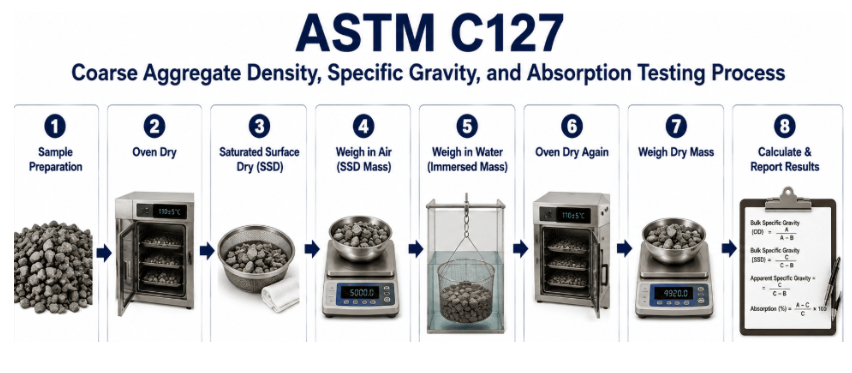
    Technicians first prepare and wash the coarse aggregate sample and condition it in water as specified. They bring the aggregate to the required saturated-surface-dry condition and record its mass. The laboratory then measures the submerged mass and dries the aggregate to determine its oven-dry mass. Technicians record all mass measurements, sample information, and test conditions. Engineers use the measurements to calculate density, relative density, and absorption and evaluate the aggregate properties.

     The image shows an ASTM C127 testing process, coarse aggregate sample preparation, water saturation, saturated-surface-dry and submerged mass measurement, oven drying, and calculation of density, relative density, and absorption.
    ASTM C127 Coarse Aggregate Density, Specific Gravity, and Absorption Testing Process

    Common Challenges and Troubleshooting

    ASTM C127 results can be influenced by: sample preparation, surface moisture, trapped air, incomplete saturation, inaccurate mass measurement, and equipment condition. The weighers should collect representative samples and conduct conditioning and weighing as described. Laboratories should check equipment prior to testing, including the balance. Technicians also should be able to remove excess surface water, leaving the aggregate in the saturated-surface-dry condition, and get to the desired test condition for the aggregate.

    Analysis Results and Interpretation

    The ASTM C127 test results give details of the density, relative density, and water absorption of the coarse aggregates. Laboratories should report the measured values along with sample information and test conditions for proper interpretation and comparison by the engineers. 

    Read more

    • The laboratory reports aggregate density in kg/m³ or Mg/m³, as applicable, and relative density (specific gravity) as a dimensionless value.
    • The laboratory reports water absorption as a percentage (%).
    • The technician records aggregate identification, specimen condition, oven-dry mass, saturated-surface-dry mass, submerged mass, and relevant test conditions.
    • The analyst evaluates the measured density, relative density, and absorption values to characterize the aggregate and support material comparison.
    • The laboratory documents specimen preparation, water conditioning, drying, mass measurements, and equipment calibration to support consistent and comparable results.

    Link to ASTM C127

    FAQ

    What does ASTM C127 measure?
    ASTM C127 specifies how to measure the density, relative density (specific gravity) and absorption of coarse aggregate.
    The method is for testing suitable coarse aggregate materials for construction applications.
    Laboratories report density in kg/m³ or Mg/m³, relative density is dimensionless and absorption is in %.
    Aggregate absorption refers to the amount of water absorbed by the aggregate, and it is useful information for the concrete mix proportioning.
    Dr Ruchika Yogesh
    About Author
    Dr Ruchika Yogesh
    Dr. Ruchika Yogesh is an entrepreneur, science and AI/ML enthusiast, medicinal chemistry subject matter expert (SME), scientific/medical copyeditor, and an independent researcher.
    Testimonials
    Real results
    Engineers trust us with what matters most
    Start Your Testing
    Project Today
    Define your requirements and get access to
    specialized laboratories ready to deliver results
    Partners with us
    Clients
    Vendors
    Process for testing
    • STEP 01

      You share your testing requirements

    • STEP 02

      You share your sample(s)

    • STEP 03

      We deliver your test reports

    Get your testing done

    Let us known your testing requirements and we will be right back with a solution.

      Let us root for each other. Collaborate to grow, expand, and accelerate our businesses.

      Partner with us

        Contact Us

        Discover more from MaTestLab

        Subscribe now to keep reading and get access to the full archive.

        Continue reading