ASTM D6742 Practice for Filled-Hole Tension and Compression Testing of Polymer Matrix
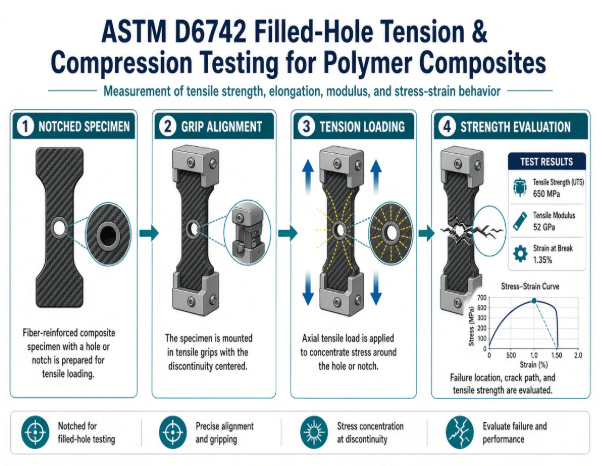
ASTM D6742 describes procedures to adapt open-hole tension and compression test methods in order to determine filled-hole tensile and compressive strengths. ASTM D6742 is analogous to open-hole testing, and the sample is tested only when a fastener is in the hole. Test materials usually tolerate a higher force during filled hole testing. Fastener selection, material hardness, fastener hole tolerance, torque, and clearance of the hole are the various parameters that might affect the strength properties of the material.
Read More
GET STARTED
ASTM D6742 Introduction
The specimen preparation, testing techniques, and data analysis methodologies for filled-hole tension and compression testing are outlined in ASTM D6742. The objective of ASTM D6742 is to enable consistent and reliable testing of composite laminates with filled holes, which are extensively applied in aerospace and structural applications. The standard focuses on polymer matrix composite laminates and includes guidelines for assessing the mechanical properties near the filled holes.
ASTM D6742 Test Procedure
ASTM D6742 provides information on the mechanical properties and performance of polymer matrix composite laminates as follows:
Service Name
Remarks
ASTM D6742 Testing Lab
Contact US
Specimen positioning and Load Application
Test specimens are conditioned to the specified surroundings before being placed in the grips or fixtures of the testing machine and subjected to a progressively increasing load until failure for the tension test or the appropriate load level for the compression test.
Displacement Monitoring
Load and displacement data are monitored and recorded using appropriate instrumentation and a data acquisition system; the testing procedure is repeated for the desired number of specimens; statistical significance and reliable average results are ensured.
ASTM D6742 Equipment and Sample Preparation
Specimen details
The test specimen for ASTM D6742 is a composite laminate with filled holes, which are representative of the holes commonly encountered in aerospace and structural applications.
Specimen dimensions
The dimensions of the sample used in ASTM D6742 vary based on the application and the composite material being evaluated.
Specimen preparation
The test specimen is prepared and filled according to the standard, using appropriate techniques to simulate the conditions encountered in practical applications.
ASTM D6742 Test Results and Interpretation
ASTM D6742 tests the strength and behavior of composite laminates by subjecting specimens to controlled loads to evaluate their mechanical properties near filled holes. When testing a composite laminate, it is important to examine the laminate’s tensile strength, compressive strength, modulus of elasticity, strain at failure, and failure mechanism. Compressive strength, or the maximum load or stress at which the specimen fails in compression, tensile strength, or failure mode are all terms used to describe the way a specimen fails.
Tests Related to ASTM D6742
ASTM D6742 is related to other standards such as ASTM D3039 for tensile properties of polymer matrix composite materials and ASTM D3410 for compressive properties of polymer matrix composite materials with unsupported gage section by shear loading.
Use of ASTM D6742 in Various Industries
The standard is widely used in the aerospace, automotive, marine, and construction industries for determining fiber-reinforced polymer composites, which are meant to prepare a sample uniformly towards material integrity and to enhance its performance.
Materials Commonly Tested with ASTM D6742
It tests the fibre reinforced polymer composites like carbon fibers, fiberglass and aramid fibres embedded in resin matrices, of great importance in aerospace, automotive, and marine fields. The standard assures that the quality of the material matches the performance requirements based on proper sample preparation and testing.
Common Challenges and Troubleshooting in ASTM D6742 Testing
Mechanical property measurements of testing frequently face difficulties with uniform thickness and alignment of the composite panels under test. Further, sometimes curing of the resin matrix can bring variations in measurements. Inhibiting problems includes calibration and sample preparation protocols as well as an optimum testing environment.
Safety and Best Practices in ASTM D6742 Testing
Testing requires composite materials to be handled very delicately, don protective gear, and ensure proper ventilation. Proper equipment maintenance, supplemented by guidelines for sample preparation, minimizes the errors and ensures that results are reliable, therefore a safe and efficient test.
Importance of ASTM D6742
The standard proves to be particularly important in making all tests of composite materials consistent and accurate, and hence dependable in high-performance application, ensuring product reliability in aircraft and the automotive industries. It has standardized preparation for test specimens helpful in quality control, product development, and safety compliance.
Related
FAQ's
Where can I get the astm d6742 tested?
You can share your astm d6742 testing requirements with MaTestLab. MaTestLab has a vast network of material testing laboratories, spread across the USA and Canada. We support your all material testing needs ranging from specific astm d6742 test to various testing techniques.
How much do I need to pay for the astm d6742 test?
Please contact us for a detailed quote for your astm d6742 testing needs. Cost incurred to carry out different astm d6742 testing methodology depends on the type of raw material; number of samples, coupons, or specimens; test conditions, turn around time etc. Costs of some ASTM testing methods start from $100 and the final value depends upon the factors listed above. Please contact us for the best and latest prices.
How many samples are required for astm d6742?
The required number of samples or specimens should comply with the procedure given in the astm d6742 standard. However, the MaTestLab operations team can assist you for your special requirements once you share your testing details with us.
How much discount can I get on the astm d6742 test?
MaTestLab has a vast testing laboratory network, hence we bring you the best testing facilities in a cost-effective way. We offer considerable discounts (15-20%) to our returning customers based on test volume and frequency.
How many days will it take to complete the astm d6742 test?
The turnaround time for astm d6742 test methodology depends upon the test procedure mentioned in the standard test document. However, we at MaTestLab understand your research requirements and hence try to get your test completed within the least possible time.
Where can I get the astm d6742 tested?
You can share your astm d6742 testing requirements with MaTestLab. MaTestLab has a vast network of material testing laboratories, spread across the USA and Canada. We support your all material testing needs ranging from specific astm d6742 test to various testing techniques.
MaTestLab Inc. offers accessible, quick, and affordable material testing, product testing, and failure analysis services. We support your on-demand testing and expert consultation needs with the help of our extensive network of material testing laboratories situated in the US and other parts of the world.
MATERIAL TESTING
We offer destructive and non-destructive tests over a range of mechanical, electrical, chemical, thermal, optical, corrosion, radiation, and biological testing methodologies defined by ASTM, ISO and other organizations.
PRODUCT TESTING
We help you evaluate and ensure your product quality and performance with standard and custom-made testing solutions. All the tests are done at well-equipped testing laboratories using standard testing methods for best output and satisfaction.
FAILURE ANALYSIS
Failure analysis ensures high levels of quality in every manufacturing process. We help you with getting the best failure or root cause analysis to determine the cause of the failure. The results help you identify means to prevent failure recurrences.