
By Malhar Khole | Last updated 8th June 2026

ASTM D3039 Standard Test Method for Tensile Properties of Polymer Matrix Composite Materials

ASTM D3039 is a standard test method for mechanically measuring the in-plane tensile properties of polymer matrix composite materials reinforced with high-modulus fibers. This method determines tensile strength, elastic modulus, strain response, and Poisson's ratio of composite laminates used within the aerospace, automotive, and structural industries. The test includes controlled uniaxial tensile loading on a universal testing machine, composite grips, and strain measurement devices. This test provides engineers with a tool for designing dependable composite structures, for performing quality control, and for aiding in material development.

Read More

GET STARTED

    Share your requirements *

    Provide your contact information *

    ASTM D3039 Introduction

    ASTM D3039 (Standard Test Method for Tensile Properties of Polymer Matrix Composite Materials) tests the tensile properties of fiber-reinforced polymer composites in uniaxial tension. This test is used to explore the behavior of composite laminates under strain in the fiber direction. The test offers valuable information for selecting materials and designing structures, and for validating their performance. This test measures the characteristics of continuous and discontinuous fiber-reinforced composite products used in aerospace panels, automotive structures, marine products, wind turbine blades, and sporting goods.

    Get Certified ASTM D3039 Testing for Reliable Composite Performance

    Certification ensures the material retains the correct tensile strength and stiffness before the manufacture of the component. Testing certification standards ensures composite parts are safer, stronger, and more durable.

    Service NameRemarks
    ASTM D3039 Testing
    Contact US

    Testing Procedures and Requirements

    First, the technicians make composite laminate specimens with a controlled fiber orientation and stacking sequence. Then, they condition the specimen under a specified environment. The technician places the specimen correctly in a universal testing machine, avoiding any slippage. The machine applies the tension to the specimen at a controlled rate until failure. Lastly, the technician records the stress-strain relationship and computes tensile properties.

    Mounting and AlignmentTechnicians carefully mount the specimen in the UTM grips and ensure proper alignment to prevent bending or eccentric loading. They employ alignment fixtures as needed to ensure axial loading conditions.
    Loading Rate ApplicationOperators load the samples in tension at a controlled crosshead speed, usually 1-2 mm/min, or as required by the material standard. This standard rate of development allows for even strain development during testing.
    Strain MeasurementTechnicians install extensometers or strain gauges on the gauge segment and measure strain continuously as they load the specimen. This enables the stress-strain behavior to be accurately determined.
    Data Calculation and ReportingTechnicians use recorded load and strain data to calculate tensile strength, modulus, and strain at break. 
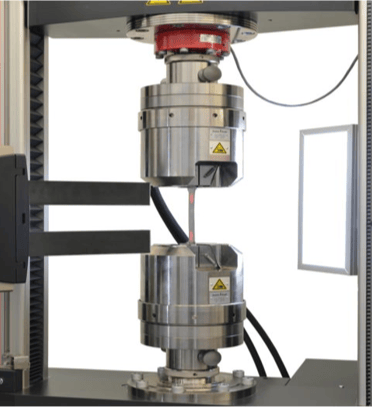
    The image shows a universal testing machine that applies a controlled tensile load to composite specimens during ASTM D3039 testing.
    ASTM D3039 Universal Testing Machine (UTM)

    Scope of ASTM D3039

    • Calculates tensile properties of polymer matrix composites. 
    • Compares the performance of fiber-reinforced laminates.
    • Used for continuous and discontinuous fiber composites. 
    • Supports the design of structures and material studies. 
    • Participates in quality control and certification. 

    ASTM D3039 Equipment and Sample Preparation

    Specimen DetailsTechnicians test fiber-reinforced polymer (FRP) composite laminates composed of carbon, glass, or aramid fibers and an epoxy, polyester, or thermoplastic matrix. Specimens are flat rectangular coupons from laminate panels in which the laminate fibers and layup are consistent. Experts ensure that the specimens have smooth, undamaged edges to avoid premature failure and maintain the composite material’s representative tensile properties.
    Specimen PreparationOperators lay up, mold, or cure composite panels based on material specifications. They use a diamond saw or water jet cutting system to avoid thermal or mechanical damage to test coupons. When needed, they bond the end tabs of composite or fiberglass to enhance gripping efficiency and prevent grip failure. 
    Specimen DimensionsThe laboratory prepares standard rectangular specimens, normally 250 mm in length and 25 mm in width. Operators ensure the same specimen thickness and the correct gauge length, thereby ensuring uniform stress distribution during tensile loading.

    Use of ASTM D3039 Test Standard

    • Measures the maximum tensile strength of a composite laminate and determines the elongation at break. 
    • Assists in the design of structures and planes in aviation 
    • Ensures the quality of composite parts production 
    • Works with material development and research 

    Why is tensile testing important for composites?

    In composites, tensile testing is crucial because it determines the material’s strength, stiffness, and tensile deformation characteristics. ASTM D3039 establishes standardized methods for measuring important mechanical properties like tensile strength, modulus of elasticity, and strain to failure. The properties are critical to material selection, design verification, and quality control in composite applications. 

    What properties does ASTM D3039 measure?

    This test provides important mechanical properties, including ultimate tensile strength, tensile strain, modulus of elasticity, Poisson’s ratio, and transition strain. These properties indicate the behavior of a composite under strain.

    Common Challenges and Troubleshooting 

    Problems technicians face include improper alignment, grip slippage, tab failure, uneven fiber distribution, or poor strain measurement. These problems affect the test’s validity. But specimen preparation, proper gripping, and calibrated strain-measurement systems enhance reliability and repeatability.

    Testing Technique, Process, and Data Collection

    Technicians prepare and condition composite laminate materials. They then attach the specimen to a universal testing machine by bonding tabs and grips. The machine applies uniaxial tensile loading to the specimen at a controlled rate until failure. Load and strain are continuously recorded in the system. Lastly, technicians produce a stress-strain curve and determine tensile properties.

    Analysis Results and Interpretation

    ASTM D3039 reports ultimate tensile strength in megapascals (MPa) or gigapascals (GPa). The strain represents mm/mm or %, and the modulus is in GPa. High tensile strength and high stiffness mean that they are well reinforced by the fibers and have good load transfer. Low values indicate a discrepancy in the fibers, the presence of voids, or defects in manufacturing. The results are useful to engineers in designing strong yet lightweight composite materials for difficult applications.

    Factors to Consider for ASTM D3039 Testing

    • Speed: Controlled loading rate gives the proper stress-strain response.
    • Expertise: Technical team with expertise in preparing and aligning specimens.
    • Cost: Efficient testing helps to lower the costs of material development and certification.

    Direct Link to ASTM D3039

    FAQ's

    Where can I get the astm d3039 tested?

    You can share your astm d3039 testing requirements with MaTestLab. MaTestLab has a vast network of material testing laboratories, spread across the USA and Canada. We support your all material testing needs ranging from specific astm d3039 test to various testing techniques.

    How much do I need to pay for the astm d3039 test?

    Please contact us for a detailed quote for your astm d3039 testing needs. Cost incurred to carry out different astm d3039 testing methodology depends on the type of raw material; number of samples, coupons, or specimens; test conditions, turn around time etc. Costs of some ASTM testing methods start from $100 and the final value depends upon the factors listed above. Please contact us for the best and latest prices.

    How many samples are required for astm d3039?

    The required number of samples or specimens should comply with the procedure given in the astm d3039 standard. However, the MaTestLab operations team can assist you for your special requirements once you share your testing details with us.

    How much discount can I get on the astm d3039 test?

    MaTestLab has a vast testing laboratory network, hence we bring you the best testing facilities in a cost-effective way. We offer considerable discounts (15-20%) to our returning customers based on test volume and frequency.

    How many days will it take to complete the astm d3039 test?

    The turnaround time for astm d3039 test methodology depends upon the test procedure mentioned in the standard test document. However, we at MaTestLab understand your research requirements and hence try to get your test completed within the least possible time.

    Where can I get the astm d3039 tested?

    You can share your astm d3039 testing requirements with MaTestLab. MaTestLab has a vast network of material testing laboratories, spread across the USA and Canada. We support your all material testing needs ranging from specific astm d3039 test to various testing techniques.

    POPULAR TESTS
    ONE-STOP FOR ALL
    MATERIAL TESTING NEEDS
    MaTestLab Inc. offers accessible, quick, and affordable material testing, product testing, and failure analysis services. We support your on-demand testing and expert consultation needs with the help of our extensive network of material testing laboratories situated in the US and other parts of the world.
    MATERIAL TESTING
    We offer destructive and non-destructive tests over a range of mechanical, electrical, chemical, thermal, optical, corrosion, radiation, and biological testing methodologies defined by ASTM, ISO and other organizations.
    PRODUCT TESTING
    We help you evaluate and ensure your product quality and performance with standard and custom-made testing solutions. All the tests are done at well-equipped testing laboratories using standard testing methods for best output and satisfaction.
    FAILURE ANALYSIS
    Failure analysis ensures high levels of quality in every manufacturing process. We help you with getting the best failure or root cause analysis to determine the cause of the failure. The results help you identify means to prevent failure recurrences.
    Process for testing
    • STEP 01

      You share your testing requirements

    • STEP 02

      You share your sample(s)

    • STEP 03

      We deliver your test reports

    Get your testing done

    Let us known your testing requirements and we will be right back with a solution.

      Let us root for each other. Collaborate to grow, expand, and accelerate our businesses.

      Partner with us

        close

        Please share your requirement with us

          ×

          Contact Us

          Discover more from MaTestLab

          Subscribe now to keep reading and get access to the full archive.

          Continue reading