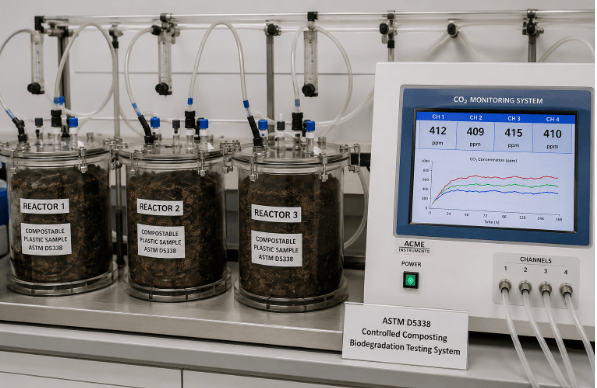
ASTM D5338, ISO 14855 Aerobic Biodegradation of Plastic Materials Under Controlled Composting Conditions at Thermophilic Temperatures
ASTM D5338 is a standard laboratory test method that determines the rate and extent of aerobic biodegradation of plastic materials under controlled composting conditions at thermophilic temperatures. The test provides reproducible and repeatable results under controlled thermophilic composting conditions.
Read More
GET STARTED
What is ASTM D5338?
ASTM D5338 is a standard test method that determines the rate and extent of aerobic biodegradation of plastic materials under controlled composting conditions. This is achieved by subjecting the materials to thermophilic temperatures in a controlled, laboratory-regulated composting environment. Representative plastic test specimens are evaluated to determine their aerobic biodegradation under controlled composting conditions. The test method is intended for evaluating plastic materials under controlled laboratory conditions that simulate industrial thermophilic composting and is not intended to represent home composting systems.
Get Certified ASTM D5338 for Compostable Plastic Verification
Testing in accordance with ASTM D5338 evaluates the aerobic biodegradation of plastic materials under controlled composting conditions. Testing in accordance with ASTM D5338 provides biodegradation data that may support compostability evaluations when used with other applicable standards and certification requirements. The use of ASTM D5338 aids in the pursuit of sustainable materials and environmental friendliness, as well as sustainable waste disposal.
Service Name
Remarks
ASTM D5338 Testing
Expert Consultation
ASTM D5338 Equipment and Sample Preparation Guide
To measure biodegradation properly, representative plastic samples and standardized composting conditions are necessary. Reliable and repeatable analytical results can be obtained by appropriate sample preparation and calibrated instruments.
Technicians reduce the materials to the desired particle size and mix them thoroughly with mature compost inoculant containing active microorganisms before adding them to the composting reactors.
Specimen Dimensions
Technicians prepare the sample quantity and particle size in accordance with ASTM D5338 to provide sufficient microbial contact and uniformity of biodegradation during the test period.
Instrumentation
Technicians use controlled composting reactors, CO₂ analyzers, infrared gas analyzers, airflow control systems, temperature-controlled incubators, moisture monitoring equipment, analytical balances, and environmental monitoring equipment for ASTM D5338 testing.
Testing Procedures and Requirements for Aerobic Biodegradation of Plastic Materials
ASTM D5338 testing measures by monitoring carbon dioxide evolution during controlled aerobic composting the biodegradation of plastic materials. Standardized laboratory methods for measurements of microbial degradation under thermophilic composting conditions that are repeatable and accurate, and allow for comparability. The process of testing includes the following:
Specimen Preparation
Technicians break down the plastic samples to the desired particle size and distribute them evenly with a mature compost inoculum containing active microorganisms.
Composting Reactor Setup
Technicians load the prepared mixture into a controlled composting reactor and closely control the temperature, moisture, and aeration conditions.
Composting and CO₂ Monitoring
Technicians conduct composting at around 58°C and monitor the carbon dioxide produced by microbial degradation throughout the incubation period.
Biodegradation Calculation and Reporting
Analysts calculate the percentage of biodegradation by comparing the amount of CO₂ released with the theoretical maximum CO₂ released from complete mineralization, check samples for physical breakdown and weight loss, and document the biodegradation percentage, carbon dioxide evolved, test conditions, and other information required by ASTM D5338.
ASTM D5338 Testing Process and Data Collection
This test procedure involves mixing plastic samples with mature compost containing active microorganisms and placing them in a controlled composting reactor. The system is at a thermophilic temperature (around 58 °C) under regulated moisture and aeration. As microorganisms break down the plastic material, they emit carbon dioxide as a metabolic product. Analytical equipment monitors and records the generated CO₂ over time.
ASTM D5338 Controlled Composting Biodegradation Testing System
What is the Scope of ASTM D5338 Test Standard?
ASTM D5338 provides guidelines for conducting aerobic biodegradation tests of plastics under controlled conditions of thermophilic composting. The standard offers uniform procedures for assessing the biodegradation properties and compostability in laboratory conditions. The scope includes:
Simulates controlled thermophilic composting conditions, typically maintained at approximately 58°C.
Measures aerobic biodegradation by CO₂ evolution.
Tests the compostability of biodegradable plastic products.
Assists in the development of environmental assessment and sustainable development of materials.
Defines standard procedures to compare the biodegradability of plastics.
Suitable for laboratory evaluation of the aerobic biodegradation of plastic materials under simulated industrial composting conditions.
What are the Uses of ASTM D5338 Testing?
ASTM D5338 testing helps manufacturers, researchers, and testing laboratories assess the biodegradation performance of plastic materials used in industrial composting environments. The results support product development, environmental claims, regulatory compliance, and quality assurance, and help develop sustainable materials. Common applications include:
ASTM D5338 provides a standardized method for measuring aerobic biodegradation of plastic materials under controlled thermophilic composting conditions.
Packaging manufacturers test compostable films, food packaging, shopping bags, and disposable packaging products to ASTM D5338 to determine their ability to biodegrade in an industrial composting facility.
Biopolymer developers use ASTM D5338 to compare new biopolymer formulations and optimize polymer composition to ensure good compostability.
Environmental research laboratories use ASTM D5338 to study the biodegradation of polymeric materials in a controlled composting environment.
Certification organizations may use ASTM D5338 test data as part of broader compostability evaluation programs that include additional standards and requirements.
What Materials Can Be Tested Under ASTM D5338?
ASTM D5338 can be used for biodegradable plastics that could be used in industrial composting applications. They usually consist of biodegradable polymer resins, compostable films, molded plastics, compostable packages, starch-based plastics, poly lactic acid (PLA), polyhydroxyalkanoates (PHA), cellulose-based plastics, biodegradable polymer blends, coated paper plastics, and other compostable plastics that can be degraded by aerobic microbial action under controlled composting conditions.
Why is ASTM D5338 Important for Biodegradable Plastics?
ASTM D5338 is a standardized testing method for evaluating the biodegradation of plastic materials under industrial composting conditions. Reliable biodegradation testing provides manufacturers with confidence in their ability to meet compostability requirements, create materials that are environmentally friendly, minimize plastic waste, and aid in sustainable product design. The use of standardized testing also allows for meaningful comparison of biodegradability of materials and can give confidence to environmental certification programs.
ASTM D5338 Common Challenges and Troubleshooting
Common challenges include sample preparation, environmental control, inoculum quality, measurement, and test duration. Solutions include calibration, standard operating procedures, quality control samples, and trained personnel.

Analysis Results and Interpretation
ASTM D5338 evaluates aerobic biodegradation by measuring the carbon dioxide generated as microorganisms metabolize the carbon contained in plastic materials under controlled thermophilic composting conditions.
The amount of carbon dioxide produced is compared with the theoretical maximum carbon dioxide that could be generated from complete biodegradation of the test material.
Biodegradation performance is typically reported as the percentage of theoretical biodegradation calculated from the cumulative carbon dioxide evolved during the test.
The biodegradation percentage is the percentage of the carbon dioxide released from the materials in relation to the theoretical maximum carbon dioxide that could be generated by mineralization of the materials.
Higher biodegradation percentages indicate greater microbial degradation under the specified test conditions; however, evaluate compostability using all applicable standards and requirements.
Engineers can visually observe loss of specimen integrity and weight loss, which may provide additional data on the material’s physical degradation.
Biodegradation results obtained using ASTM D5338 may be considered together with other applicable compostability requirements and standards when evaluating materials for industrial composting applications.
What are the Factors to Consider for ASTM D5338?
Speed: The biodegradation test requires a prolonged incubation period, which in most cases takes a few weeks to measure microbial breakdown.
Expertise: The evaluation requires skilled lab workers who are conversant with methods for monitoring microbial activity, composting systems, and carbon dioxide measurements.
Cost: The ASTM D5338 test may help create more environmentally friendly materials and support compostability claims.
Rohit Dhembare is an Operations Associate at MaTestLab Inc. and holds a postgraduate degree in Organic Chemistry.
FAQ's
Where can I get the astm d5338 tested?
You can share your astm d5338 testing requirements with MaTestLab. MaTestLab has a vast network of material testing laboratories, spread across the USA and Canada. We support your all material testing needs ranging from specific astm d5338 test to various testing techniques.
How much do I need to pay for the astm d5338 test?
Please contact us for a detailed quote for your astm d5338 testing needs. Cost incurred to carry out different astm d5338 testing methodology depends on the type of raw material; number of samples, coupons, or specimens; test conditions, turn around time etc. Costs of some ASTM testing methods start from $100 and the final value depends upon the factors listed above. Please contact us for the best and latest prices.
How many samples are required for astm d5338?
The required number of samples or specimens should comply with the procedure given in the astm d5338 standard. However, the MaTestLab operations team can assist you for your special requirements once you share your testing details with us.
How much discount can I get on the astm d5338 test?
MaTestLab has a vast testing laboratory network, hence we bring you the best testing facilities in a cost-effective way. We offer considerable discounts (15-20%) to our returning customers based on test volume and frequency.
How many days will it take to complete the astm d5338 test?
The turnaround time for astm d5338 test methodology depends upon the test procedure mentioned in the standard test document. However, we at MaTestLab understand your research requirements and hence try to get your test completed within the least possible time.
Where can I get the astm d5338 tested?
You can share your astm d5338 testing requirements with MaTestLab. MaTestLab has a vast network of material testing laboratories, spread across the USA and Canada. We support your all material testing needs ranging from specific astm d5338 test to various testing techniques.
MaTestLab Inc. offers accessible, quick, and affordable material testing, product testing, and failure analysis services. We support your on-demand testing and expert consultation needs with the help of our extensive network of material testing laboratories situated in the US and other parts of the world.
MATERIAL TESTING
We offer destructive and non-destructive tests over a range of mechanical, electrical, chemical, thermal, optical, corrosion, radiation, and biological testing methodologies defined by ASTM, ISO and other organizations.
PRODUCT TESTING
We help you evaluate and ensure your product quality and performance with standard and custom-made testing solutions. All the tests are done at well-equipped testing laboratories using standard testing methods for best output and satisfaction.
FAILURE ANALYSIS
Failure analysis ensures high levels of quality in every manufacturing process. We help you with getting the best failure or root cause analysis to determine the cause of the failure. The results help you identify means to prevent failure recurrences.