

What is Outgassing Testing Per ASTM E595?
Outgassing testing measures how materials release trapped gases and vapors when exposed to heat and a vacuum. The two basic parameters are measured in this test method: Total Mass Loss (TML), which is the total amount of all the volatilized material emitted, and Collected Volatile Condensable Material (CVCM), which is the amount of volatiles that condense on cold surfaces. ASTM E595 is a standard operating practice that evaluates the outgassing behavior of materials to be used in spacecrafts, satellites, and other high vacuum environments. At elevated temperatures, when placed under vacuum, the material releases volatile compounds that may be transferred and condensed onto vital surfaces of spaceships.
Matestlab has an expert team that performs general and customized outgassing tests per ASTM E595 for the clients. The standard ASTM E595 methodology specifies that the test be carried out at 125°C as the sample temperature; however, we can run the test at 90 °C or any other temperature to make it a modified ASTM E595 test. The ASTM E595 test lasts 24 hours. With sample preparation, etc, it takes ~ 1 week to complete the test, and we can run 3-5 samples in one batch under similar conditions. The sample weight should be at least 200 mg per test. The test crucibles are cylindrical, approximately 10 mm high and ~9 mm wide.
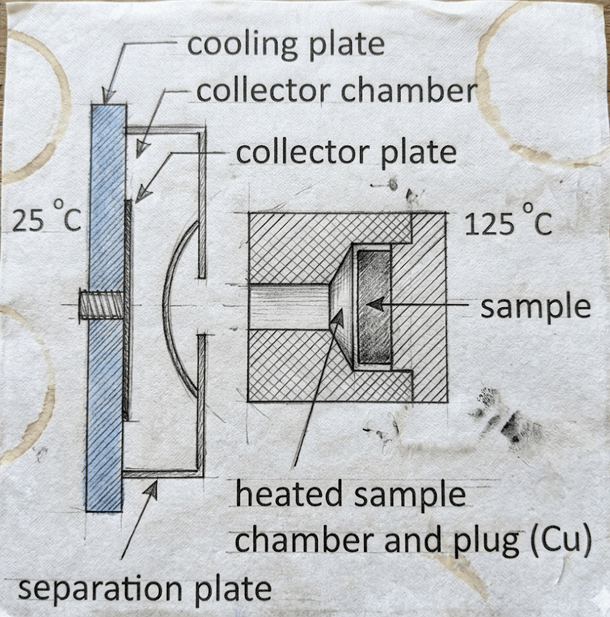
What is the Scope of ASTM E595 Test?
Key parameters measured are –
- Total Mass Loss (TML): The percentage of a material’s mass that evaporates or releases into a vacuum.
- Collected Volatile Condensable Materials (CVCM): The percentage of outgassed volatile matter that condenses onto a cooled collector plate.
- Water Vapor Regained (WVR): An optional parameter measuring the amount of moisture re-absorbed by the material after initial testing
- The experimental process replicates high-vacuum conditions and space temperatures to test volatile release, condensable deposition, and residue formation.
What is the Principle of the ASTM E595 Test Method?
This test standard evaluates the outgassing behavior of materials under high-vacuum conditions by heating a specimen at a controlled temperature and measuring the mass lost due to vaporization. The released vapors are collected on a cooled surface, and both the total mass loss (TML) and collected volatile condensable materials (CVCM) are determined. These values indicate how much material evaporates and how much of it can re-condense on nearby surfaces, helping assess suitability for vacuum environments.
Testing Procedure Overview
The specimen is first conditioned and weighed, then placed in a vacuum chamber. It is heated (typically around 125 °C) under high vacuum for a specified duration, while a cooled collector plate is positioned nearby to capture condensable vapors. After the test, the sample and collector are reweighed to determine total mass loss (TML) and collected volatile condensable material (CVCM). These values are then calculated and reported to assess the material’s outgassing characteristics.
| Specimen details | The specimens are flat sheets or discs that have certain dimensions so that their exposure can be uniform during testing. |
| Specimen dimensions | The specimen size is 25.4 mm (1 inch) or 50.8 mm (2 inches), and a thickness of around 1 to 3 mm (0.04 to 0.12 inches). |
| Specimen preparation | The surface contaminants that may affect the outgassing results are cleaned, and to stabilize the properties of the specimen, the specimen is conditioned. |
What is the Significance of ASTM E595 Outgassing Test?
ASTM E595 provides a standardized way to assess the outgassing potential of materials in vacuum or space environments. Even small amounts of volatile release can contaminate sensitive surfaces such as optics, sensors, and electronic components. By quantifying TML and CVCM, the test ensures material reliability, prevents performance degradation, and supports stringent selection criteria for high-performance applications. It acts as a critical tool for quality assurance, material screening, and compliance with aerospace requirements.
Application of ASTM E595
ASTM E595 is widely used in the aerospace, satellite, and vacuum technology industries to evaluate materials such as polymers, adhesives, coatings, and sealants for low outgassing. It is essential in spacecraft design to prevent contamination of optical instruments, solar panels, and thermal control surfaces. The method is also used in electronics, vacuum chambers, and high-precision equipment where maintaining a clean vacuum environment is critical. Overall, it supports the selection and validation of materials for use in sensitive, low-pressure conditions. Following materials are tested using ASTM E595-
- Polymer, adhesives, coatings, foams, and elastomers.
- Blankets and thermal-regulating films.
- Composite materials and lubricants.
- Electrical insulation, tapes, and structural laminates.
- Spacecraft hardware must be low-contaminated.


