
ASTM E1382 is a standard test method for determining average grain size in polycrystalline metallic and nonmetallic materials. This method works for equiaxed or elongated grains. Sizes are uniform or duplex. Engineers rely on it for quality control and material comparisons. It also comes up in microstructural research. Laboratories use ASTM E1382 (Standard Test Methods for Determining Average Grain Size Using Semiautomatic and Automatic Image Analysis) to measure grain intercept lengths, intercept counts, and grain areas through digital image analysis. Analysts process a microscope image of the etched surface with semiautomatic tablets or automatic analyzers that produce statistical grain-size data and reduce operator bias.
ASTM E1382 Standard Test Methods for Determining Average Grain Size Using Semiautomatic and Automatic Image Analysis
What is ASTM E1382?
What is the Scope of ASTM E1382 Test Standard?
The scope of ASTM E1382 includes determining the average grain size of metallic and nonmetallic polycrystalline materials using semiautomatic and automatic image analysis techniques. The method applies to single-phase and multiphase materials with clearly defined grain boundaries and evaluates equiaxed, elongated, uniform, and duplex grain structures. The standard also supports analysis of microstructures with grain-like features, such as cells.
The scope of ASTM E1382 standard includes:
- Material type: Metallic and nonmetallic polycrystalline materials with identifiable grain boundaries.
- Purpose: Determination and evaluation of average grain size and grain size distribution.
- Property evaluated: Grain intercept length, intercept count, and grain area.
- Testing Method: Semiautomatic digitizing tablets or automatic image analysis systems analyze magnified micrographs of the material.
- Results: Grain size data are reported from measured intercepts, counts, or grain areas.
- Test Limitations: The method requires clearly distinguishable grain boundaries for reliable image analysis.
- Use conditions: Applicable to equiaxed and elongated grains, as well as single and duplex grain-size distributions.
- Applications: Used for quality control, material comparison, microstructural research, and evaluation of processing effects.
What are the Uses of ASTM E1382 Testing?
Applications of ASTM E1382 testing include quality control, product development, and scientific research. Laboratories analyze grain-size data for consistency across different production batches. On the other hand, engineers relate grain size to mechanical properties while designing new alloys. This standard-
- Helps in quality control of production runs.
- Aids researchers in studying the effects of structure on properties during processing.
- Compares grain size efficiency of different material compositions.
- Validates results of heat treatments on microstructures.
- Helps engineers select materials for challenging applications.
Which Materials Can Be Tested Under ASTM E1382?
ASTM E1382 covers various polycrystalline metallic and non-metallic solid materials. Stainless steel, aluminum, and titanium alloys are common examples used in structures and aerospace products. In addition, analysts use the test to analyze ceramic materials and certain polymer materials that have a grain-like structure. Industries that rely on the durability of materials use this test.
Why is ASTM E1382 Important?
ASTM E1382 is an important standard because there is a relationship between microstructure and mechanical properties. The grain structure affects the strength, ductility, and fatigue resistance of metals and alloys. Generally, finer and more uniformly distributed grains lead to higher strength and toughness of the metal structures. As such, precise information regarding the grain size can assist engineers in predicting material behavior.
ASTM E1382 Equipment and Sample Preparation Guide
ASTM E1382 requires equipment with a calibrated image analysis system, along with a well-prepared metallographic specimen. The following table gives details about the equipment and specimen required.
| Sample and Specimen Material | Technicians test polished sections of metallic or nonmetallic polycrystalline material for grain analysis. |
| Specimen Preparation | Grinding, polishing, and etching prepare the surface to reveal clear grain boundaries before imaging. |
| Specimen Dimension | A specimen requires a minimum polished surface area of 160 mm² (0.25 in.²) for reliable measurement. |
| Instrumentation | The test uses an optical microscope, a semiautomatic or automatic image analyzer, and grain boundary detection software. |
Testing Procedures and Requirements
Testing procedures and requirements adhere to a specific order from specimen imaging to reporting of results with regard to this test procedure. First, technicians establish the magnification and boundary detection criteria before testing. The ASTM E1382 test methods comprise the following test procedure-
| Specimen Imaging | Technicians capture a magnified image of the etched grain structure using a microscope. |
| Microscopic Measurement | The system counts grains per unit area, grain boundary length, and intercept lengths across multiple fields for statistical accuracy. |
| Distribution Plotting | Analysts organize intercept length or area measurements from many grains into a histogram of frequency versus size class. |
| Result Reporting | Laboratories report the mean grain size or the grain size distribution along with the measurement method used. |
ASTM E1382 Testing Process and Data Collection
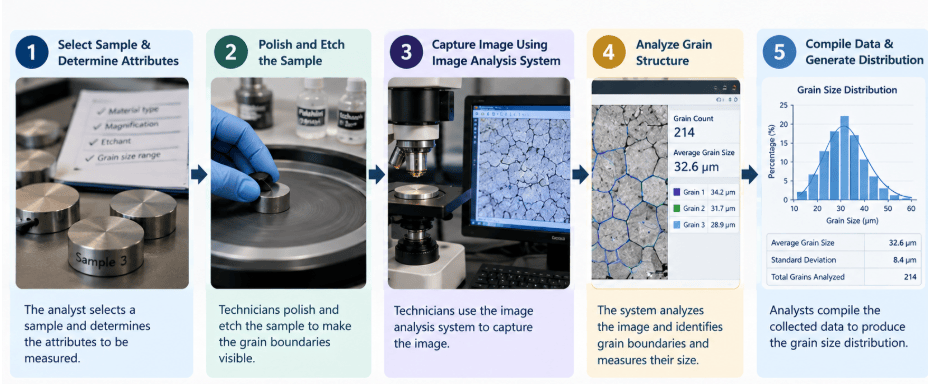
ASTM E1382 testing and data collection begin with sample selection and determining the attributes that analysts measure. Technicians then polish and etch the samples to make the grain boundaries visible. Technicians use the image analysis system to capture the image. Analysts finally compile the collected data to produce the grain size distribution.
Common Challenges and Troubleshooting
Problems and troubleshooting include the uniform preparation of specimens, which is still a major issue in grain size image analysis; difficulties in polishing specimens or poor etching results make it difficult to see the grain boundaries and cause data to be misjudged. The image artifacts and magnification error can also affect the accuracy of boundary detection. Thus, the issues are resolved by tuning polishing techniques, regularly calibrating imaging systems and optimizing threshold values for boundary detection by the engineers.
ASTM E1382 Analysis Results and Interpretation
ASTM E1382 analysis results and interpretation involve analysts converting grain measurements into a standardized grain size value after each test. The report compares intercept, area, or count data against recognized grain size classifications. These findings help laboratories interpret results consistently under this test method.
- The laboratory reports the mean grain size as a grain size number or average grain diameter in mm or µm, as applicable.
- Analysts report the distribution of grain intercept lengths or measured grain areas in mm or µm, as applicable, based on the selected measurement approach.
- Engineers compare equiaxed and elongated grain structures when both morphologies are present and document the corresponding grain-size measurements.
- Analysts identify uniform or duplex grain-size populations from the measured grain distribution and record the relevant observations.
- Engineers evaluate statistical confidence based on the number of grains and measurement fields analyzed and use the results to assess the reliability of the reported grain-size value
Get Certified ASTM E1382 Testing for Reliable Grain Size Analysis
Manufacturers use microstructural consistency to assess the mechanical properties and performance of critical components after obtaining ASTM E1382 certification for reliable grain size analysis. The certification test ensures that the grain structure of the material satisfies the requirements of a particular design. Thus, independent testing eliminates all doubts in regard to the quality of the materials. Matestlab supports manufacturers with calibrated image analysis systems and trained metallographers who deliver dependable, comparable grain size data.
FAQ
For what is ASTM E1382 used?
ASTM E1382 is used to determine the grain size in polycrystalline metals and nonmetallic materials through image analysis. Laboratories use it for quality control, material comparison, and microstructural research.
What is measured during this test method?
This test method measures grain intercept lengths, intercept counts, grain boundary length, and grain areas. These measurements produce a grain size or a full grain size distribution.
Which materials can be tested with this method?
This method tests steel, aluminum, and titanium alloys along with ceramics and polymers. Any material with visible grain boundaries qualifies for image analysis.
Why choose automatic image analysis over manual counting?
Laboratories choose automatic image analysis over manual counting because these methods reduce operator bias and speed up data collection. They also enable a larger sample size, which improves statistical confidence in the results.
Updated on September 14, 2026

Testimonials
Real results
Engineers trust us with what matters most
“We had a great experience working with this company for our ASTM E84 testing. They were the first company to respond to our inquiry within just a few minutes of submitting it. From start to finish, the communication was excellent, and the entire process was swift, straightforward, and hassle-free.”

“Very good communication, testing associates were very patient with delays on our end. Reasonable turnaround time for results and nicely detailed report. Analysts were also quick to answer any follow-up questions. Happy with results.”
“Matestlab connected us with an accredited lab within days, cutting weeks off our product validation timeline.”
Start Your Testing
Project Today
Project Today
Define your requirements and get access to
specialized laboratories ready to deliver results
specialized laboratories ready to deliver results
Start Testing
Partners with us
Clients
Vendors