
ASTM D4541 Pull-Off Strength of Coatings Using Portable Adhesion Testers

    What is ASTM D4541?

    ASTM D4541 is a standard test for assessing the pull-off strength of coatings on metal, concrete, and other rigid substrates. It determines the force needed to remove a coating from the substrate or an intermediate coating layer using a portable adhesion tester. Engineers and technicians use ASTM D4541(Standard Test Method for Pull-Off Strength of Coatings Using Portable Adhesion Testers) to assess coating adhesion and identify areas of poor adhesion within the coating system. The method is used for coating quality control, surface preparation assessment, maintenance inspections, and comparing coating systems. Results can also be used to check the coating’s adhesion effectiveness for the intended service environment and application.

    Read more

    Get Certified ASTM D4541 Testing for Reliable Coating Adhesion

    Coatings must be sufficiently adherent to stay on the material being coated during handling and use. Therefore, pull-off adhesion testing helps engineers assess coating performance and pinpoint areas of poor adhesion. ASTM D4541 provides a standardized method for measuring coating pull-off strength using a portable adhesion tester. Findings can be used for quality control, coating qualification, evaluation of surface preparation, and maintenance decision-making.
    What is the Scope of the ASTM D4541 Test Standard?

    ASTM D4541 is a test for determining pull-off strength that measures the force applied to a coating perpendicular to the surface. The method employs portable adhesion testers, appropriate loading fixtures, and dollies. The ASTM D4541 standard-

    Read more

    • Measures the pulling strength of coatings.
    • Assesses the bond between coating and substrate.
    • Determines poor interfaces for coating systems.
    • Works on coatings on rigid substrates.
    • Uses portable adhesion testing equipment.
    • Helps to control the quality of the coating.
    • Assesses surface preparation and coating application.
    • Records the failure location and type.

    What are the Uses of ASTM D4541 Testing?

    ASTM D4541 testing assesses the adhesion strength of coating systems for use by laboratories and engineers. The results provide insight into coating bonding and enable the detection of possible adhesion problems. This standard-

    • Measures the pull-off strength of coatings.
    • Evaluates coating-to-substrate adhesion.
    • Recognizes cohesive/adhesive failures.
    • Supports coating qualification.
    • Assists with the assessment of the surface preparation.
    • Assists in the quality control of coating application.
    • Assists in the investigation of coating failures.
    • Provides information for maintenance and repair decisions.

    Which materials can be tested under ASTM D4541?

    ASTM D4541 is applicable to coatings that have been applied to rigid substrates and for which the specific portable adhesion tester used is capable of conducting the test. These are usually used for coatings on metal and concrete surfaces. Before choosing the testing equipment and dolly configuration, technicians should determine the coating system, substrate, coating thickness, and expected adhesion.

    Why is ASTM D4541 Important?

    ASTM D4541 is a standard method for measuring coating adhesion using portable equipment. Regular testing helps engineers determine whether coatings adhere to their substrates. The results also help identify weak interfaces and inform decisions about coating application, surface preparation, maintenance, and repair.

    Equipment and Sample Preparation Guide (ASTM D4541)

    ASTM D4541 requires a portable adhesion tester with an appropriate loading fixture and dolly. The surface to be coated and the dolly are prepared and firmly secured prior to applying the tensile load.

    Read more

    Sample and Specimen DetailsLaboratories test coated rigid substrates with representative coating systems and suitable test locations.
    Specimen PreparationTechnicians clean and prepare the test area and attach the dolly to the coating using a suitable adhesive.
    Specimen DimensionsDolly size and test spacing vary by adhesion tester type, coating system, and test requirements.
    InstrumentationThe testing process uses a portable pull-off adhesion tester, loading fixture, dollies, adhesive, surface preparation, and thickness-measuring equipment.

    Testing Procedures and Requirements for ASTM D4541

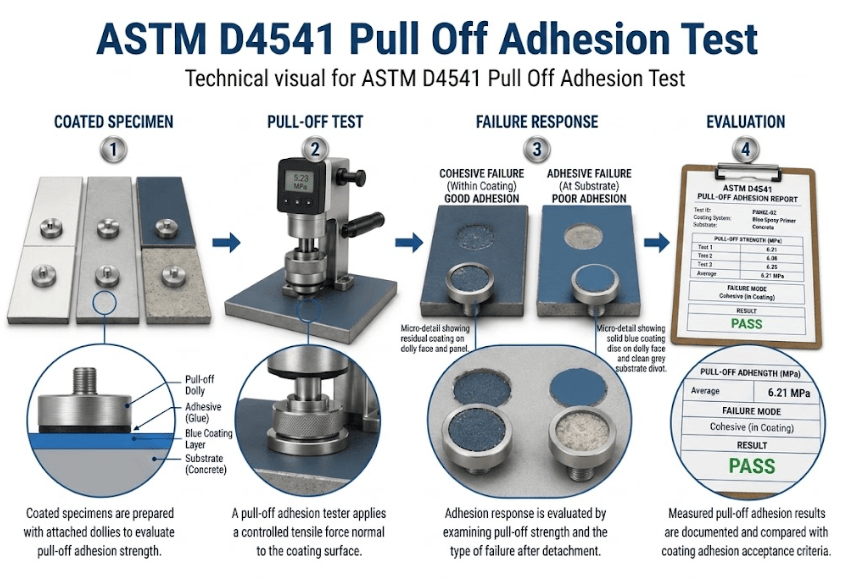
    Technicians mount a loading fixture on the coating and apply tensile force perpendicular to the coated surface, as required by ASTM D4541. The load is incremented at the specified rate until the coating system separates or the desired test condition is reached. The procedure outlined in ASTM D4541 is as follows-

    Read more

    Surface PreparationTechnicians surface-prepare the coating, then select representative test points before attaching the loading fixture.
    Dolly AttachmentThe operator applies an appropriate adhesive to attach the dolly to the coating and ensures the bond forms properly.
    Pull-Off TestingTechnicians connect the portable adhesion tester and apply tensile force perpendicular to the surface until failure occurs.
    Failure EvaluationEngineers pinpoint the failure location and decide whether it is at the coating-substrate interface, in the coating, or in another layer.
    Result ReportingLaboratories report pull-off strength, test location, coating information, substrate details, and failure mode.

    ASTM D4541 Testing Process and Data Collection

    Technicians select representative coating areas and prepare them for testing. They then affix appropriate dollies to the coating and let the adhesive cure as per the requirements. Then, the operator attaches the portable adhesion tester and stretches it parallel to the coated surface. The equipment records the force required to separate the objects and achieve separation. Finally, the engineers assess the failure site and then calculate or document the pull-off strength. The adhesion value measured on the samples is reported by the laboratories along with the failure mode and sample details.

     This image shows a portable adhesion tester applying tensile force to a dolly attached to a coated surface according to ASTM D4541.
    ASTM D4541 Pull-Off Adhesion Testing

    Common Challenges and Troubleshooting

    Proper surface preparation, dolly attachment, adhesive bonding, and equipment operation are all important to obtain accurate ASTM D4541 results. If there is a poor bond between the dolly and the coating, an incorrect or false result may be obtained. Technicians must pick representative test locations and maintain dolly alignment during testing. They should also carefully examine the failure surface to determine the true failure location.

    ASTM D4541 Analysis Results and Interpretation

    The report provides an overview of the adhesion and pull-off of the tested coating system. The measured pull-off strength is reported along with the coating, substrate, test location, and failure mode.

    Read more

    • The test results report the pull-off strength of coating systems according to ASTM D4541, typically expressed in MPa or psi, and indicate the force required to cause coating separation.
    • Engineers evaluate the failure location to distinguish between adhesive and cohesive failure and determine the mode of coating separation.
    • Engineers interpret higher pull-off strength values as greater resistance to separation under the specified test conditions.
    • Laboratories compare the test results with applicable coating specifications and acceptance requirements to evaluate coating performance.
    • The test results support coating quality assessment when technicians use proper surface preparation and securely attach the dollies to obtain consistent measurements.

    Link to ASTM D4541

    FAQ

    Where can I get the astm d4541 tested?
    You can share your astm d4541 testing requirements with MaTestLab. MaTestLab has a vast network of material testing laboratories, spread across the USA and Canada. We support your all material testing needs ranging from specific astm d4541 test to various testing techniques.
    Please contact us for a detailed quote for your astm d4541 testing needs. Cost incurred to carry out different astm d4541 testing methodology depends on the type of raw material; number of samples, coupons, or specimens; test conditions, turn around time etc. Costs of some ASTM testing methods start from $100 and the final value depends upon the factors listed above. Please contact us for the best and latest prices.
    The required number of samples or specimens should comply with the procedure given in the astm d4541 standard. However, the MaTestLab operations team can assist you for your special requirements once you share your testing details with us.
    MaTestLab has a vast testing laboratory network, hence we bring you the best testing facilities in a cost-effective way. We offer considerable discounts (15-20%) to our returning customers based on test volume and frequency.
    The turnaround time for astm d4541 test methodology depends upon the test procedure mentioned in the standard test document. However, we at MaTestLab understand your research requirements and hence try to get your test completed within the least possible time.
    Gokula Srinivasan Selvam
    About Author
    Gokula Srinivasan Selvam
    Gokula Srinivasan Selvam is a Material Testing Associate at MaTestLab Inc. and holds a postgraduate degree in Ceramic Engineering from IIT (BHU), Varanasi.
    Testimonials
    Real results
    Engineers trust us with what matters most
    Start Your Testing
    Project Today
    Define your requirements and get access to
    specialized laboratories ready to deliver results
    Partners with us
    Clients
    Vendors
    Process for testing
    • STEP 01

      You share your testing requirements

    • STEP 02

      You share your sample(s)

    • STEP 03

      We deliver your test reports

    Get your testing done

    Let us known your testing requirements and we will be right back with a solution.

      Let us root for each other. Collaborate to grow, expand, and accelerate our businesses.

      Partner with us

        Contact Us

        Discover more from Matestlab Inc

        Subscribe now to keep reading and get access to the full archive.

        Continue reading