ASTM D1044 Standard Test Method for Resistance of Transparent Plastics to Surface Abrasion by the Taber Abraser
What is ASTM D1044?
ASTM D1044 is a standard test method that quantifies transparent plastics’ resistance to surface abrasion based on changes in optical properties. The method numerically quantifies abrasive damage by measuring the haze difference between abraded and unabraded specimens, with haze measured in accordance with ASTM D1003. In the test, a Taber Abraser produces controlled surface abrasion under a set of conditions. ASTM D1044 (Standard Test Method for Resistance of Transparent Plastics to Surface Abrasion by the Taber Abraser) provides a method to compare transparent plastic materials and assess optical changes in material quality caused by abrasion. The results support material selection, product development, and quality control for applications where surface wear may affect transparency.
Get Certified ASTM D1044 Testing for Reliable Abrasion Resistance of Transparent Plastics
During use, transparent plastics can sustain surface damage from cleaning, wiping, handling, and other contact. Hence, abrasion testing is used to determine the optical properties of these materials after controlled abrasion. ASTM D1044 defines a standardized Taber abrasion procedure and provides a measure of the optical change from the haze measurement. The results support material comparison, product development, and quality control.
What is the Scope of the ASTM D1044 Test Standard?
ASTM D1044 measures transparent plastics’ resistance to a single type of surface abrasion. This method quantifies abrasive damage by the difference in haze between abraded and unabraded samples and measures the change in optical properties. The ASTM D1044 standard-
Measures the resistance to surface abrasion of transparent plastics.
Measures optical changes due to surface abrasion.
Compares the haze of abraded and unabraded specimens.
Permits grading of transparent plastic materials relative to each other.
Supports assessment of abrasion’s impact on a material’s optical performance.
What are the Uses of ASTM D1044 Testing?
ASTM D1044 testing assesses the optical impact of controlled surface abrasion on transparent plastics in a laboratory. Engineers use the findings to compare materials and determine their ability to resist this type and amount of abrasion. The ASTM D1044 standard-
Measures changes in haze due to abrasion.
Makes comparisons between transparent plastic materials.
Assists in material choices and elaboration.
Assists in the assessment of optical-quality retention.
Aids in quality control of products.
Gives relative abrasion-resistance information.
Assists in determining transparent plastics for service applications involving surface contact.
Which materials can be tested under ASTM D1044?
ASTM D1044 applies to transparent plastic test specimens that can be prepared and mounted for Taber abrasion testing. The technique is designed for materials in which surface abrasion can cause a measurable change in optical properties. Technicians should use appropriate materials and specimen dimensions for mounting and optical measurements. Also, consult the applicable material specification, as it may require changes to the ASTM D1044 procedure.
Why is ASTM D1044 Important?
ASTM D1044 offers a standardized method for correlating the transparency of plastics given a given type of surface abrasion. The test is useful to see whether abrasion results in a major increase in surface haze. The method is essential for comparative material testing and quality control. But ASTM D1044 does not measure all types of abrasion and should not be considered a general volume-loss test.
ASTM D1044 Equipment and Sample Preparation Guide
ASTM D1044 requires a Taber Abraser along with the following: abrasive wheels that meet specified requirements; a specimen holder; a vacuum pickup system; and a hazemeter that meets the applicable requirements. ASTM D1003 details the procedure for determining haze and luminous transmittance.
Operators test transparent plastic specimens suitable for Taber abrasion and optical measurements.
Specimen Preparation
Before specimens are put into the abrasion, they are cleaned and conditioned to measure their haze levels initially.
Specimen Dimensions
Specimens are approximately 100 mm in diameter or approximately 100 mm square, with substantially plane and parallel surfaces and a central mounting hole. Technicians normally test three specimens per sample unless the applicable requirements specify otherwise.
Instrumentation
A Taber Abraser, specified abrasive wheels, vacuum pickup system, specimen holder, and properly adjusted hazemeter support the test.
Testing Procedures and Requirements for ASTM D1044
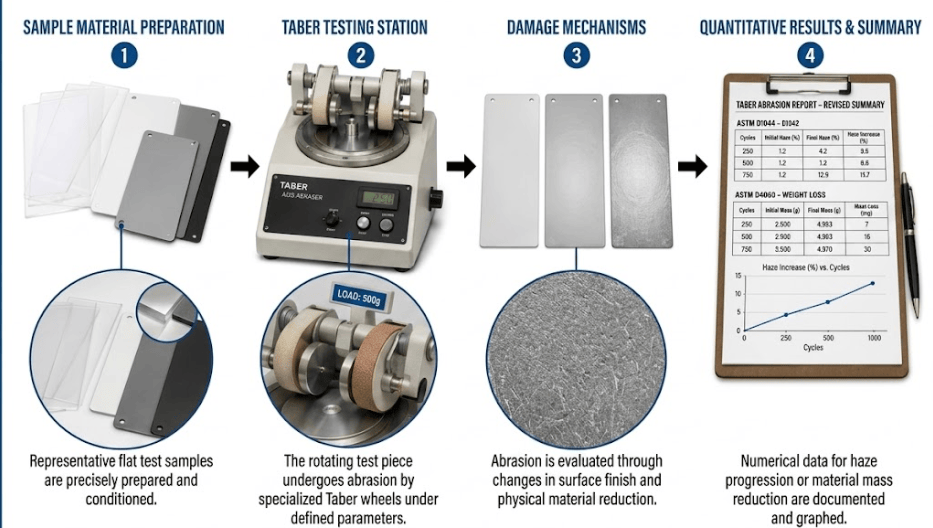
ASTM D1044 subjects transparent plastic test specimens to a prescribed abrasion, and measures the resulting increase in haze. Technicians take a measurement of the starting haze; place the specimen on the table; use the required wheel and load to do the abrasion; then take a measurement of the abraded haze following the optical procedure appropriate to the specimen. The procedure outlined in ASTM D1044 is as follows-
Technicians measure the haze of clean, unabraded test specimens per ASTM D1003.
Abrasion Setup
Operators position the specimen and set up the desired abrasive wheels and vacuum pick-up system.
Abrasion Testing
Technicians apply 500 g per wheel unless otherwise agreed and normally use 100 abrasion cycles unless otherwise specified.
Final Haze Measurement
Technicians measure the haze of the abraded track using the properly adjusted hazemeter.
Result Calculation
Engineers can use the difference between abraded and unabraded haze to measure abrasive damage.
Result Reporting
Operators report the results of the haze measurement, the conditions of the test, information about the specimen, and observations and remarks that are relevant to the test.
ASTM D1044 Testing Process and Data Collection
Technicians clean the transparent plastic specimens and condition them before initial haze measurements. They then prepare the Taber Abraser and ensure the abrasive wheels are properly conditioned. Operators mount the specimens and apply the required wheel load. The number of abrasion cycles is 100, and the weight per wheel is 500 g, unless otherwise agreed or specified. Dust from the abrasion process is removed during testing by a vacuum pickup system. Technicians should monitor abrasive-wheel condition because material can transfer to the wheels and cause clogging. Technicians should also consider stabilizing the wheel surface to avoid wheel-surface temperature affecting haze. Lastly, technicians measure the abraded haze and compare it to the unabraded haze. The abrasive effect is reported by the engineers in the form of the haze difference.
ASTM D1044 Taber Abrasion Testing of Transparent Plastics
Common Challenges and Troubleshooting
To obtain accurate results per ASTM D1044, properly prepare specimens, condition abrasive wheels, load them correctly, run controlled abrasion cycles, and adjust the hazemeter properly. The material may transfer from the specimen to the wheel surface and cause clogging, which affects abrasive characteristics. Clean or re-face the wheels as needed, and stabilize their surface temperature before testing. They should also check the hazemeter setting, since the optical setting could be incorrect, which will lead to incorrect haze values.
The laboratory reports haze as a percentage (%) and determines the change in haze from the abraded and unabraded specimen measurements.
The analyst compares the initial and final haze values to quantify the optical change produced by abrasion.
The laboratory records relevant test conditions, including abrasion cycles, applied load, wheel condition, specimen characteristics, and hazemeter settings.
The analyst interprets a smaller increase in haze as greater resistance to the specified type of abrasive damage under comparable test conditions.
The engineer compares haze-change results among materials or formulations while considering the applicable abrasion and measurement conditions; the method does not determine abrasion-related volume loss.
Rohit Dhembare is an Operations Associate at Matestlab Inc., holds a postgraduate degree in Organic Chemistry and is trained in Materials Science testing techniques. Know More
Testimonials
Real results
Engineers trust us with what matters most
“We had a great experience working with this company for our ASTM E84 testing. They were the first company to respond to our inquiry within just a few minutes of submitting it. From start to finish, the communication was excellent, and the entire process was swift, straightforward, and hassle-free.”
Ivars FancyWalls
United States
“Very good communication, testing associates were very patient with delays on our end. Reasonable turnaround time for results and nicely detailed report. Analysts were also quick to answer any follow-up questions. Happy with results.”
Skye Henderson
United States
“Matestlab connected us with an accredited lab within days, cutting weeks off our product validation timeline.”
Rebecca Kozodoy-Pins
United States
Start Your Testing Project Today
Define your requirements and get access to specialized laboratories ready to deliver results