
ASTM A991 Standard Test Method for Conducting Temperature Uniformity Surveys of Furnaces Used to Heat Treat Steel Products

    What is ASTM A991?

    ASTM A991 describes a standard test method for temperature uniformity surveys of furnaces used to heat-treat steel products. It tests a furnace’s ability to maintain temperature in the qualified working zone under defined operating conditions. ASTM A991 (Standard Test Method for Conducting Temperature Uniformity Surveys of Furnaces Used to Heat Treat Steel Products) helps engineers and technicians detect temperature variations that may affect heat-treatment results. The survey is conducted with calibrated temperature sensors installed at specific points in the furnace and logging the temperatures over the specified survey period. The results support furnace qualification, process control, heat-treatment consistency, equipment verification, and quality assurance for steel products processed under controlled thermal conditions.

    Read more

    Get Certified ASTM A991 Testing for Reliable Furnace Temperature Uniformity.

    Uniform furnace temperature is essential for heat-treating steel to achieve the desired material properties. Thus, temperature uniformity surveys ensure the furnace can maintain the required temperature across the working zone. ASTM A991 is a standard way of measuring furnace temperature uniformity during the heat treatment of steel products. The results can be used for process control, furnace qualification, quality assurance, and consistent heat-treatment operations.

    What is the Scope of the ASTM A991 Test Standard?

    ASTM A991 is a test for temperature uniformity in furnaces employed for heat treating steel products. The method uses calibrated temperature sensors to measure temperature at selected points in the furnace working zone. The standard-

    Read more

    • Determines furnace temperature uniformity and applies to furnaces used for steel heat treatment.
    • Determines temperatures in several positions in the furnace.
    • Recognizes differences in temperature in the working zone.
    • Uses calibrated temperature sensors.
    • Supports furnace qualification.
    • Assists in checking heat-treatment process conditions.
    • Helps to maintain quality control and process consistency.

    What are the Uses of ASTM A991 Testing?

    ASTM A991 testing helps laboratories or engineers determine whether the furnace they use for heat treatment has uniform temperatures across the qualified working zone. The results can identify temperature differences that could affect steel processing. The ASTM A991 standard-

    • Measures the temperature uniformity of the furnace.
    • Checks furnace running conditions.
    • Identifies temperature variations.
    • Supports furnace qualification.
    • Helps maintain consistent heat treatment.
    • Supports process control.
    • Supplies information for equipment verification.
    • Supports quality assurance.

    Which materials can be tested under ASTM A991?

    ASTM A991 is not for testing a specific steel specimen; it is for furnaces used to heat-treat steel products. The survey assesses how well the furnace temperature performs under the operating conditions chosen for the heat-treatment process. Before the survey, engineers should determine the following furnace parameters: furnace type, working area, temperature range, heat-treatment process, and survey conditions.

    Why is ASTM A991 Important?

    ASTM A991 establishes a uniform procedure for determining the temperature uniformity of heat-treatment furnaces. Uniform temperature distribution matters because it ensures steel products are exposed to a uniform temperature throughout the qualified furnace zone. The results also identify areas that need adjustment and enable reliable heat-treatment process control.

    ASTM A991 Equipment and Sample Preparation Guide

    ASTM A991 provides a calibrated furnace temperature-measuring system based on temperature sensors linked to a recording system to determine furnace temperature at various points. Technicians set up the sensors around the working zone of the furnace, based on the survey requirements.

    Read more

    Sample and Specimen DetailsThe survey is based on assessing furnace temperature conditions rather than using conventional material specimens.
    Specimen PreparationThe technicians prepare and check the calibration of the temperature sensors and survey assembly before installing them in the furnace.
    Specimen DimensionsSensor placement and survey locations depend on the furnace working area and the applicable survey configuration. Specimen dimensions depend on the typical dimensions of steel products processed in the furnace. Flat products can be rectangular, cylindrical, or complex-shaped, while cylindrical products can be 10 mm in diameter by 100 mm in length. For complex-shaped products, specimens should mimic their shapes and sizes as closely as possible.
    InstrumentationThe survey is supported by calibrated temperature sensors, data acquisition or recording equipment, sensor holders, and temperature monitoring equipment.

    Testing Procedures and Requirements for ASTM A991

    ASTM A991 requires calibration of temperature sensors at specific points in the furnace working zone and documentation of temperatures during the survey. The survey is carried out at the stipulated furnace operating temperature, and the temperature distribution obtained at the time of the survey is judged. The procedure outlined in ASTM A991 is as follows-

    Read more

    Sensor PreparationThe technicians check the temperature sensors for calibration and condition prior to the survey.
    Sensor PlacementThe operators set the sensors at the desired points in the furnace working zone.
    Furnace OperationThe technicians control the furnace temperature and create the necessary thermal conditions.
    Temperature RecordingDuring the survey period, the recording system takes continuous or periodic temperature readings from the survey sensors.
    Uniformity EvaluationEngineers analyze the recorded temperatures and determine the temperature variation throughout the furnace working zone.
    Result ReportingLaboratory record: temperatures, survey conditions, sensor data, the temperature range, and any observations.

    ASTM A991 Testing Process and Data Collection

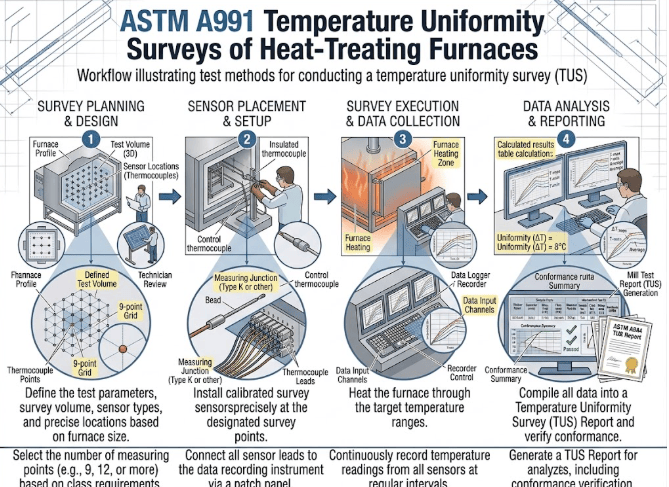
    Technicians determine the furnace and required survey conditions before setting up the temperature measurement system. They then check sensor calibration and place them at representative points in the furnace’s working area. The operator then brings the furnace to the specified operating temperature and takes temperature readings from the installed sensors. The collected data show temperature variations across different positions in the furnace. Finally, engineers analyze the temperature readings and calculate the furnace’s temperature uniformity under the surveyed conditions. The laboratory documents the survey results, equipment information, and relevant operating conditions.

     This image shows calibrated temperature sensors positioned throughout a heat-treatment furnace during an ASTM A991 temperature uniformity survey.
    ASTM A991 Furnace Temperature Uniformity Survey

    Common Challenges and Troubleshooting

    Accurate ASTM A991 results depend on proper sensor calibration, correct sensor placement, stable furnace operation, and reliable temperature recording. The measured temperature distribution can be influenced by incorrect placement or faulty sensors. Before the survey, technicians should verify sensor calibration and monitor sensor positions during furnace operation. Engineers also need to accurately determine temperature variations when using the recorded data.

    ASTM A991 Analysis Results and Interpretation

    The report presents the temperature distribution obtained from the furnace working zone during the survey. The laboratory reports the recorded temperature, the survey status, sensor data, and the calculated temperature variation.

    Read more

    • ASTM A991 provides furnace temperature uniformity results.
    • Temperature is frequently expressed in either °C or °F.
    • Results may include maximum and minimum temperatures.
    • Temperature change can be expressed as a temperature difference in either °C or °F.
    • Engineers compare the measured temperature distribution to applicable heat-treatment requirements.
    • Analysts achieve reliable survey results through regular calibration and proper sensor placement.

    Link to ASTM A991

    FAQ

    Where can I get the astm a991 tested?
    You can share your astm a991 testing requirements with MaTestLab. MaTestLab has a vast network of material testing laboratories, spread across the USA and Canada. We support your all material testing needs ranging from specific astm a991 test to various testing techniques.
    Please contact us for a detailed quote for your astm a991 testing needs. Cost incurred to carry out different astm a991 testing methodology depends on the type of raw material; number of samples, coupons, or specimens; test conditions, turn around time etc. Costs of some ASTM testing methods start from $100 and the final value depends upon the factors listed above. Please contact us for the best and latest prices.
    The required number of samples or specimens should comply with the procedure given in the astm a991 standard. However, the MaTestLab operations team can assist you for your special requirements once you share your testing details with us.
    MaTestLab has a vast testing laboratory network, hence we bring you the best testing facilities in a cost-effective way. We offer considerable discounts (15-20%) to our returning customers based on test volume and frequency.
    The turnaround time for astm a991 test methodology depends upon the test procedure mentioned in the standard test document. However, we at MaTestLab understand your research requirements and hence try to get your test completed within the least possible time.
    Malhar Khole
    About Author
    Malhar Khole
    Malhar Khole is a Material Testing Associate at MaTestLab Inc. and holds a postgraduate degree in Material Science and Technology from IIT (BHU), Varanasi.
    Testimonials
    Real results
    Engineers trust us with what matters most
    Start Your Testing
    Project Today
    Define your requirements and get access to
    specialized laboratories ready to deliver results
    Partners with us
    Clients
    Vendors
    Process for testing
    • STEP 01

      You share your testing requirements

    • STEP 02

      You share your sample(s)

    • STEP 03

      We deliver your test reports

    Get your testing done

    Let us known your testing requirements and we will be right back with a solution.

      Let us root for each other. Collaborate to grow, expand, and accelerate our businesses.

      Partner with us

        Contact Us

        Discover more from MaTestLab

        Subscribe now to keep reading and get access to the full archive.

        Continue reading