
ASTM A944 Standard Test Method for Comparing Bond Strength of Steel Reinforcing Bars to Concrete Using Beam-End Specimens

    What is ASTM A944?

    ASTM A944 specifies a standard procedure for comparing the bond strength between steel reinforcing bars and concrete using beam-end specimens. The test assesses the ability of reinforcing bars to transmit forces to the concrete through bond interaction. ASTM A944 (Standard Test Method for Comparing Bond Strength of Steel Reinforcing Bars to Concrete Using Beam-End Specimens) is a test method engineers and technicians can use to compare the surface characteristics of reinforcing bars, concrete mixtures, and other factors that may affect bond performance. It quantifies the force needed to produce a given bar displacement relative to the concrete. Results support research, material comparison, reinforcement evaluation, concrete construction development, and quality control. The test provides comparative bond information and does not necessarily represent the performance of the structure as a whole.

    Read more

    Get Certified ASTM A944 Testing for Reliable Reinforcing Bar Bond Performance

    A strong bond between reinforcing bars and concrete is essential for effective force transfer in reinforced concrete (R/C) structures. Therefore, bond testing is highly informative about the interaction between reinforcement and concrete. ASTM A944 offers a controlled beam-end test procedure for the comparison of the bond strength of reinforcing bars. Researchers use the results for reinforcement research, concrete mix evaluation, material comparison, and product development.
    What is the Scope of the ASTM A944 Test Standard?

    ASTM A944 is a test method for the bond strength of steel reinforcing bars in concrete by beam-end specimens. The method assesses the force needed to cause relative movement between the reinforcing bar and the concrete. The ASTM A944 standard-

    Read more

    • Compares the strength of steel reinforcing bars to concrete.
    • Produces beam-end test specimens.
    • Assesses the performance of reinforcement bars (rebar) in bond.
    • Measures the movement of bars.
    • Compares conditions of reinforcing bar surfaces.
    • Assists in assessing concrete and reinforcement combinations.
    • Facilitates research and creative production of materials.
    • Compares bond performance.

    What are the Uses of ASTM A944 Testing?

    Engineers use ASTM A944 testing to compare the bond performance of reinforcing bars embedded in concrete. The results enable engineers to check the reinforcement features and concrete combinations. The ASTM A944 standard-

    • Compares the bond strength of the reinforcing bar.
    • Evaluates bar-to-concrete interaction.
    • Assists in comparing the surface of reinforcing bars.
    • Supports reinforcement research.
    • Assists in the assessment of concrete mixes.
    • Supports material development.
    • Provides information for quality control.
    • Participates in the evaluation of relative bond performance.

    Which materials can be tested under ASTM A944?

    ASTM A944 is applicable to steel reinforcing bars cast in beam-end specimens of concrete. Comparisons can be made between various reinforcing bar types or surface characteristics using controlled laboratory specimen configurations. Before preparing the specimens, technicians should determine the reinforcing bar type, bar size, concrete mixture, embedment arrangement, and test conditions.

    Why is ASTM A944 Important?

    ASTM A944 is a standard for comparing the bond behavior of reinforcing bars in concrete. Standardized beam-end testing helps engineers determine how varying reinforcement characteristics affect load transfer. The results can support reinforcement development, concrete research, and material comparisons, as well as assessments of factors affecting bar-to-concrete bond performance.

    ASTM A944 Equipment and Sample Preparation Guide

    ASTM A944 calls for a proper loading machine and beam-end specimen setup to apply a controlled force to the reinforcing bar. Technicians prepare concrete samples containing reinforcement steel in the desired orientation.

    Read more

    Sample and Specimen DetailsLaboratory testing of beam-end concrete specimens with steel reinforcing bars embedded in them to a required length and configuration.
    Specimen PreparationTechnicians set up concrete samples and carefully place the rebar before pouring and curing of concrete.
    Specimen DimensionsThe beam-end specimen’s dimensions vary depending on standard or project requirements. Typical dimensions include length (600mm-24 inches), width (100mm-4 inches), and height (100mm-4 inches). Length is measured from the steel rebar to the concrete beam, while width ranges from 100mm to 150mm. The height ranges from 100mm to 150mm.
    InstrumentationThe testing process uses a testing machine, a load cell, displacement measurement equipment, reinforcing-bar gripping fixtures, molds, and dimensional measurement tools.

    Testing Procedures and Requirements for ASTM A944

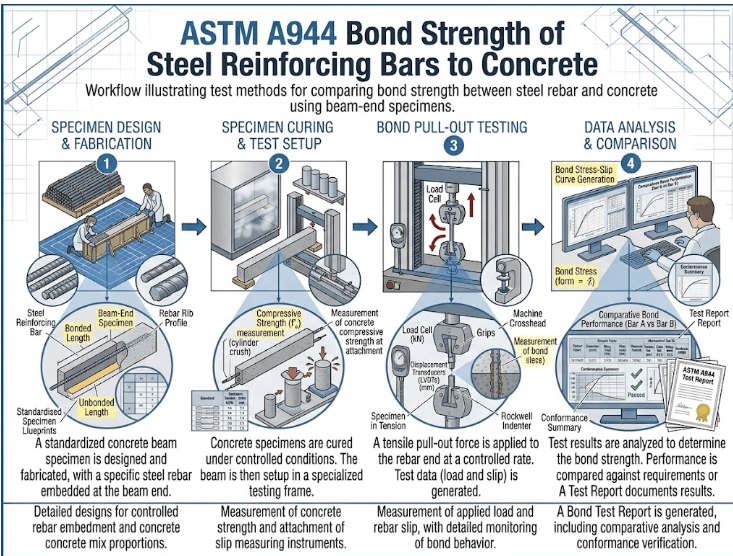
    ASTM A944 testing puts a controlled force on the reinforcing bar in a beam-end specimen and measures the relative movement between the bar and concrete. The specimen is prepared and placed in testing equipment, and a load is applied under controlled conditions. The procedure outlined in ASTM A944 is as follows-

    Read more

    Specimen PreparationThe technicians prepare the concrete beam-end specimen and embed the reinforcing bar as needed.
    Specimen ConditioningOperators cure and condition the concrete specimen according to the test requirements.
    Specimen InstallationTechnicians set up the beam-end specimen in the testing apparatus and set the reinforcing bar for controlled loading.
    Bond TestingThe testing machine applies force to the reinforcing bar while technicians record bar movement relative to the concrete.
    Result ReportingLaboratories report the applied load, bar movement, specimen information, and comparative bond-strength results.

    ASTM A944 Testing Process and Data Collection

    Before preparing the beam-end specimens, technicians choose the reinforcing bar and concrete materials. Afterward, they place the reinforcing bar inside the concrete and set the specimens in a controlled environment. Then, operators place the specimens in the testing apparatus and exert a force on the reinforcing bar. The equipment measures the load applied, and technicians observe the movement between the bar and concrete. Finally, the engineer analyzes the load and displacement measurements to compare bond performance. Laboratories report measurement results along with specimen and test-condition details.

    This image shows a beam-end concrete specimen containing a steel reinforcing bar during bond-strength testing according to ASTM A944
    ASTM A944 Beam-End Bond Strength Testing

    Common Challenges and Troubleshooting

    Correct placement of the reinforcing bar, concrete preparation, embedment length, specimen curing, and load alignment are important factors in obtaining accurate ASTM A944 results. Measured bond behavior can be impacted by changes in these factors. Technicians are encouraged to check specimen size and bar positions before casting the concrete. Reliable results also require proper fixture alignment and calibrated load and displacement measurement systems.

    ASTM A944 Analysis Results and Interpretation

    The report provides an overview of the bond performance of steel reinforcing bars embedded in concrete. Applies load, movement of the reinforcing bar, information on the specimen, and other measurements as appropriate, as reported by the laboratories.

    Read more

    • Comparative bond strength results are produced by ASTM A944.
    • The applied load may be displayed in either N or lbf.
    • Bar movement can be reported in mm or inches.
    • Bond stress may be expressed in either MPa or psi, depending on the procedure used to calculate it.
    • Results are used to compare the reinforcing bar and concrete combination.
    • The more resistance to bar movement measured, the better the bond performed under the test conditions.
    • Laboratories that use consistent specimen preparation and loading provide reliable, comparable data.

    Link to ASTM A944

    Updated on August 25, 2026

    Laraib Hashmi
    About Author
    Laraib Hashmi is an aspiring research enthusiast and science content professional with a strong interdisciplinary skill set, holding a postgraduate degree in Applied Microbiology from KIIT Bhubaneshwar, Odisha.
    Know More
    Testimonials
    Real results
    Engineers trust us with what matters most
    Start Your Testing
    Project Today
    Define your requirements and get access to
    specialized laboratories ready to deliver results
    Partners with us
    Clients
    Vendors
    Process for testing
    • STEP 01

      You share your testing requirements

    • STEP 02

      You share your sample(s)

    • STEP 03

      We deliver your test reports

    Get your testing done

    Let us know your testing requirements and we will be right back with a solution.

      Let us root for each other. Collaborate to grow, expand, and accelerate our businesses.

      Partner with us

        Discover more from Matestlab

        Subscribe now to keep reading and get access to the full archive.

        Continue reading