Introduction
During service, protection and decoration coatings are often exposed to severe environments. Over time, coatings may lose their effectiveness and lose their appearance when exposed to ultraviolet (UV) radiation, humidity, rain, temperature cycling, salt exposure, and pollutants. To assess the behavior of coatings under these conditions in an accelerated manner, without waiting several years for outdoor exposure, manufacturers conduct accelerated weathering and durability tests. Specialized environmental chambers expose coated specimens to controlled environmental stresses in a controlled environment to predict the long-term service performance of coatings in much less time than is needed in the environment. Such tests enable manufacturers to fine-tune coating formulations, enhance product reliability, and select the right coating for a specific service environment. Accelerated weathering testing provides comparative durability data and can help estimate long-term performance when correlated with natural weathering studies. Although accelerated weathering provides valuable comparative durability data, laboratory exposure does not exactly replicate natural outdoor weathering. Correlation with field exposure depends on the coating system and service environment.

Scope of Accelerated Weathering and Durability Testing
- Analyzes coating performance over time.
- Simulates aspects of outdoor environmental exposure.
- Evaluates the resistance of the material to UV radiation, moisture, and temperature changes.
- Compares the durability of different coating formulations.
- Helps with product development and quality control.
- Provides comparative data for estimating long-term coating performance.
- Verifies compliance with industry specifications.
Principle of Accelerated Weathering and Durability Testing
Accelerated weathering testing subjects coated specimens to controlled environmental conditions that simulate accelerated weathering by combining UV radiation, moisture, temperature, humidity, and, where applicable, salt exposure. Test chambers are used to subject samples to the combined effects of UV, moisture, condensation, salt spray, temperature, and humidity. Samples are periodically inspected to check for any changes in appearance or performance. The common symptoms of degradation are color change, loss of gloss, chalking, blistering, cracking, delamination, and corrosion. Tracking such changes enables manufacturers to predict coating durability and compare one product’s durability with another’s.
Common Accelerated Weathering and Durability Tests for Coatings
| ASTM G154 | Exposes coatings to fluorescent UV light and condensation to simulate outdoor weathering. |
| ASTM G155 | Uses xenon arc light to simulate full-spectrum sunlight and environmental exposure. |
| ASTM B117 | Evaluates corrosion resistance of coatings using salt spray exposure. |
| ASTM D1654 | Assesses degradation and corrosion resulting from an accelerated exposure test. |
| ASTM D714 | Measures the degree of blistering in coatings. |
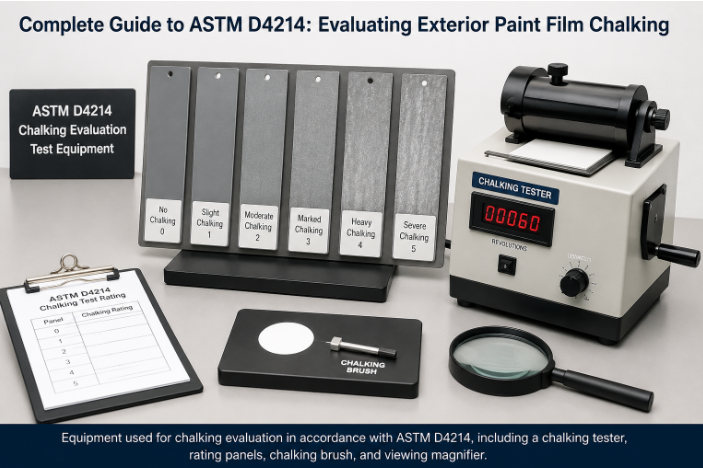
| ASTM D4214 | Measures chalking resistance of exterior coatings. |
| ASTM D523 | Measures gloss before and after weathering to evaluate gloss retention. |
Test Procedure Overview
| Sample Preparation | Coats standardized test panels with coating systems and cures the samples as per specifications. |
| Exposure Setup | Exposes specimens under specified environmental conditions. |
| Environmental Cycling | Exposes samples to UV, moisture, temperature, or salt exposure. |
| Periodic Inspection | Analyzes samples for degradation at regular time periods. |
| Result Evaluation | Evaluates changes such as color change, gloss loss, blistering, cracking, chalking, delamination, and corrosion. |
Significance
Accelerated weathering and durability testing enable manufacturers to evaluate or estimate the long-term performance of coatings in the field before use. The testing reveals areas where formulations and coatings may be lacking and can help manufacturers improve coating formulations for enhanced durability. The findings are used for material selection, product qualification, warranty programs, and quality assurance activities. Understanding the degradation mechanisms of coatings under environmental exposure may enable manufacturers to create more durable, weather-resistant coatings with longer lifespans.
Applications
- Assesses coatings for buildings and architecture.
- Assesses automotive paint performance.
- Evaluates corrosion-protective coatings
- Supports the qualification of coatings for use in the aerospace and marine industries.
- Compares exterior coating formulations.
- Tests powder coatings and protective coatings.
- Supports quality control and product development programs.
- Evaluates the performance of coatings on outdoor infrastructure.
- Demonstrates compliance with customer and industry requirements.
- Supports research on long-term coating durability.