Introduction to Charpy Impact Test
Impact resistance is one of the most important properties of polymer components, especially when they are subjected to sudden impacts during manufacturing, transportation, and usage. The absorption of energy without fracturing can be evaluated to help manufacturers ensure the durability, reliability, and safety of products in demanding applications. The Charpy impact test is a simple and standard test method to determine the toughness of polymers and their brittle behavior. It is so repeatable and effective that it has become one of the most commonly used impact testing procedures for quality control, material selection and product development.
What is the Charpy Impact Test?
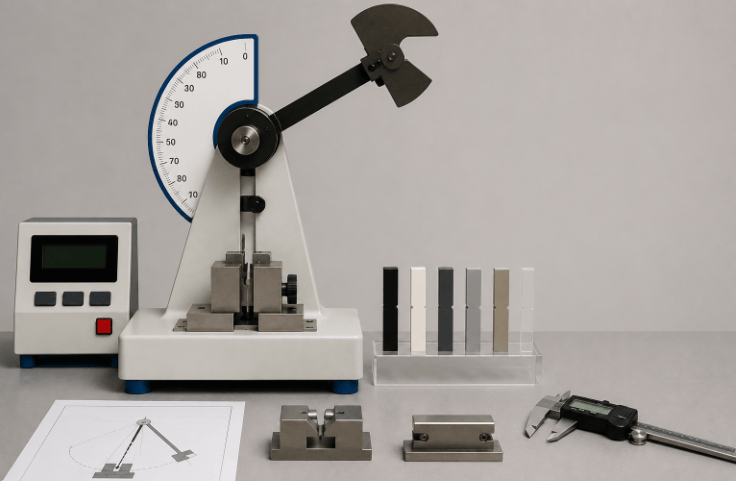
The Charpy impact test is a standardized method to measure a material’s notch toughness and resistance to brittle fracture. Charpy impact test is used to measure resistance to sudden impact by measuring the energy absorbed by the material before fracture. A standardized notched specimen is struck during the test by a swinging pendulum hammer, and the amount of impact energy absorbed by the specimen is determined based on the difference in the height of the pendulum before and after impact.
This test is commonly used to assess the toughness and ductility of plastics and other engineering materials. The higher the energy absorbed, the tougher and more resistant to sudden fracture the material is; the lower the energy absorbed, the more brittle the material is. ASTM D6110 (Standard Test Method for Determining the Charpy Impact Resistance of Notched Specimens of Plastics) is used to determine the resistance of plastics to breakage by flexural shock as indicated by the energy extracted from standardized pendulum-type hammers, mounted in standardized machines, in breaking standard specimens with one pendulum swing. The Charpy impact test is widely adopted due to its ease of use, repeatability, and its ability to detect brittle behavior, making it a valuable tool for material qualification, quality control, and performance assessment.
ASTM D6110: The Standard for Charpy Impact Testing of Plastics
The standard test method for determining the Charpy impact resistance of notched plastic specimens is ASTM D6110. It establishes uniform specifications for specimen preparation, test conditions, equipment, and reporting to ensure consistency and reliability.
The standard specifies:
- Standard dimensions and notch geometry of specimens
- Pendulum impact testing equipment
- Before being tested, the specimen is conditioned in the following manner:
- The absorbed impact energy is measured using test procedures:
- Reporting of impact resistance results
Charpy vs. Izod Impact Test: What’s the Difference?
Both tests measure impact resistance, but test specimen positions and loading configuration are different.
| Charpy Impact Test | Izod Impact Test |
| Specimen is held up horizontally from both ends. | Specimen is set up vertically at one end. |
| The pendulum striker strikes the ends of the pendulum that are attached to the notch. | The pendulum striker is facing the notch. |
| The impact is at the center of the supported specimen. | The impact takes place above the fixed clamp. |
| Used for engineering plastics and structural materials. | Often employed for quality control of plastics and comparison of plastic products. |
How to Perform a Charpy Impact Test Correctly?
The Charpy impact test is carried out with a pendulum impact machine calibrated to a specific value and using standard test specimens.
| Step | Procedure |
| Specimen Preparation | Cut the specimen to the proper dimensions and notch as per ASTM D6110. |
| Conditioning | Precondition the specimen to test temperature prior to testing. |
| Specimen Positioning | Place the specimen horizontally along these two sets of supports, with the notch side away from the pendulum. |
| Impact Testing | Allow the pendulum to strike the specimen and break it in one blow. |
| Data Collection | Note absorbed impact energy and investigate fractures, if necessary. |
Key Variables That Influence Charpy Impact Values
There are a number of factors that may have a substantial influence on Charpy impact.
- Toughness is affected by material composition, including the polymer type, fillers, reinforcements, and additives.
- Notch geometry: Values of stress concentration and impact values are highly sensitive to changes in notch dimensions.
- Specimen dimensions: Standard specimen size to facilitate comparisons between the materials.
- Testing temperature: At low temperatures, many polymers lose their impact strength due to becoming brittle.
- Environmental conditioning: Test results may be affected by moisture content and environmental conditioning.
- Pendulum velocity: The pendulum velocity has to be within the standard for repeatable measurements.
Beyond Room Temperature – Instrumented Charpy Testing
Although standard Charpy testing is usually conducted at room temperature, some applications require testing the material properties over a wider temperature range.
Higher or lower test temperatures provide a way to evaluate the effect of impact resistance under various service conditions. In environments such as outdoor applications, cryogenic applications, and structural components that are susceptible to brittle fracture, low-temperature testing is especially critical.
While absorbed energy is the main reported data from Charpy testing, instrumented Charpy testing adds force and displacement data as it continuously monitors fracture behavior during the impact event. This enables engineers to differentiate between crack initiation and crack propagation energy, giving engineers a better understanding of how materials will perform.
How to Read and Report Charpy Impact Data?
The Charpy test results help to gain insight into the fracture behavior and impact performance of a material.
| Test Result | Significance |
| Absorbed Energy | Indicates the amount of energy absorbed during fracture. The higher the value, the tougher the material. |
| Fracture Appearance | Indicates if a material has broken in a ductile, brittle, or compound failure mode. |
| Lateral Expansion | Measures permanent deformations at the notch root and tells how much plastic deformation has occurred before failure. |
| Impact Behavior at Different Temperatures | Aids in the determination of toughness changes in the material and the behavior of the material in the ductile to brittle transition. |
Conclusion
Charpy impact test is one of the most useful tests used to assess the impact resistance and toughness of polymers when subjected to a sudden load. It provides a measurement of absorbed impact energy and fracture behavior analysis to help manufacturers make material comparisons and optimize product performance and reliability in demanding applications.
ASTM D6110 covers a standardized method for Charpy impact testing of plastics, which provides a consistent and reproducible result across different laboratories. Overall, Charpy impact testing is a valuable method for evaluating the durability and toughness of polymer materials, which can be applied to various fields such as quality control, product development, material selection, and failure analysis.