


Introduction to Plastic Testing
The applications of plastic materials are found in nearly all sectors of modern industry, ranging from the automotive, aerospace, medical devices, electronics, packaging, and construction industries. With the growing number of applications, it is important to ensure that the plastic components have the necessary properties to meet the specified requirements, such as strength, durability, safety, and long-term performance. Complete plastic testing enables manufacturers to assess the behavior of plastics under various mechanical, thermal, physical, and environmental conditions, ensuring they can manufacture a reliable product, achieve consistent quality, and reduce the likelihood of product failure throughout the plastic’s lifetime.
Why is Plastic Testing Essential?
There are thousands of polymer combinations that make up plastics, ranging from rigid engineering plastics to soft elastomers. Polymer performance is sensitive to many factors, such as molecular weight, crystallinity, processing conditions, additives, and environmental exposure, whereas metals are often determined by composition and heat treatment.
Manufactured parts of the same resin may have different mechanical properties as a result of variations in processing conditions. Therefore, testing is now the only way to be sure that a plastic material or product meets its performance and design requirements. Analytical testing is increasingly critical to modern industries to determine the chemical makeup, thermal properties, and microscopic flaws that are not discernible visually. Plastic testing provides definitive, fact-based conclusions relevant to issues such as unexpected cracking, discoloration, heat degradation, or when suppliers provide unlabeled resin.
Four Main Categories of Plastic Testing
Plastic testing can be broadly divided into four major categories: mechanical testing. thermal testing, environmental testing, and physical and rheological testing:
| Category | Purpose |
| Mechanical Testing | Assesses strength, stiffness, toughness, hardness, and impact resistance. |
| Thermal Testing | Identifies resistance to heat and softening, melting properties, and thermal transitions. |
| Environmental Testing | Evaluates the resistance to chemicals, UV damage, moisture, and outside weathering. |
| Physical & Rheological Testing | Measures the flow behavior, identification of materials, crystallinity, and processing properties. |
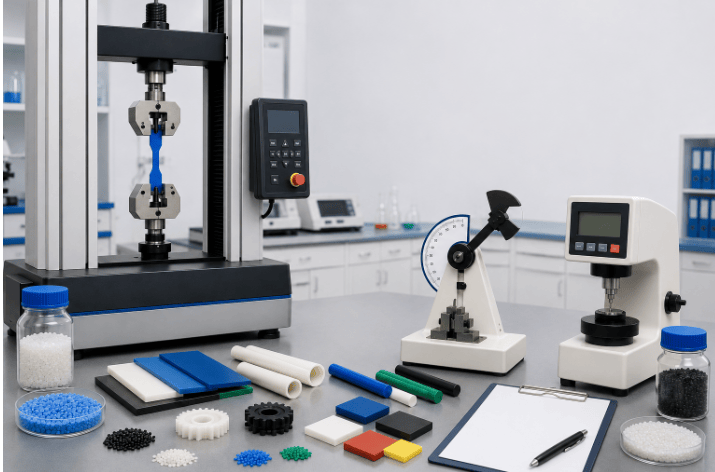
Mechanical Testing: Evaluating Strength and Toughness
Mechanical testing evaluates how plastics respond to applied forces during service and helps determine their suitability for specific applications. Tensile testing measures properties such as tensile strength, tensile modulus, yield strength, and elongation at break, providing insight into a material’s ability to withstand pulling forces. Flexural testing assesses the strength and stiffness of plastics under bending loads using a three-point bending configuration. Impact testing evaluates a material’s toughness by measuring the energy required to fracture a notched specimen under sudden loading, helping identify its resistance to impact. Hardness testing measures a material’s resistance to indentation and is commonly used to assess the surface hardness of both flexible and rigid plastics. Together, these mechanical tests establish the performance baseline required for material selection, product development, and quality assurance.
Thermal Testing: How Plastics Behave Under Heat
Thermal testing evaluates how polymers perform at elevated temperatures and identifies important thermal properties.
| Test Method | Purpose |
| ASTM D648 – Heat Deflection Temperature (HDT) | Measures the temperature at which a material will bend when it is under a specific amount of stress. |
| ASTM D1525 – Vicat Softening Temperature | Measures the temperature at which a standard needle is able to pierce the surface of a polymer. |
| ASTM E793 / ISO 11357 – Differential Scanning Calorimetry (DSC) | Determines melting point, Glass Transition Temperature (Tg), crystallinity, and oxidation behavior. |
Environmental and Weathering Tests for Long-Term Durability
Environmental testing is used to assess plastic resistance to harsh service environments during the plastics service life.
- ASTM D543 – Chemical Resistance: Measures mass, dimension, appearance, and mechanical property changes when immersed in chemicals.
- ASTM G154 – Fluorescent UV Weathering: This tests long-term weathering effects by using ultraviolet exposure.
- ASTM G155 – Xenon Arc Weathering: Realistic simulation of sunlight for color stability and outdoor durability. These tests can assist manufacturers in forecasting long-term performance in real-world conditions.
Physical and Rheological Tests for Raw Materials
Physical and rheological testing verifies raw material consistency and processing behavior before manufacturing.
| Test Method | Purpose |
| ASTM D1238 – Melt Flow Index (MFI) | Measures and controls the flow rate of molten polymer; monitors molecular weight changes and material degradation. |
| ASTM E793 / ISO 11357 – DSC | Provides polymer identification, crystallinity, melting behavior, and glass transition temperature for incoming materials verification. |
How to Build a Testing Plan for Your Polymer Product
The key to a successful testing program is to be based on the product’s intended application and service environment. A thorough testing program usually consists of:
- Mechanical tests for strength, stiffness, hardness, and impact resistance.
- Thermal Testing for Service Temperature and Thermal stability.
- Chemical, UV, and weathering-resistant testing.
- Raw material testing, physical and rheological, and raw material checking for quality and consistency of processing.
- Compliance with regulatory standards (if applicable), including FDA, ISO 10993, RoHS, or REACH.
- The right mix of tests guarantees that polymer products perform and comply with regulatory standards.
Conclusion
Plastic testing is an important part of the quality, strength, and performance of polymer materials. The properties of polymers depend upon the formulation, processing conditions, and exposure to the environment, so testing is needed during product development and manufacture. The mechanical, thermal, environmental, and rheological assessments performed with recognized ASTM and ISO standards allow manufacturers to validate material performance, design products to meet specific requirements, achieve consistent quality, and ensure reliability over time in various industrial applications.


