Introduction to the ASTM D4214 Test
Exterior paint surfaces are constantly subjected to harsh environmental conditions that wear away their protective property and aesthetic value over time. Chalking of paint films is one of the most obvious signs of weathering degradation caused by the breakdown of the coating binder over time. The amount of chalking is a critical parameter to track in evaluating coating durability, estimating service life, and providing long-term protection of exterior surfaces. A standardized test enables manufacturers and inspectors to make consistent product evaluations based on weathering performance and to have a basis for comparing the performance of various coating formulations.
What is Paint Film Chalking?
Paint film chalking is a type of surface degradation when exterior paint and coatings endure prolonged outdoor exposure. It occurs when the organic binder resin in the paint is gradually decomposed by the effects of ultraviolet (UV) radiation, moisture, and oxygen. As the binder deteriorates, pigment particles become exposed and are released from the coating surface as a fine chalk-like powder. ASTM D4214 (Standard Test Methods for Evaluating the Degree of Chalking of Exterior Paint Films) determines the extent of chalking in exterior paint films from weathering.
The chalking phenomenon is one of the most familiar weathering failure scenarios associated with exterior architectural coatings, industrial maintenance coatings, and wood finishes. In some self-cleaning coatings, a small amount of controlled chalking is acceptable, but when the level of chalking is too high, the protective performance and appearance of the coating will be compromised, and the coating will need to be evaluated regularly.
Understanding the ASTM D4214 Standard
ASTM D4214 provides standardized procedures for evaluating the degree of chalking on weathered exterior paint films. ASTM D4214 assigns chalking ratings from 10 (no chalking) to 0 (severe chalking) based on comparison with ASTM photographic reference standards.
| ASTM D4214 Rating | Degree of Chalking |
| 10 | No chalking |
| 8–9 | Slight chalking |
| 5–7 | Moderate chalking |
| 1–4 | Heavy chalking |
| 0 | Severe chalking |
The ratings are based on the amount of chalk that has been transferred during the test, in relation to ASTM photographic reference standards. Standardized procedures enable the coating manufacturer, the researcher, and the QC lab to compare the weathering performance of various paint formulations on a consistent basis.
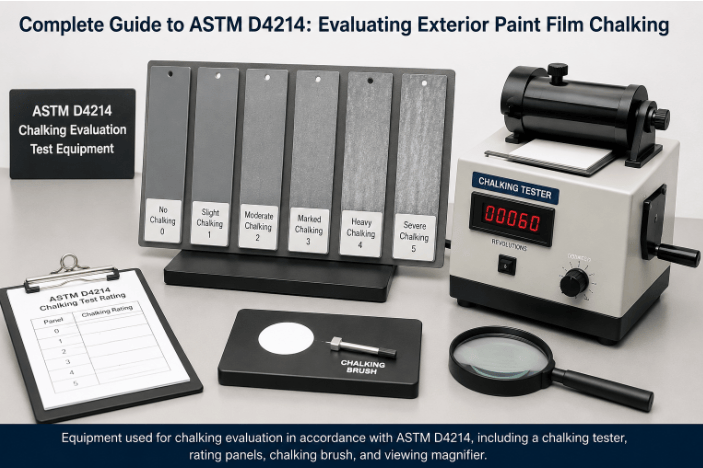
How to Test for Paint Chalking: The Key Methods
ASTM D4214 includes two standard procedures to assess the degree of chalking of exterior paint films. In both methods, the amount of chalk transferred from the coating surface is compared with ASTM photographic reference standards and assigned a rating from 10 (no chalking) to 0 (severe chalking).
| Test Method | Description |
| Method A – Felt Cloth Rub Method | The surface of the chalked paint is rubbed with a piece of dark-coloured felt cloth under controlled pressure. The chalk transferred to the felt cloth is compared with ASTM photographic reference standards and assigned a chalking rating from 10 (no chalking) to 0 (severe chalking). |
| Method B – Adhesive Tape Method | A piece of pressure-sensitive adhesive tape is firmly pressed on the coating surface and then pulled off. The amount of chalk transferred to the adhesive tape is compared with ASTM photographic reference standards and assigned a rating from 10 (no chalking) to 0 (severe chalking). |
Accelerated Weathering Assessment of Exterior Paint Films
Chalking may not be evident after a few months or even years of exposure outside. Coatings are sometimes subjected to accelerated weathering before chalking evaluation to expedite product evaluation.
Accelerated weathering tests include:
- Fluorescent UV Exposure according to ASTM G154
- Xenon arc weathering may be performed in accordance with ASTM G155 before chalking evaluation using ASTM D4214.
The paint film is then assessed for chalking resistance, according to ASTM D4214, after a particular period of time has elapsed, and compared to the original film.
What Causes Paint to Chalk?
Several formulation and environmental factors affect the rate at which a coating develops chalking. Major factors are-
Pigment Volume Concentration (PVC): Higher pigment volume concentration (PVC) means there is less binder available to protect pigment particles. Coatings with higher PVC generally chalk more rapidly because less binder is present to resist weathering.
Binder Chemistry: The binder plays an important role in the weathering performance. Acrylic and silicone-modified binder systems are more resistant to degradation from UV rays than traditional alkyd and linseed oil binders, and they are less likely to chalk.
Titanium Dioxide (TiO₂) Pigment: Chalking behavior is also determined by the crystal form of the titanium dioxide. Rutile TiO₂, which has been treated with a protective agent, will offer much greater resistance to binder degradation in exterior coatings, while Anatase TiO₂ tends to encourage degradation.
UV Stabilizer Package: Common additives found in modern coatings are the ultraviolet absorbers (UVA) and hindered amine light stabilizers (HALS). They inhibit the action of UV on the film and greatly slow the chalking process.
Environmental Conditions: Coating durability is influenced by the climate. Generally, chalking is much more rapid in areas of intense sunlight and high temperatures, including tropical and desert areas, than in cooler regions.
Applications of ASTM D4214 in the Industry
ASTM D4214 is a general test to assess the weathering performance and durability of exterior paint systems, and is widely used throughout the coatings industry. Common applications include:
- Approving exterior house paints, façade coatings, masonry coatings and wood finishes for extended exterior use.
- Determining the chalking resistance of coatings on pipelines, marine and coastal structures, equipment and storage tanks in harsh outdoor environments.
- Evaluating the chalking resistance of coated automotive exterior components exposed to outdoor weathering.
- Evaluation and comparison of various paint formulations to optimize paint binder systems, pigments, UV stabilizations, and paint weathering.
- Evaluating coating formulations during product development and qualification to compare their resistance to chalking after natural or accelerated weathering.
- Supporting quality control by monitoring coating performance consistency between production batches.