ASTM G155 Standard Practice for Operating Xenon Arc Light Apparatus for Exposure of Non-Metallic Materials

    What is ASTM G155?

    ASTM G155 is a standard practice for operating a xenon arc lamp and water apparatus to expose nonmetallic materials under controlled light, heat, and moisture (if applicable). The practice is designed to mimic the effects of weathering from exposure to sunlight, whether it be direct sunlight or through window glass, as well as moisture, including humidity, rain, and dew. The practice outlines procedures for controlling, measuring, and recording exposure conditions but does not prescribe a single exposure cycle for all materials. ASTM G155 (Standard Practice for Operating Xenon Arc Light Apparatus for Exposure of Non-Metallic Materials) specifies the use of optically filtered xenon arc radiation and controlled environmental conditions. The combination of filters and exposure can be varied as per the applicable material standard.

    Read more

    Get Certified ASTM G155 Xenon Arc Exposure Testing

    ASTM G155 testing is a controlled accelerated-weathering method for assessing the response of nonmetallic materials to light, heat, and moisture. The exposure can be used to replicate aspects of an outdoor or indoor end-use environment and to examine changes in material properties after controlled exposure to a xenon arc. Xenon arc exposure testing can be helpful for materials or products that may encounter sunlight or window glass in service. Controlled exposure allows manufacturers and engineers to assess changes in durability and to compare materials under certain exposure conditions. ASTM G155 makes space for various exposure conditions, and the specific cycle should be determined based on the material specification or standard being tested or the objective of the test. ASTM explicitly states that the practice does not specify the conditions of exposure that are most appropriate for a specific material. 
    What is the Scope of ASTM G155?

    ASTM G155 covers the basic principles and procedures for operating xenon arc lamp and water apparatus. It establishes procedures for obtaining, measuring, and controlling exposure conditions using optically filtered xenon arc radiation under controlled environmental conditions. The practice is intended to be used together with a material-specific practice or test method that defines the exposure conditions and the method for evaluating changes in material properties. It does not itself deliver a specific result or establish one universal exposure cycle for all materials. The scope of ASTM G155 covers:

    Read more

    • Material Type: Nonmetallic materials exposed to controlled xenon arc radiation.
    • Purpose: Accelerated exposure to light, heat, and optionally moisture to evaluate weathering-related material changes.
    • Property Measured: Changes in material properties selected by the applicable material-specific test method or specification.
    • Method: Exposure using an optically filtered xenon arc lamp and controlled environmental conditions.
    • Result: Exposure condition and subsequent changes in specified material properties; ASTM G155 itself does not produce one universal property result.
    • Test Limitations: Results depend strongly on the selected exposure conditions, and the practice is not intended to simulate localized phenomena such as atmospheric pollution, biological attack, or saltwater exposure. It is also not intended for corrosion testing of bare metals.
    • Environmental Conditions: Controlled xenon arc radiation with specified combinations of light, temperature, humidity, and/or water exposure according to the applicable cycle.
    • Applications: Weathering evaluation, durability studies, product development, quality control, material comparison, and accelerated exposure research.

    What Are the Uses of ASTM G155 Testing?

    ASTM G155 testing allows technicians to expose nonmetallic materials to controlled environmental stresses that resemble selected aspects of sunlight and moisture encountered during service. The apparatus can provide light and heat and can optionally introduce moisture to the specimens. The practice is useful when engineers need controlled and repeatable exposure conditions for evaluating material changes. Because different exposure conditions can produce significantly different results, technicians must document the exact operating conditions used during the test. The test helps to:

    • Evaluate Weathering: Determine how materials respond to controlled xenon arc exposure.
    • Assess Durability: Investigate material changes associated with sunlight, heat, and moisture.
    • Compare Formulations: Evaluate different materials or formulations under comparable exposure conditions.
    • Support Product Development: Identify materials with improved resistance to environmental exposure.
    • Monitor Quality: Compare production materials against controls or applicable requirements.
    • Study Property Changes: Evaluate changes in appearance, mechanical properties, or other characteristics specified by the applicable test method.
    • Support Service-Life Studies: Generate accelerated exposure data for durability investigations.

    Which Materials Can Be Tested According to ASTM G155?

    ASTM G155 is intended for nonmetallic materials that require controlled xenon arc exposure. The specific specimen preparation and subsequent evaluation are established by the ASTM method or specification applicable to the material being tested. Materials may be exposed to filtered xenon arc radiation using different optical filter configurations selected according to the intended application. The practice can therefore support a broad range of nonmetallic weathering investigations rather than being limited to one specific material class. The method applies to:

    • Plastics and Polymer Materials: Materials requiring accelerated light and weathering evaluation.
    • Coatings and Related Materials: Materials requiring controlled xenon arc exposure when the applicable coating standard specifies G155 exposure.
    • Rubber and Elastomeric Materials: Nonmetallic materials evaluated for environmental durability.
    • Films and Sheets: Thin nonmetallic materials suitable for controlled exposure.
    • Other Nonmetallic Products: Products for which a material-specific specification or test method calls for xenon arc exposure.

    Why is ASTM G155 Testing Important?

    The significance of ASTM G155 testing is that nonmetallic materials are subject to changes during service as a result of exposure to sunlight, heat, and moisture. Technicians can study these changes by carefully exposing the materials to the xenon arc under carefully controlled and measurable conditions. The practice also enhances the ability to compare weathering studies if the exposure conditions are documented by the technicians and maintained. ASTM suggests that similar control materials be exposed with test specimens and replicate specimens for comparative and statistical evaluation.

    ASTM G155 Equipment and Sample Preparation Guide

    Technicians prepare the xenon arc apparatus, specimens, controls, and monitoring equipment according to ASTM G155 and the applicable material-specific exposure procedure. The apparatus must provide controlled filtered xenon arc radiation and the environmental conditions required for the selected exposure cycle.

    Read more

    Xenon Arc Lamp and Optical FiltersTechnician provides controlled, filtered radiation that reproduces selected portions of sunlight exposure.
    Irradiance and Environmental Monitoring SystemTechnician measures and controls the specified radiation and environmental exposure conditions.
    Water Spray/Humidity System and Temperature ControlsTechnician provides the moisture and temperature conditions required by the selected exposure cycle.
    Specimen and Control PreparationTechnicians prepare representative specimens and control materials according to the applicable material-specific method. Specimen dimensions are determined by the applicable material standard rather than by one universal G155 specimen size.
    Specimen dimensions ASTM G155 does not specify a single mandatory specimen size, as specimen dimensions are typically dictated by the material’s specific standard or product specification.

    ASTM G155 Testing Procedures and Requirements

    Technicians operate the xenon arc apparatus according to the exposure cycle specified by the applicable material standard or test program. They establish the required radiation, temperature, moisture, and other environmental conditions and continuously monitor the apparatus during exposure. The testing process includes the following steps.

    Read more

    Apparatus Setup and VerificationThe technician confirms that the xenon arc lamp, filters, monitoring devices, and environmental controls are ready for exposure.
    Specimen Installation and ExposureTechnician positions test specimens and controls correctly and exposes them to the selected xenon arc conditions.
    Exposure Condition MonitoringThe technician measures and controls radiation, temperature, moisture, and other specified operating conditions throughout the exposure.
    Post-Exposure EvaluationAnalysts remove specimens according to the specified schedule and evaluate property changes using the applicable material test method or specification.

    ASTM G155 Testing Process and Data Collection

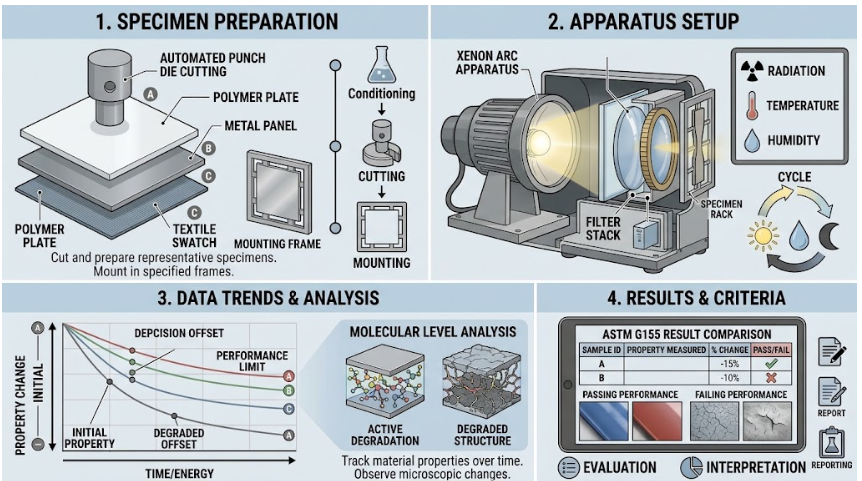
    Technicians prepare specimens according to the applicable ASTM material method or specification. G155 itself does not establish one universal specimen size because specimen preparation and evaluation are addressed by the specific material standard. Technicians mount the xenon arc lamp, set up the appropriate optical filters, mount the irradiance monitoring equipment, attach the temperature sensors, and mount the moisture-control components. Technicians regulate the intensity of light, specimen temperature, humidity, water spray, or other conditions, as specified, according to the exposure cycle. Analysts record the actual exposure conditions throughout the test. The test record should identify the exposure cycle and operating conditions because ASTM G155 states that results should not be referenced without the specific operating conditions being reported.

    The image shows nonmetallic material specimens mounted inside a xenon arc weathering apparatus while filtered xenon radiation, temperature, and moisture conditions are controlled and monitored.
    ASTM G155 Xenon Arc Exposure Testing Process 

    Common Challenges and Troubleshooting

    Irradiance control, lamp & filter condition, temperature stability, water quality, moisture delivery, and specimen positioning can all cause problems when exposing specimens to ASTM G155. Since the practice allows for varying exposure conditions, proper documentation and control of the chosen cycle are critical. Technicians should check irradiance monitoring and ensure the desired operating condition is maintained. The severity of exposure may be altered by misuse of the thermometer. The temperature sensors and environmental controls must be checked by an analyst. Exposure conditions can be impacted by deposits, impurities, or inconsistent water delivery. Water system maintenance should be carried out by the technician, and a check of the moisture-delivery system should be made. The entire exposure cycle should be recorded, and results from various apparatus used for the same exposure should not be compared until reproducibility has been demonstrated.

    Analysis Results and Interpretation

    The report summarizes the weathering-related property changes observed in the tested nonmetallic material following ASTM G155 exposure. It presents the measured result together with relevant sample identification, specimen information, exposure conditions, exposure duration or radiant exposure, control information, post-exposure measurements, and other required test information.

    Read more

    • ASTM G155 does not produce one general material-property value. The report presents the property-specific change selected by the applicable material test method or specification, such as change in color, gloss, tensile properties, mass, appearance, or another specified characteristic.
    • The technician records specimen identification, specimen dimensions in mm, exposure duration in h, and applicable environmental measurements such as temperature in °C, relative humidity in %, and irradiance in the specified W/m² units when required by the selected exposure procedure.
    • The analyst documents the selected xenon arc filter configuration, irradiance condition, temperature, moisture exposure, water-spray or condensation condition, and other operating parameters.
    • Analysts document control-material performance, repeat the results of the tests, collect pre-exposure and post-exposure measurements, visually observe the material, and note the property changes as required by the material standard. 
    • Engineers compare changes between specimens, controls, formulations, or exposure conditions to determine the resistance to weathering, durability, material stability, and suitability of the material for the intended use.

    Link to ASTM G155

    FAQ

    Does ASTM G155 specify one exposure cycle?
    No. ASTM G155 provides operating procedures but does not specify the exposure conditions best suited for a particular material.
    The apparatus can expose specimens to controlled light and heat and, when specified, moisture such as humidity, rain, or dew.
    Yes. ASTM G155 recommends simultaneous exposure of similar materials with known performance as controls and recommends at least three replicates of each test specimen and control material.
    Different operating conditions can produce significantly different results, so the exposure conditions must accompany the reported results.

    Updated on September 11, 2026

    Dr Ruchika Yogesh
    About Author
    Dr. Ruchika Yogesh is a serial entrepreneur, material science and AI/ML enthusiast, medicinal chemistry subject matter expert (SME), scientific/medical copyeditor, and a researcher.
    Know More
    Testimonials
    Real results
    Engineers trust us with what matters most
    Why Choose Matestlab?
    Matestlab is a unified testing services partner based in the USA. Matestlab offers raw material and product testing services through accredited, expert laboratories primarily based in the USA. Matestlab supports physical, thermal, chemical, electrical, mechanical, environmental, and characterization testing needs through its global network of 2200+ accredited testing laboratories. Matestlab's in-house materials science experts curate and design comprehensive testing programs matched to the sample material and specific testing need, with regulatory requirements and confidentiality in mind.

    If you are looking for a managed and trusted testing partner to achieve your research goals, feel free to schedule a meeting with us or send us a request at connect@matestlabs.com to learn more about our services. For a quick quote, call us at (302)244-7710. We are happy to serve you.
    Start Your Testing
    Project Today
    Define your requirements and get access to
    specialized laboratories ready to deliver results
    Partners with us
    Clients
    Vendors
    Process for testing
    • STEP 01

      You share your testing requirements

    • STEP 02

      You share your sample(s)

    • STEP 03

      We deliver your test reports

    Get your testing done

    Let us know your testing requirements and we will be right back with a solution.

      Let us root for each other. Collaborate to grow, expand, and accelerate our businesses.

      Partner with us