Introduction to Polymer Hardness Testing
Polymers are found in a wide range of applications from flexible rubber products to engineering plastics, where a uniform mechanical response is critical. The most rapid and reliable method for evaluating such materials is hardness testing, which is one of the useful tests available for determining the resistance to indentation and durability of the material. Polymer hardness testing provides valuable information on material stiffness, wear resistance, and consistency in manufacturing, enabling manufacturers to choose the right material for their products and ensure consistent performance across a variety of industrial applications.
What is Polymer Hardness and Why Does It Matter?
Hardness is a measure of polymer resistance to indentation or penetration at a given load. It provides a rapid and economical assessment of the mechanical properties of polymers and is used to evaluate plastics, rubber, elastomers, and foam materials.
Polymers have viscoelastic properties, unlike metals, where the property of the material is directly related to the applied force and the time. Therefore, instead of the conventional metal hardness test, specialized hardness tests are used, such as the Shore durometer and IRHD (International Rubber Hardness Degree) test.
Tests for polymer hardness serve for:
- The selection of materials in product design
- A quality control and production monitoring system is in place.
- Incoming material inspection
- Variations in curing and processing may be detected.
- Consistency of the products across different manufacturing batches.
What are the Standard Test Methods for Polymer Hardness?
There are several standardized methods for measuring polymer hardness, depending on the type of polymer and its uses.
| Test Method | Description |
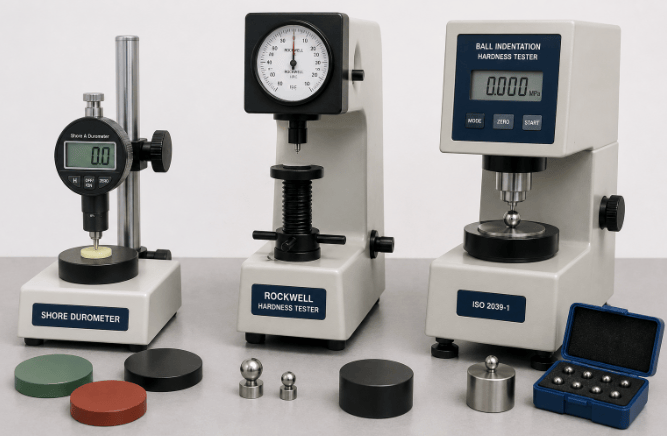
| Shore Durometer (ASTM D2240) | It is the most popular polymer hardness test. Shore A is for soft materials like rubber, elastomers, and flexible PVC, and Shore D is for rigid plastics and hard rubber. The hardness numbers from 0 (softest) to 100 (hardest) indicate their properties. |
| Rockwell Hardness (ASTM D785) | It is mostly used for rigid plastics. A steel ball indenter is pressed into the specimen at a specific load, and the depth of penetration is used to measure the hardness. Usually used for thermoplastics like nylon, acetal, and polycarbonate. |
| Ball Indentation Hardness (ISO 2039-1) | Indicates the depth of indentation of a hardened steel ball subjected to a certain load. Reported in MPa, the results give an indication of material stiffness. This is a technique often used in European plastics specifications. |
How to Select the Correct Hardness Test for Your Polymer?
The selection of the proper hardness test should be determined more by the material being tested than by the performance information desired.
| Material Type | Recommended Test |
| Soft rubber and elastomers | Shore A (ASTM D2240) |
| Flexible PVC and soft plastics | Shore A (ASTM D2240) |
| Rigid plastics | Shore D (ASTM D2240) or Rockwell (ASTM D785) |
| Engineering thermoplastics | Rockwell Hardness (ASTM D785) |
| Plastics requiring stiffness evaluation | Ball Indentation (ISO 2039-1) |
Key Variables That Influence Polymer Hardness Results
There are several factors that might influence the hardness measurement and which should be carefully controlled during the test.
- Hardness values are affected by material composition, e.g., different polymers, different fillers, different additives.
- Hardness variations between different parts of the rubber compound may be visible in under-cured or over-cured rubber compounds.
- The hardness of the polymer varies with temperature, and thus standard test conditions are important.
- If the specimen is too thin, it may give false readings because of the effects of the substrate.
- Polymers are viscoelastic, so the depth of indentation could be deeper when the load is applied for a longer time.
- Clean, smooth, and defect-free surfaces for better measurement uniformity.
Navigating International Hardness Standards
To standardize polymer hardness testing throughout the industry, there are several internationally recognized standards.
| Standard | Purpose |
| ASTM D2240 | Shore durometer hardness testing for rubber, elastomers, and plastics. |
| ASTM D785 | Rockwell hardness testing for rigid plastics. |
| ISO 2039-1 | Ball indentation hardness testing for plastics. |
| IRHD Standards | International Rubber Hardness Degree methods specifically developed for rubber materials. |
Industry Applications of Polymer Hardness Testing
Hardness testing determines material durability and suitability for applications, whether you’re making polymer films for food packaging or plastic interior elements for automobiles.
- Hardness testing of polymers is a common technique in many industries for evaluating materials and ensuring quality.
- Quality control and incoming inspection: Ensures that plastic and rubber materials have the proper hardness, that there are no batch-to-batch variations between samples, and that they are not made with a different material.
- Tests tires, weatherstrips, bushings, seals, and gaskets for sealing, vibration dampening, and durability.
- Verifies the hardness of catheter tubing, silicone seals, and other flexible medical devices to ensure patient comfort, product function, and manufacturing consistency.
- Tests the hardness of plastic packaging materials for product performance and dimensional stability.
- Evaluates polymers in seals, insulation, flooring, and other construction materials to guarantee their mechanical characteristics.
Conclusion
Hardness testing of polymers is a critical technique for evaluating the mechanical properties of plastics, rubber, elastomers, and other polymeric materials. The resistance to indentation is measured, allowing manufacturers to quickly determine product quality, optimize process conditions, and ensure adherence to industry specifications.
Polymer hardness testing is beneficial for various industrial applications, such as quality control, product development, incoming inspection, and material selection, helping manufacturers create reliable, repeatable, high-performance products.