

What is Water Activity Testing per ISO 18787?
Water activity testing per ISO 18787 is a standardized laboratory method for measuring how much water in a food or feed product is available for chemical reactions, texture changes, and microbial growth. The standard is titled Foodstuffs – Determination of water activity and applies to foods and animal feeds with water activity (aw) from 0 to 1.
What Was the Client Looking to Evaluate?
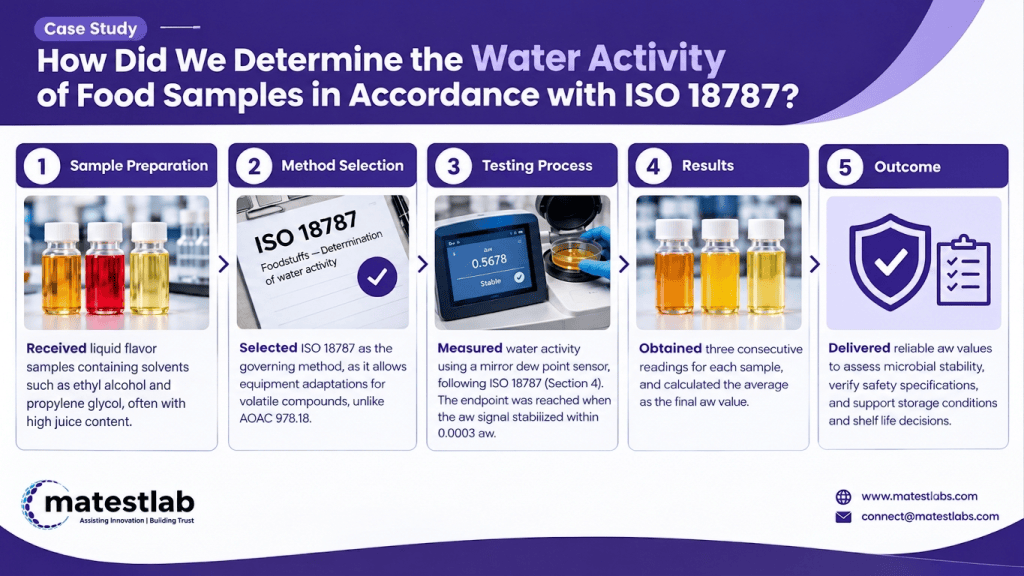
The client aimed to determine the water activity (aw) of their liquid flavor samples to assess their potential for microbial growth and overall stability. The results would help verify compliance with safety specifications and guide appropriate storage conditions and shelf-life decisions.
What Was the Analysis Challenge and How Did We Solve It?
Analysis challenge:
The client required water activity testing of liquid food flavor samples containing solvents such as ethyl alcohol and propylene glycol, often with high juice content. However, they were uncertain about the appropriate test method. They believed AOAC 978.18 would not be suitable because solvents could interfere with the measurement and result in artificially elevated water activity (aw) values. Their primary objective was to assess the safety of the flavor samples based on their water activity.
How Did We Solve It:
We addressed this challenge by selecting ISO 18787 as the governing test method, while accounting for potential interference from ethanol and propylene glycol in conventional sensor-based water activity measurements. Unlike AOAC 978.18, ISO 18787 allows for equipment adaptations when volatile compounds are present, making it a more suitable approach for testing these liquid food flavor samples.
The Customized Testing Approach by Matestlab
The water activity was measured using an AquaLab meter CX2 with a mirror dew point sensor, as described in section 4 of ISO 18787. The instrument determined the end point when the aw signal stabilized within 0.0003 aw. The reported value is the average of three consecutive displayed readings.
What Were the Analysis Results and Interpretations?
For each sample, water activity (aw) was measured and reported based on three consecutive readings. The average of these readings was calculated and reported as the final aw value to provide a representative result for each sample.
Discussion and Conclusions
The water activity (aw) of the liquid flavor samples was successfully determined in accordance with ISO 18787. The results provided the client with a reliable assessment of water activity in these complex liquid formulations, supporting the evaluation of microbial stability, verification of applicable safety specifications, and informed decisions regarding product storage conditions and shelf life.
Why Should You Choose Matestlab for ISO 18787 Testing?
Matestlab provides ISO 18787 testing services through expert laboratories based in the USA. Matestlab is your unified testing partner for physical, thermal, chemical, electrical, mechanical, environmental, and characterization testing needs, supported by our global network of 2200+ accredited testing laboratories. Our in-house materials science experts curate and design comprehensive testing programs matched to your sample material and ISO 18787 testing requirements, keeping regulatory requirements in mind.
If you are looking for a managed and trusted testing partner to achieve your research goals, feel free to schedule a meeting with us or send us a request at connect@matestlabs.com to learn more about our services. The best way to get a quote quickly is to call us at (302)244-7710. We are happy to support you.
FAQs
What is the Cost of Water Activity Testing Per ISO 18787?
The estimated testing cost ranges from $125 to $200 per sample, plus reporting charges. Additional charges may apply for sample preparation or customized testing requirements.
What is the Typical Turnaround Time (TAT) for Water Activity Testing?
The typical turnaround time is up to one week. However, turnaround time may vary depending on sample composition, instrument availability, and the time required to obtain stable and repeatable measurements.
What Are the Usual Sample Requirements for Water Activity Testing?
The usual minimum sample requirements are:
| Liquid samples | At least 25 mL of product |
| Solid samples | At least 20 g of material |
Please note that the sample requirements may vary depending on the sample composition, physical state, and properties.
Is Water Activity the Same as Moisture Content?
Water activity is not the same as moisture content. It is the ratio of the water-vapor pressure in equilibrium with the sample to the saturation vapor pressure of pure water at the same temperature:
aw = PP0
It is dimensionless: 0 represents an essentially anhydrous sample, while 1 represents pure, salt-free water. At equilibrium, relative humidity equals aw × 100%.
Why Does Water Activity Determination Matter?
Water activity helps predict product stability and shelf life because many spoilage organisms and biochemical reactions depend on available water rather than total water. It is commonly used for:
- Microbial-stability assessment and hurdle-technology formulation
- Shelf-life and packaging decisions
- Texture, caking, crystallization, and moisture-migration control
- Verifying drying, drying-agent use, or formulation targets
- Regulatory or customer specification compliance
ISO notes that water activity can be used to predict microbial growth and estimate how long a foodstuff can be kept.
Which Materials Are Covered Under ISO 18787?
ISO 18787 applies to foods for human consumption and animal feed, but not to products stored below their freezing point, water-in-fat emulsions, or crystalline products such as sugars, salts, and minerals. Products containing volatile compounds—such as alcohol—may need equipment adaptations because those vapours can interfere with the sensors.
How to Interpret ISO 18787 Water Activity Test Results?
ISO 18787 reports water activity (aw) on a scale from 0 to 1, representing the water available for microbial growth and deterioration reactions; it is measured after the sample reaches equilibrium in a sealed chamber at a controlled temperature.
| Average aw Range | Interpretation |
|---|---|
| 0.00–0.59 | Microbiologically stable. Below the approximate lower limit for growth of bacteria, yeasts, and molds; microbial proliferation is generally inhibited. |
| 0.60–0.69 | Very low microbial risk. Most microorganisms cannot grow, though a few highly specialized xerophilic molds may survive under favorable conditions. |
| 0.70–0.79 | Low to moderate spoilage risk. Most molds are inhibited below about 0.70, but some molds and specialized yeasts may still grow; pathogenic bacteria are not supported. |
| 0.80–0.84 | Low pathogen risk, possible yeast/mold spoilage risk. Most pathogenic bacteria cannot grow, but product stability depends on pH, preservatives, packaging, and storage conditions. |
| 0.85–0.89 | Borderline for pathogen control. aw ≤ 0.85 is generally used as the cutoff for preventing growth of most pathogens, so values just above 0.85 require additional safety controls. |
| 0.90–0.92 | Higher microbial risk. Some bacteria, including certain pathogens, may grow; the product should not be considered shelf-stable based on aw alone. |
| 0.93–0.97 | High microbial risk. Conditions can support growth of many bacteria, including some pathogens; refrigeration, thermal processing, pH control, preservatives, or other hurdles are typically needed. |
| 0.98–1.00 | Very high microbial risk. Sufficient free water is available for rapid growth of most bacteria, yeasts, and molds; the product is highly perishable without other preservation controls. |
Important notes:
- Interpret the result with the test temperature, because aw changes with temperature; ISO 18787 requires equilibrium measurement under controlled conditions.
- An aw result indicates microbiological stability, not complete shelf-life stability; oxidation, enzymatic activity, phase separation, and chemical degradation can still occur.
- For products containing ethanol, propylene glycol, or other volatile materials, confirm that the selected instrument/method accounts for volatile interference, since these can affect the apparent aw.
- Use aw together with pH, preservatives, packaging, initial microbial load, and storage temperature when making a final safety or shelf-life decision.


