What is ASTM D2520 Testing?
ASTM D2520 is a standard test method used to determine the complex permittivity (dielectric constant) of solid electrical insulating materials at microwave frequencies and temperatures up to 1650⁰C. The test measures two key electrical properties: the dielectric constant (relative permittivity), which indicates a material’s ability to store electrical energy in an electric field, and the dissipation factor (loss tangent), which measures the amount of electrical energy dissipated as heat when the material is exposed to an alternating electromagnetic field.
ASTM D2520 specifies two test methods, Method A and Method B, as outlined below.
| Test Method A | Test Method B |
| Waveguide method | Resonant cavity method |
| Accurate specimen shaping and dimensional fit are essential | Specimen size, geometry, and placement must suit the resonant cavity |
| Measuring dielectric properties using a waveguide setup | Measuring dielectric properties using a resonant cavity setup |
What Was the Client Looking to Evaluate?
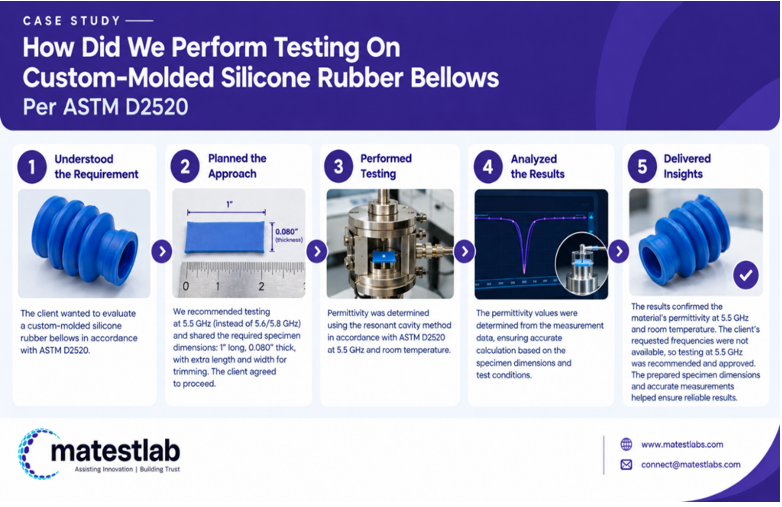
The client wanted to evaluate dielectric properties of custom-molded silicone rubber bellows in accordance with ASTM D2520.
What Were the Testing Challenges and How Did We Solve It?
The client wanted to evaluate a custom-molded silicone rubber bellows to determine its permittivity at 5.6 GHz at room temperature. We recommended testing at 5.5 GHz and explained that the results were not expected to vary significantly across this frequency range. The client agreed to proceed at 5.5 GHz. We also shared the required specimen dimensions and recommended providing a 1-inch-long specimen at the as-molded thickness of 0.080 inches, with additional length and width to allow trimming to the required dimensions. We confirmed that the specimen could be trimmed as needed and emphasized the importance of accurate dimensional measurements to ensure reliable permittivity results.
What Were the Analysis Results and Interpretation?
Permittivity was determined using ASTM D2520 Method B (Resonant Cavity Method) at a frequency of 5.5 GHz under the specified test conditions.
Discussion and Conclusions
The permittivity of the custom-molded silicone rubber bellows was evaluated using the resonant cavity method in accordance with ASTM D2520 at 5.5 GHz and at room temperature. The specimen dimensions were prepared to meet the testing requirements, enabling accurate measurement and reliable determination of the material’s permittivity under the specified conditions. The client was satisfied with the testing performed and the results delivered ahead of the estimated turnaround time.
Why Should You Choose Matestlab for ASTM D2520 Testing?
Matestlab provides ASTM D2520 Method B at 5.5 Hz, 9.8 Hz, and 14.5 Hz frequencies at expert laboratories based in the USA. Matestlab is your unified testing partner for physical, thermal, chemical, electrical, mechanical, environmental, and characterization testing needs, supported by our global network of 2200+ accredited testing laboratories. Our in-house materials science experts curate and design comprehensive testing programs tailored to your sample material and ASTM D2520 requirements, with regulatory requirements in mind. If you are looking for a managed and trusted testing partner to achieve your research goals, feel free to schedule a meeting with us or send us a request at connect@matestlabs.com to learn more about our services. The best way to get a quote quickly is to call us at (302)244-7710. We are happy to support you
FAQs
What is the cost for the ASTM D2520 testing?
The cost of testing per ASTM D2520 Method B is approximately $2,000 per sample + reporting charges. The cost may vary depending on the specific testing requirements and whether customization is involved.
What is the typical turnaround time (TAT)?
The typical turnaround time (TAT) is one week.
Which materials are covered under ASTM D2520?
ASTM D2520 applies to solid dielectric materials, including ceramics, glass, and organic insulating materials such as polymers and silicone rubber, for evaluating dielectric constant and dissipation factor at microwave frequencies.
What information is included in an ASTM D2520 test report?
ASTM D2520 test report typically includes the measured dielectric constant and dissipation factor, test frequency, relevant test conditions, specimen details, and the testing method used. Results may also be compared against specified acceptance criteria, if applicable.
What do low and high dielectric constant (ε′) and loss tangent (tan δ) values indicate?
A low dielectric constant (ε′) indicates lower electrical polarization and a lower ability to store electrical energy in an electric field. A high value indicates greater electrical polarization and a higher ability to store electrical energy in an electric field. Loss tangent (tan δ) indicates a material’s dielectric energy loss. A low value indicates lower dielectric energy loss, meaning less electrical energy is dissipated as heat relative to the energy stored. A high value indicates greater dielectric energy loss, meaning more electrical energy is dissipated as heat relative to the energy stored.