

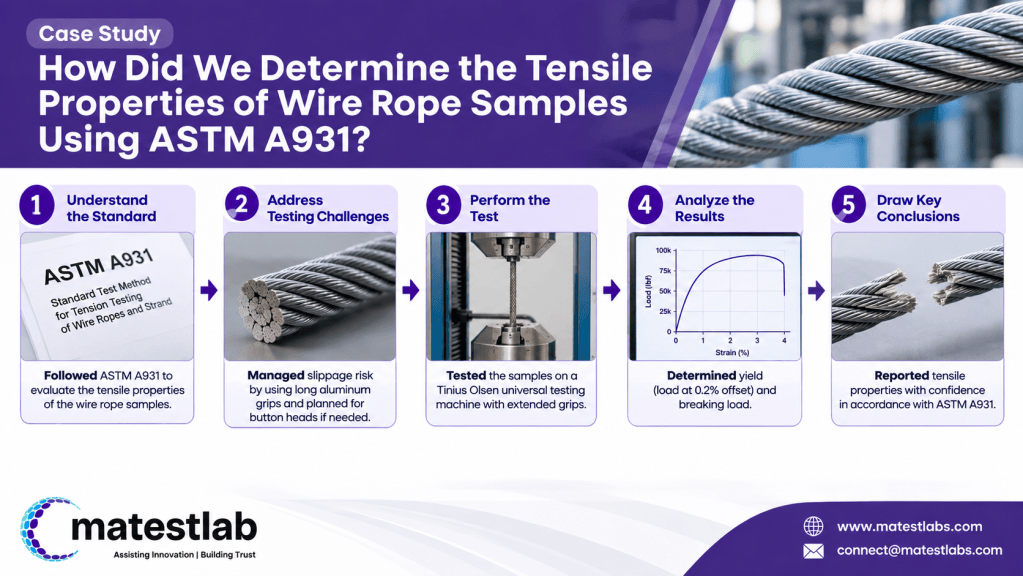
What is ASTM A931?
ASTM A931 is the standard test method for determining tension in wire ropes and strands. It covers room-temperature tensile testing of complete wire rope or strand assemblies to determine their mechanical performance. ASTM A931 is used to determine measured breaking force, yield strength, where applicable, elongation, and modulus of elasticity. It applies to wire ropes and strands tested as assembled products, not simply to individual wires. The test is performed at room temperature and is intended specifically for tension testing; it is not a general-purpose method for other mechanical or environmental evaluations. It is commonly used for qualification, quality control, and verification of minimum or measured breaking-force requirements for wire rope used in lifting, structural, marine, transportation, and similar applications.
What Was the Client Looking to Evaluate?
The client wanted to evaluate the tensile performance of steel wire rope samples in accordance with ASTM A931, specifically to determine the yield strength and ultimate tensile strength under axial tension loading.
What Was the Analysis Challenge?
The wire rope samples were not terminated, and their smooth, lubricated surface increased the likelihood of slippage from the grips during tension testing. End fittings or suitable gripping arrangements would therefore be required to secure the samples in the load frame. The samples were identified as 10-strand wire ropes with an internally lubricated, plastic-coated core. As they had been exposed to weather for an extended period, the current effectiveness of the internal lubricant was unknown, adding uncertainty to the expected gripping behavior and tensile-test performance.
How Did We Address the Challenge?
We requested one extra 66-inch cable sample to attempt testing without swaged ends. We first tested a sample using long aluminum semi-circular grips, despite the presence of internal oil. The plan was to proceed with the remaining samples if the cable broke cleanly without excessive slippage. If slippage occurred, we planned to have button heads swaged onto the remaining samples. Alternatively, we considered using custom-machined aluminum conical grips with button heads on the cable tails to prevent slippage and help ensure failure occurred in the cable’s mid-span rather than at the ends.
The Customized Testing Approach by Matestlab
- Initial Test: Test one 66-inch cable specimen using long aluminum semi-circular grips to determine whether it can be loaded to failure without excessive slippage.
- Proceed with Testing: If the specimen breaks cleanly, proceed with tensile testing of the remaining specimens.
- Alternative Approach: If excessive slippage prevents an acceptable break, have button heads swaged onto the remaining three specimens.
- Final Testing: If swaging is required, machine and install the necessary test-frame shims, then perform tensile testing on the three swaged specimens.
How Was ASTM A931 Testing Performed?
Testing was performed using a Tinius Olsen 120,000-lbf Super-L 602 universal testing machine equipped with extended hydraulic grips for stranded materials. To determine whether the specimens could be tested without swaged end fittings, we fabricated 10-inch-long semicircular aluminum gripping inserts and used the first specimen to evaluate the gripping method. The trial confirmed that the wire rope could be gripped and pulled to failure in-house without requiring external swaging. A 24-inch Tinius Olsen Class B-1 extensometer was attached to measure deformation for yield load determination. However, audible popping during loading, indicating progressive internal wire failures, prompted us to remove the extensometer to prevent damage before sufficient strain data could be collected for determining the 0.2% offset yield load. After failure, elongation was determined using visual readings from a calibrated tape measure, following a Class D measurement approach consistent with the practice described in ASTM A1061 for prestressing strand. ASTM A1061 was referenced solely for the elongation measurement approach; all wire rope tensile testing was conducted in accordance with ASTM A931.
For the remaining specimens, load, extensometer displacement, and machine stroke were recorded simultaneously. The extensometer displacement and machine stroke measurements were used to characterize the combined compliance of the testing machine and grip system. After removing the extensometer, specimen deformation was estimated from the machine stroke by correcting for load-dependent compliance and applying a transition correction based on the overlapping measurements. The corrected elongation was then divided by the initial grip-to-grip length to establish a continuous estimated strain history. These corrected estimates were considered more representative of specimen elongation than uncorrected machine-stroke measurements.
What Were the Analysis Results and Interpretations?
The steel wire rope specimens were tested in accordance with ASTM A931 to determine their tensile properties, including maximum breaking load and, where reliable deformation data were available, an estimated 0.2% offset yield load.
The 0.2% offset yield load was estimated by fitting a straight reference line to the initial portion of the measured load–strain curve, offsetting the line by 0.002 strain, and identifying its intersection with the compiled load–strain curve. Because these intersections occurred after extensometer removal, the resulting yield loads were calculated estimates rather than values determined entirely from direct extensometer measurements. The post-removal strain estimates were subject to uncertainty associated with combined machine/grip-system compliance and potential grip movement.
Discussion and Conclusions
- 0.2% Offset (Yield) Load: Estimated tensile load at the intersection of the 0.2% offset reference line and the load–strain curve. Reported only for the specimens tested after the initial trial.
- Breaking Load: Maximum tensile load recorded during each specimen’s test to failure.
- Elongation (%): For the initial trial specimen, determined from calibrated tape-measure readings following failure using a Class D measurement approach. For the remaining specimens, estimated from compliance-corrected machine stroke at the breaking load.
The elongation values obtained using the two methods are not directly equivalent. For the initial trial specimen, elongation was measured visually after failure, whereas for the remaining specimens, it was estimated from compliance-corrected machine displacement. The offset yield loads for the later-tested specimens were calculated from reconstructed load–strain relationships and were subject to uncertainty associated with the estimated strain values.
Why Should You Choose Matestlab for ASTM A931 Testing?
Matestlab provides ASTM A931 testing services through expert laboratories based in the USA. Matestlab is your unified testing partner for physical, thermal, chemical, electrical, mechanical, environmental, and characterization testing needs, supported by our global network of 2200+ accredited testing laboratories. Our in-house materials science experts curate and design comprehensive testing programs matched to your sample material and ASTM A931 testing requirements, keeping regulatory requirements in mind.
If you are looking for a managed and trusted testing partner to achieve your research goals, feel free to schedule a meeting with us or send us a request at connect@matestlabs.com to learn more about our services. The best way to get a quote quickly is to call us at (302)244-7710. We are happy to support you.
FAQs
What is the Cost of ASTM A931 Testing?
The cost is $1,700 per sample, plus reporting fees. If swaged ends are required, additional charges will apply for machining and installing the shims.
What is the Typical Turnaround Time (TAT) for ASTM A931?
The typical turnaround time is 2 weeks; however, this project required 3 weeks due to the additional trial testing.
What Are the Usual Sample Requirements for ASTM A931?
For ASTM A931 tension testing, wire-rope samples should normally be supplied as straight, undamaged lengths with suitable end terminations so they can be securely held in the test machine without slippage or premature failure at the grips. The required specimen lengths are as follows:
| Wire Rope Diameter | Minimum Test Specimen Length (Between Sockets) |
| Up to 1 in. (25.4 mm), inclusive | 3 ft (0.91 m) |
| 1⅛ in. (28.6 mm) to 3 in. (77 mm) | 5 ft (1.52 m) |
| Greater than 3 in. (77 mm) | At least 20 times the rope diameter |
What Properties Does ASTM A931 Evaluate?
The method can determine measured breaking force, yield strength, elongation, and modulus of elasticity, depending on the test setup and client requirements.
Does ASTM A931 Apply to Individual Wires or Complete Wire Ropes?
No. It applies to the complete wire rope or strand assembly, not to individual wires removed from the rope.
Are End Terminations Required for ASTM A931 Testing?
Yes, in most cases. The rope ends should be fitted with suitable terminations—commonly poured sockets—or otherwise securely gripped to prevent slippage and ensure failure occurs in the rope rather than at the grip.
What Information is Required Before Conducting ASTM A931 Testing?
The laboratory typically needs the rope diameter and construction, expected breaking force or load range, required properties, end-termination preference, available sample length and quantity, and any acceptance criteria.


