

What is ASTM E903 Solar Optical Testing?
ASTM E903 is a standard test method for determining the solar absorptance, reflectance, and transmittance of materials using an integrating sphere over the spectral range of 250 nm to 2500 nm (ultraviolet, visible, and near-infrared spectra). In this procedure, a spectrophotometer equipped with a specialized integrating sphere collects both specular and diffuse radiation reflected from or transmitted through a specimen. By integrating these spectral measurements against standard solar irradiance distributions, materials scientists can establish solar optical properties critical for thermal management, current-carrying capacity (ampacity), and solar heat gain calculations in industrial and utility applications.
What Was the Client Looking to Evaluate?
The client sought to assess the optical efficiency and solar thermal performance of a high-performance protective/thermal coating applied to cables. Cables operate under intense continuous solar exposure, where excessive solar heat absorption degrades current-carrying capacity and accelerates thermal aging. The primary goal was to measure solar absorptance and solar reflectance to evaluate baseline coating performance on both flat control plates and actual curved cable geometry.
What Were the Testing Challenges?
Executing standardized ASTM E903 spectrophotometry on real-world, cylindrical samples presents significant experimental and optical hurdles:
- Sub-Dimensional Specimen Diameter: The standard sample port apertures of the integrating sphere used for ASTM E903 require a minimum flat specimen coverage diameter of 26 mm. The client-provided cable sample had a smaller diameter, resulting in incomplete aperture coverage and the potential for stray light scattering.
- Surface Curvature & Geometry: Unlike ideal flat calibration plates, the cylindrical shape and stranded outer profile of the cable scatter incident light at non-planar angles within the integrating sphere, introducing potential measurement error.
The Customized Testing Approach by Matestlab
To address the dimensional and geometric constraints of the cable specimen, Matestlab established a client-confirmed “Best Effort” testing protocol before testing. The client formally acknowledged that the small diameter and surface curvature could introduce minor aperture uncovered area errors.
To mitigate these optical discrepancies, our technical team executed a comparative baseline methodology utilizing a few flat control plates coated with the exact same material formulation. This strategy allowed our team to validate baseline planar optical measurements against the cylindrical geometry of the cable under controlled integrating sphere alignment.
A Balanced Testing Plan
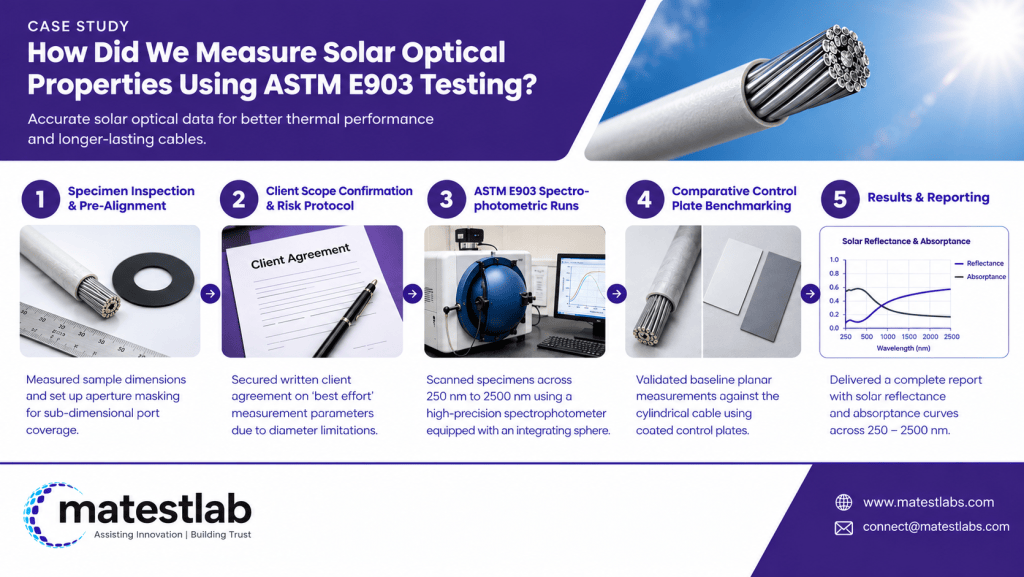
Our team executed a multi-stage testing workflow structured to maximize optical data accuracy, transparency, and reporting clarity:
- Specimen Inspection & Pre-Alignment: Evaluating sample dimensions and setting up aperture masking for sub-dimensional port coverage.
- Client Scope Confirmation & Risk Protocol: Securing written client agreement on ‘best effort’ measurement parameters due to diameter limitations.
- ASTM E903 Spectrophotometric Runs: Scanning specimens across 250 nm to 2500 nm using a high-precision spectrophotometer equipped with an integrating sphere.
- Comprehensive Reporting & Deliverables: Compiling fully verified solar reflectance, transmittance, and absorptance curves into a final laboratory data package.
What Were the Analysis Results and Interpretation?
Using high-precision integrating sphere spectrophotometry, Matestlab delivered a comprehensive evaluation report containing:
- Solar Reflectance: Spectral reflectance values across the 250- 2500 nm spectral range
- Solar Absorptance: Precise solar absorptance values calculated from integrated reflectance data
Discussion and Conclusions
The successful implementation of comparative control plate benchmarking combined with ‘best effort’ conductor spectrophotometry enabled our client to obtain accurate, actionable solar property data for their cable sample.
Why Should You Choose Matestlab for ASTM E903 Testing?
Matestlab provides comprehensive ASTM E903 testing services through expert accredited laboratories based in the USA. Matestlab is your unified testing partner for physical, thermal, chemical, electrical, mechanical, environmental, and characterization testing needs, supported by our global network of 2200+ accredited testing laboratories. Our in-house materials science experts curate and design comprehensive testing programs matched to your sample material and ASTM E903 testing requirements, keeping regulatory requirements in mind.
If you are looking for a managed and trusted testing partner to achieve your research goals, feel free to schedule a meeting with us or send us a request at connect@matestlabs.com to learn more about our services. The best way to get a quote quickly is to call us at (302)244-7710. We are happy to support you.
FAQs
What is the typical pricing for ASTM E903 testing?
The cost is $350-$500 per sample, plus reporting fees. Additional charges may apply for sample preparation or customized testing requirements.
Why does specimen geometry matter in integrating sphere testing?
Integrating spheres rely on complete aperture coverage to properly capture and reflect light. Non-flat or sub-dimensional samples allow light to escape or scatter differently, requiring baseline calibration against flat control plates.
What is meant by a ‘best effort’ measurement in material testing?
A ‘best effort’ test protocol is agreed upon when a sample does not meet standard requirements (e.g., aperture size). The lab utilizes specialized alignment and masking techniques to collect the most accurate data possible while documenting known sources of geometric uncertainty.
What is the standard turnaround time for ASTM E903 testing?
The standard turnaround time for this test is 1-2 weeks. However, turnaround time may vary depending on the samples being handled and the required test conditions.


