

What Is X-Ray Photoelectron Spectroscopy (XPS)?
X-ray Photoelectron Spectroscopy (XPS) is a surface-sensitive analytical technique used to identify elements present in a material’s near-surface region and investigate their chemical states. By analyzing the binding energies of emitted photoelectrons, XPS can provide information about elemental composition and chemical environments, depending on the material and the quality of the acquired spectra.
What Was the Client Looking to Evaluate?
The client needed to determine whether specific elements were present in a newly developed material and obtain information about its surface chemistry. The analysis was intended to support further material evaluation by providing elemental identification and, where the spectral data permitted, insight into the chemical states of the detected elements.
How Did We Approach the XPS Testing Challenge?
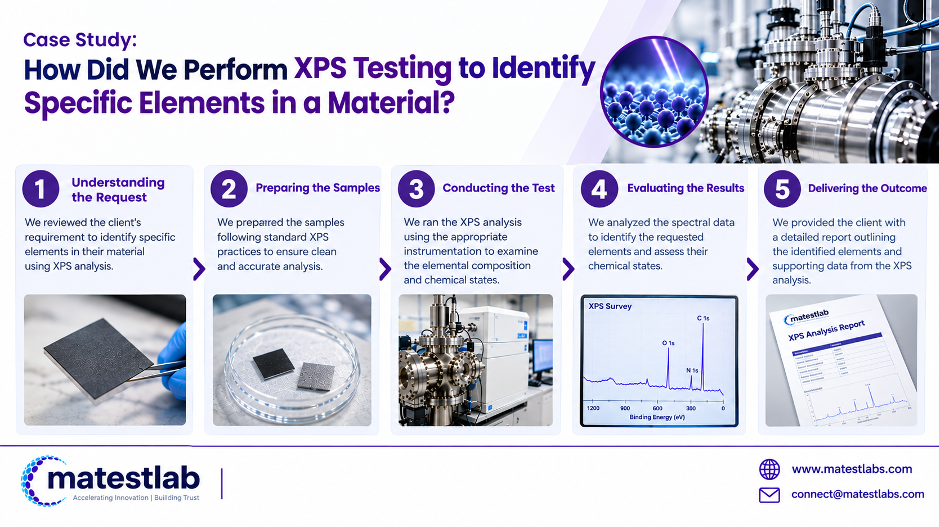
We reviewed the client’s analytical requirements and established the scope of the XPS evaluation. We then prepared the samples for analysis, acquired XPS spectral data, and evaluated the signals associated with the elements of interest. This approach connected the original testing requirement with the analytical information needed for the final report.
How Did We Evaluate the XPS Results?
We examined the acquired spectra to identify characteristic signals associated with elements of interest. Where supported by the data, we also considered chemical-state information to provide additional insight into the material’s surface chemistry. Elemental identification and chemical-state interpretation depended on the spectral evidence; no specific detected elements or numerical results were assumed.
Discussion and Conclusions
XPS provided an appropriate analytical approach for investigating the client’s surface elemental composition and potential chemical-state characteristics. By defining the testing requirements, preparing the samples, and evaluating the spectral data, we addressed the requested type of material characterization.
Why Should You Choose Matestlab for XPS Testing?
Matestlab provides XPS testing services through expert laboratories based in the USA. Matestlab is your unified testing partner for physical, thermal, chemical, electrical, mechanical, environmental, and characterization testing needs, supported by our global network of 2200+ accredited testing laboratories. Our in-house materials science experts curate and design comprehensive testing programs matched to your sample material and XPS testing requirements, keeping regulatory requirements in mind.
If you are looking for a managed and trusted testing partner to achieve your research goals, feel free to schedule a meeting with us or send us a request at connect@matestlabs.com to learn more about our services. The best way to get a quote quickly is to call us at (302)244-7710. We are happy to support you.
FAQs
How much does XPS testing cost?
Estimated total costs for complex depth profiling range from $1,100 to $1,250 per sample + reporting charges.
How long does XPS testing take?
Standard: Ranges from 5 business days to 2–4 weeks depending on the full project scope.
What sample size is required for XPS testing?
Standard testing is typically conducted on 2-inch × 2-inch (~50 mm × 50 mm) coupons, though the system can accommodate maximum sample dimensions up to 75 mm × 75 mm with a 20 mm thickness limit.
Why was XPS selected to identify specific elements?
XPS was suitable because it provides surface-sensitive elemental identification and can offer information about the chemical states of detected elements and to investigate surface composition rather than determine only the bulk composition of the material. The achievable information depends on the sample and the acquired spectral data.
What information can an XPS report provide?
X-ray Photoelectron Spectroscopy (XPS) provides surface-sensitive chemical analysis by quantifying all elements except H and He down to 0.1 at.% using relative sensitivity factors (RSFs). Through high-resolution peak fitting, it determines exact oxidation states, bonding environments, and peak separations (e.g., distinguishing metallic versus oxide states). When integrated with argon ion sputtering, XPS measures compositional profiles as a function of depth up to 1–5 µm in thin films. All data are backed by ISO-compliant binding energy calibration using Ag, Au, and Cu metallic standards, alongside validated charge neutralization and analyzer energy resolution.


