

What is the ASTM D2584 Test Method?
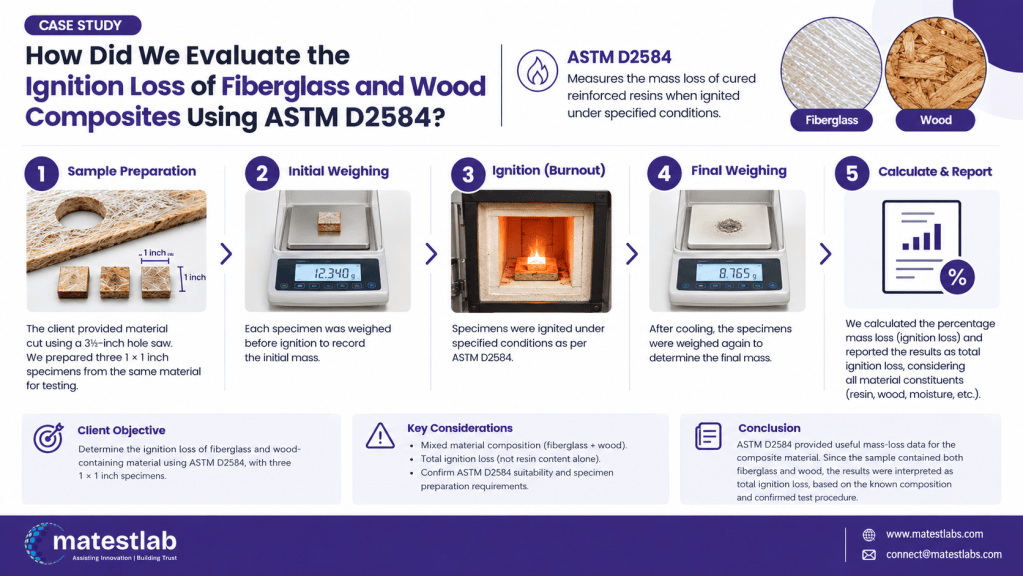
ASTM D2584 is the standard test method for ignition loss of cured reinforced resins. It measures the mass loss when a cured reinforced resin specimen is ignited under specified conditions. The result is commonly used to estimate the resin content of a reinforced composite, provided the other material constituents and their behavior during ignition are understood. The method involves weighing the specimen before and after ignition and calculating the percentage mass loss.
What Was the Client Looking to Evaluate?
The client wanted to evaluate fiberglass and wood-containing material using ASTM D2584 burnout testing. The objective was to determine the ignition loss of the material through controlled heating and mass measurement.
The client indicated that the samples would be prepared using a 3½-inch hole saw. For the proposed testing, we requested three specimens of the same material, each measuring 1 × 1 inch.
What Were the Testing Challenges?
The project involved several considerations:
- Mixed Material Composition: The samples contain both fiberglass and wood. Under the ASTM D2584 test conditions, both the organic resin and the wood fraction may undergo thermal decomposition or combustion, contributing to the measured mass loss. Therefore, the result should be reported as total ignition loss and should not be interpreted as resin content alone.
- Specimen Preparation: The client planned to cut the material using a 3½-inch hole saw. The resulting pieces would need to be prepared to meet the required 1 × 1-inch specimen dimensions.
The Customized Testing Approach Adopted by Matestlab
Matestlab reviewed the client’s material description and proposed ASTM D2584 ignition loss testing.
An updated quotation was provided for testing one sample. The proposed sample requirement was three specimens of the same material, each measuring 1 × 1 inch.
Before testing, we would need to confirm that ASTM D2584 was suitable for the fiberglass-and-wood composition and that the specimens prepared from the hole-saw-cut material met the method’s requirements.
Discussion and Conclusions
It is important to consider both material composition and specimen preparation while evaluating ignition loss. ASTM D2584 can provide useful mass-loss data for cured reinforced resin materials. Given that the sample contained both fiberglass and wood, the measured ignition loss may include contributions from the resin, wood, moisture, and other volatile constituents. The results should therefore be interpreted as total ignition loss rather than resin content in the context of the material’s known composition and the confirmed test procedure. The testing plan was devised to evaluate the material using three 1 × 1 inch specimens, subject to ASTM D2584 method suitability and specimen preparation requirements.
Why Should You Choose Matestlab for ASTM D2584 Testing?
Matestlab provides ASTM D2584 testing through qualified laboratories in the USA. Matestlab serves as a unified testing partner for physical, thermal, chemical, electrical, mechanical, environmental, and characterization testing needs, supported by a network of testing laboratories.
Our materials science team works with clients to coordinate testing programs based on their material, analytical objectives, applicable standards, and sample requirements.
If you are looking for a testing partner for your materials evaluation, contact connect@matestlabs.com or call (302) 244-7710 for assistance.
FAQs on the Evaluation of Ignition Loss of Fiberglass and Wood Composites
What is the cost and turnaround time for ASTM D2584 testing?
ASTM D2584 testing costs 700 USD plus reporting charges, and the usual TAT is 9-10 days. However, the final cost depends on the material type, number of samples, the confirmed testing scope, and client requirements. Contact Matestlab for a project-specific quotation covering both materials.
What does ASTM D2584 ignition loss testing measure?
ASTM D2584 measures the % of a cured reinforced resin specimen’s mass lost during ignition under specified test conditions. The result can help assess resin content when the material composition is appropriate for the method.
How many specimens are required for this project?
The quoted requirement is three specimens of the same material, each measuring 1 × 1 inch.
How should the client prepare the samples?
The client indicated that the material would be cut using a 3½-inch hole saw. Our quoted requirement is three 1 × 1-inch specimens of the same material. Please confirm the final preparation and acceptance of the specimens with us before shipment.


