

What is ASTM E23 Notched-Bar Impact Testing?
ASTM E23 is a standard test method for determining the notch impact properties of metallic materials. In a notched-bar impact test, a machined specimen containing a specified notch is struck by a pendulum impact machine under controlled test conditions. The test measures the energy absorbed by the specimen during fracture and can also provide additional fracture-related measurements, including lateral expansion and percent shear.
What Was the Client Looking to Evaluate?
The client required impact testing of a metal sheet material at cryogenic temperature points. The specimens were to be machined from the supplied sheet material and tested in accordance with ASTM E23. The objective was to characterize the material’s resistance to impact fracture under low-temperature conditions and document the change in impact response across the requested temperature points.
What Were the Testing Challenges?
Impact testing of sheet material at cryogenic temperatures requires careful attention to specimen preparation, dimensional suitability, and temperature control. Key considerations for this scope included:
- Specimen Dimensions and Sheet Thickness: The specimens must be machined from the sheet while meeting the applicable ASTM E23 specimen geometry requirements. The available sheet thickness and material quantity may affect whether standard-size or sub-size specimens can be prepared.
- Notch Preparation: The notch geometry and finish are critical to obtaining consistent impact results. Machining and inspection must be controlled to meet the applicable requirements of the selected ASTM E23 procedure.
- Cryogenic Temperature Control: Specimens must be conditioned at the specified low temperatures and transferred to the impact machine while maintaining the required test temperature.
- Temperature-Dependent Interpretation: A sufficient range and number of temperature points are needed to characterize the material’s transition behavior and develop an S-curve. The requested temperature matrix should therefore be confirmed before testing.
The Customized Testing Approach by Matestlab
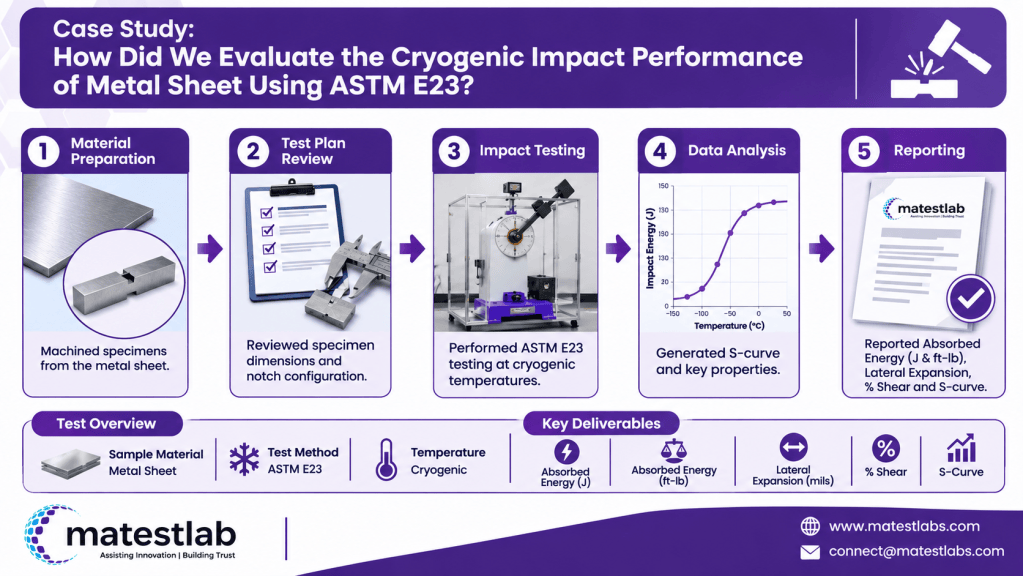
Our team developed a testing approach involving machining specimens directly from the client’s metal sheet material, followed by impact testing in accordance with ASTM E23 at the specified cryogenic temperature points. Prior to testing, the specimen dimensions, sheet thickness, notch configuration, and temperature matrix were reviewed and confirmed to establish specimen suitability and testing feasibility.
A Balanced Testing Plan
The proposed workflow is organized to support consistent specimen preparation, controlled low-temperature testing, and clear reporting:
- Sample Review and Feasibility: Review the sheet material dimensions, thickness, available quantity, and requested cryogenic temperature points.
- Specimen Machining: Machine the impact specimens from the supplied sheet material in accordance with the agreed ASTM E23 specimen configuration.
- Notch Inspection and Preparation: Prepare and verify the notch geometry and specimen dimensions before testing.
- Cryogenic Conditioning and Impact Testing: Condition specimens at each specified temperature and perform the impact tests in accordance with ASTM E23.
- Data Review and Reporting: Compile the measured impact properties and present the temperature-dependent results, including an S-curve where the test data support its development.
What Were the Analysis Results and Interpretation?
The following properties were evaluated and reported for the tested specimens:
- Absorbed Energy: Impact energy absorbed during fracture, reported in joules (J) and foot-pounds (ft-lb).
- Lateral Expansion: Lateral expansion measured after fracture, reported in mils.
- % Shear: Percent shear fracture
- S-Curve: A plot of impact response versus test temperature, using the measured results across the specified temperature points.
The S-curve will illustrate how the measured impact response varies with temperature. Its interpretation will depend on the number and range of temperature points tested; a complete transition curve may require additional points if the supplied temperature matrix does not span the relevant transition region.
Discussion and Conclusions
The ASTM E23 testing program evaluated the cryogenic impact behavior of the metal sheet material using specimens machined from the supplied sheet. The report included absorbed energy in both J and ft-lbf, along with lateral expansion, percent shear, and the temperature-dependent S-curve, providing a comprehensive assessment of the material’s impact response at the tested temperatures.
Why Should You Choose Matestlab for ASTM E23 Testing?
Matestlab provides comprehensive ASTM E23 testing services through expert accredited laboratories based in the USA. Matestlab is your unified testing partner for physical, thermal, chemical, electrical, mechanical, environmental, and characterization testing needs, supported by our global network of 2200+ accredited testing laboratories. Our in-house materials science experts curate and design comprehensive testing programs matched to your sample material and ASTM E23 testing requirements, keeping regulatory requirements in mind.
If you are looking for a managed and trusted testing partner to achieve your research goals, feel free to schedule a meeting with us or send us a request at connect@matestlabs.com to learn more about our services. The best way to get a quote quickly is to call us at (302)244-7710. We are happy to support you.
FAQs
What is the typical pricing for ASTM E23 testing?
The cost is $500-$800 per sample, plus reporting fees. Additional charges may apply for sample preparation or customized testing requirements.
Why is cryogenic temperature impact testing performed?
Cryogenic impact testing evaluates how metallic materials respond to sudden impact and fracture at extremely low temperatures, helping assess their low-temperature toughness.
What is percent shear in impact testing?
Percent shear represents the proportion of the fracture surface exhibiting ductile shear characteristics, helping assess the fracture behavior of the material.
What is the standard turnaround time for ASTM E23 testing?
The standard turnaround time for this test is 2 to 3 weeks. However, turnaround time may vary depending on the samples being handled and the required test conditions.


