What is Thermal Conductivity and W/(m·K)?
Thermal transfer is an important consideration in numerous industries, including construction, aerospace, automotive, electronics, and manufacturing. Engineers need to understand the behavior of materials when subjected to heat to create products that will consistently function as needed under operating conditions. Thermal conductivity is a type of heat-transfer property of a material. This property is usually given in watts per meter-kelvin W/(m·K). Thermal conductivity is the rate of heat flow through a material 1 meter thick with a cross-sectional area of 1 square meter when a temperature difference of 1 kelvin exists across the material. Copper and aluminum have high thermal conductivity, and heat is conducted rapidly. Insulators such as fiberglass and polyurethane foam have low thermal conductivity. Thermal conductivity data simplify product development and material selection, improve product efficiency, and support compliance with industry standards. Thermal conductivity values vary with temperature, moisture content, density, and material composition. Reported W/(m·K) values are therefore usually associated with a specified test temperature.
What is the Scope of Thermal Conductivity Measurement?
- Identifies the heat transfer properties of materials.
- Assesses thermal performance and insulation effectiveness.
- Assists in product development and material selection.
- Assists quality control and specification compliance.
- It applies to metals, plastics, composites, ceramics, and insulation materials.
- Supports research and thermal performance studies.
- Checks energy efficiency standards.
What is the Principle of Thermal Conductivity Measurement?
Thermal conductivity testing determines how quickly heat passes through a material under controlled conditions. In a test, a laboratory sets up a temperature gradient across the material being tested and determines the heat flow through the material. The thermal conductivity (k) value is then determined and put into the report in terms of W/(m·K). The higher the number, the faster the material conducts heat, and the lower the number, the better it insulates. For instance, the thermal conductivity of copper is more than 400 W/(m·K), whilst that of insulating foams is less than 0.05 W/(m·K).
Test Procedure Overview
| Sample Preparation | The analyst prepares flat, representative specimens according to the applicable standard. |
| Instrument Setup | The analyst configures the thermal conductivity instrument and establishes the required temperature conditions. |
| Specimen Installation | The analyst places the specimen between heated and cooled plates. |
| Measurement Process | The analyst measures heat flow through the specimen under steady-state conditions. |
| Result Calculation | The analyst determines the thermal conductivity from the measured heat flow in accordance with the applicable standard. |
What are the Common Standards Used to Measure W/(m·K)?
| ASTM C177 | Measures steady-state thermal transmission properties using a guarded hot plate apparatus. |
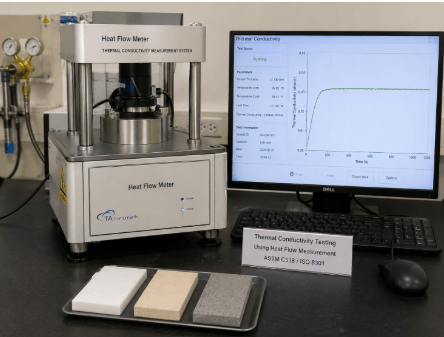
| ASTM C518 | Measures thermal conductivity using a heat flow meter apparatus |
| ASTM E1530 | Determines resistance to thermal transmission using the guarded heat flow meter technique. |
| ISO 8301 | Determines thermal resistance and related thermal transmission properties using a heat flow meter apparatus |
| ISO 8302 | Determines thermal resistance and thermal conductivity using a guarded hot plate apparatus. |
What is the Significance of W/(m·K) in Material Testing?
Thermal conductivity data is of vital importance for material selection and product design. The purpose of the W/(m·K) specifications for engineers is to optimize thermal management, improve energy efficiency, and to improve product reliability. In the building sector, low-thermal-conductivity materials help reduce energy use and enhance building insulation. High-thermal-conductivity materials are used in electronics for heat dissipation and to prevent component failure. Accurate W/(m·K) measurements are also helpful in research, quality control, and regulatory compliance activities.
Applications of Thermal Conductivity Testing
- Assesses building and industrial insulation materials.
- Assesses thermal management materials for electronics and batteries.
- Supports material qualification programs in the aerospace and automotive sectors.
- Supports the development of energy-efficient building products.
- Assesses plastics, composites, and polymer foams.
- Helps control quality as materials are produced.
- Helps to develop new and improved thermal materials for research and development.
- Verifies compliance with customer and industry specifications.