
By Malhar Khole | Last updated 15th May 2026

ASTM C518 Steady-State Thermal Transmission Properties by Means of the Heat Flow Meter Apparatus

ASTM C518 is a test method that measures steady-state thermal transmission properties using a heat flow meter apparatus. This technique is used in the industries to measure the insulation performance of construction and industrial systems. The test involves the use of calibrated heat flux transducers, parallel plates, and controlled temperature differences. Values of thermal conductivity, thermal resistance, and conductance are reported and are usually specified in W/m · K, m2·K/W, and m2·K/W, which are useful for making precise thermal design and material choices.

Read More

GET STARTED

    Share your requirements *

    Provide your contact information *

    ASTM C518 Introduction

    ASTM C518 (Standard Test Method for Steady-State Thermal Transmission Properties by Means of the Heat Flow Meter Apparatus) is a reliable method for testing the steady-state thermal transmission characteristics of materials using a heat flow meter. The properties are useful for assessing insulation efficiency and heat transfer characteristics in practice. Thermal conductivity is the ease with which the material conducts heat, and thermal resistance is the capacity of the material to conduct heat. Thus, ASTM C518 facilitates the choice of materials, product design, and quality assurance. The technique uses the Fourier law and requires proper calibration with reference samples. Consequently, industries depend on ASTM C518 to obtain precise and reliable thermal performance information. 

    Get Certified ASTM C518 for Accurate Thermal Performance Testing

    Proper thermal data guarantees good thermal performance of insulation in buildings and industrial systems. Additionally, certification testing ensures that materials comply with required thermal specifications. This means that manufacturers minimize performance risk and enhance product consistency within real-life scenarios.

    Service NameRemarks
    ASTM C518 Testing
    Expert Consultation

    Testing Procedure and Requirements

    ASTM C518 is a method of measuring steady-state heat flow through flat specimens based on a calibrated heat flow meter apparatus. Technicians put the specimen between two parallel plates with controlled temperatures. This system induces one-dimensional heat flow, and measurements are made using heat flux and temperature difference sensors. These values are useful in the determination of thermal properties based on the Fourier law.

    Conditioning and mounting the test specimenTechnicians condition the test specimen to appropriate temperature and humidity levels. Then they mount the test specimen between two plates of the heat flow meter. 
    Applying the temperature differenceA temperature difference of 10 to 40 °C is applied across the specimen by controlling the temperatures of the two plates. Technicians measure and record heat flow through the specimen.
    Calculating thermal conductivity and resistanceTechnicians calculate thermal conductivity and thermal resistance from heat-flow data.
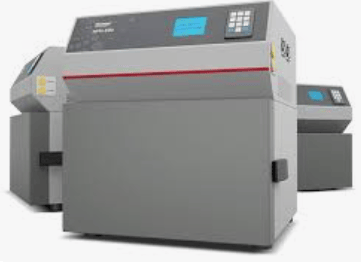
     The image shows a heat flow meter (HFM) apparatus to measure the steady-state thermal transmission properties of materials, such as insulation, as described in ASTM C518.
    ASTM C518 Heat Flow Meter (HFM) Apparatus

    Scope of ASTM C518 Test Standard

    • ASTM C518 is used in solid materials, polymer foams, rigid boards, and composite materials; textiles; cellulose insulation; fibreboards; gypsum products; building envelope materials, and other low- to moderate-thermal-conductivity materials. 
    • The test includes the determination of thermal conductivity (k), apparent thermal conductivity (l), and thermal resistance (R) in specified temperature conditions. 
    • It models one-dimensional heat conduction in steady-state conditions in building and industrial settings. 

    Equipment and Sample Preparation

    Heat Flow Meter ApparatusMeasures heat flux through the specimen under steady-state conditions.
    Parallel PlatesMaintain a constant temperature difference across specimen surfaces.
    Temperature SensorsRecord plate temperatures for thermal calculations.
    Specimen detailsASTM C518 test method applies to a wide range of materials, including building materials, insulation products, and composite structures.
    Specimen dimensionsThe acceptable specimen dimensions to ASTM C518 must be at least 150 mm x 150 mm (6 in. x 6 in.) and a minimum of 25 mm (1 in.) thick.
    Specimen preparationThe test specimens are conditioned to the desired temperature and humidity levels and prepared in line with the instructions of the manufacturer before being tested.

    Use of ASTM C518 Test Standard

    • It helps in choosing the insulation material that will be used on roofs, walls, refrigeration systems, furnaces, and vehicles. 
    • Engineers use test data to design building envelopes with R-values that optimize, validate computational thermal models, and certify novel insulation materials. 
    • It is also employed to analyze the effects of aging, moisture absorption, and compression on the thermal performance of insulation products.

    How Does the Heat Flow Meter Apparatus Work?

    The device measures a constant heat flow in a sample between two plates. One plate is hot, and the other is cold. Heat flux and temperature difference across the sample are measured using sensors. Then the Fourier law determines thermal conductivity and resistance. This method will guarantee quick and precise thermal measurements.

    Why Is Calibration Critical in ASTM C518?

    Calibration guarantees thermal measurements accuracy when subjected to test conditions. It is based on the principle of using reference samples with known properties of either ASTM C177 or ASTM C1114. In addition, the calibration should correspond to the type of specimen, its thickness, and temperature range. Otherwise, there can be serious errors in results without the necessary calibration. Thus, to ensure the reliability of measurements, technicians constantly check calibration factors.

    Common Challenges and Troubleshooting

    Thermal results tend to be different depending on the composition of the materials used. Also, the presence of moisture or thermal history can cause changes in measurements. Anisotropic or inhomogeneous samples can result in non-uniform heat flow measurements. Specimen thermal bridges can also produce unreliable results. To eliminate these problems, technicians make sure that they have dry specimens, are properly calibrated, and are   homogenized. 

    Testing Technique Process, and Data Collection

    A specimen is placed between hot and cool plates, and then the testing begins. The system creates a uniform flow of heat through the material. The sensors continuously measure the heat flux and temperature difference. Technicians then compute thermal conductivity, resistance, and conductance using the data collected. The uniformity of measurements guarantees the comparability of various materials.

    Analysis Results and Interpretation 

    ASTM C518 gives the results in SI units. Thermal conductivity is given in W/m -K, thermal resistance as m2-K/W, and thermal conductance is given in W/m2-K. A high thermal resistance means higher insulation performance. Higher conductivity values imply less heat transfer. These results help engineers choose materials that can be used to build efficient thermal systems.

    Factors to Consider For ASTM C518

    • Speed: The technique offers quick thermal measurements as opposed to primary techniques. Effective testing aids prompt decision-making.
    • Expert: Ensuring proper calibration and adequate handling of the specimen is ensured by skilled technicians. Knowledge enhances precision and uniformity.
    • Cost: The procedure has economical testing of standard quality control. The effective functioning decreases the total cost of testing.

    Link to ASTM C518 Standard

    FAQ's

    Where can I get the astm c518 tested?

    You can share your astm c518 testing requirements with MaTestLab. MaTestLab has a vast network of material testing laboratories, spread across the USA and Canada. We support your all material testing needs ranging from specific astm c518 test to various testing techniques.

    How much do I need to pay for the astm c518 test?

    Please contact us for a detailed quote for your astm c518 testing needs. Cost incurred to carry out different astm c518 testing methodology depends on the type of raw material; number of samples, coupons, or specimens; test conditions, turn around time etc. Costs of some ASTM testing methods start from $100 and the final value depends upon the factors listed above. Please contact us for the best and latest prices.

    How many samples are required for astm c518?

    The required number of samples or specimens should comply with the procedure given in the astm c518 standard. However, the MaTestLab operations team can assist you for your special requirements once you share your testing details with us.

    How much discount can I get on the astm c518 test?

    MaTestLab has a vast testing laboratory network, hence we bring you the best testing facilities in a cost-effective way. We offer considerable discounts (15-20%) to our returning customers based on test volume and frequency.

    How many days will it take to complete the astm c518 test?

    The turnaround time for astm c518 test methodology depends upon the test procedure mentioned in the standard test document. However, we at MaTestLab understand your research requirements and hence try to get your test completed within the least possible time.

    Where can I get the astm c518 tested?

    You can share your astm c518 testing requirements with MaTestLab. MaTestLab has a vast network of material testing laboratories, spread across the USA and Canada. We support your all material testing needs ranging from specific astm c518 test to various testing techniques.

    POPULAR TESTS
    ONE-STOP FOR ALL
    MATERIAL TESTING NEEDS
    MaTestLab Inc. offers accessible, quick, and affordable material testing, product testing, and failure analysis services. We support your on-demand testing and expert consultation needs with the help of our extensive network of material testing laboratories situated in the US and other parts of the world.
    MATERIAL TESTING
    We offer destructive and non-destructive tests over a range of mechanical, electrical, chemical, thermal, optical, corrosion, radiation, and biological testing methodologies defined by ASTM, ISO and other organizations.
    PRODUCT TESTING
    We help you evaluate and ensure your product quality and performance with standard and custom-made testing solutions. All the tests are done at well-equipped testing laboratories using standard testing methods for best output and satisfaction.
    FAILURE ANALYSIS
    Failure analysis ensures high levels of quality in every manufacturing process. We help you with getting the best failure or root cause analysis to determine the cause of the failure. The results help you identify means to prevent failure recurrences.
    Process for testing
    • STEP 01

      You share your testing requirements

    • STEP 02

      You share your sample(s)

    • STEP 03

      We deliver your test reports

    Get your testing done

    Let us known your testing requirements and we will be right back with a solution.

      Let us root for each other. Collaborate to grow, expand, and accelerate our businesses.

      Partner with us

        close

        Please share your requirement with us

          ×

          Contact Us

          Discover more from MaTestLab

          Subscribe now to keep reading and get access to the full archive.

          Continue reading