ASTM D6943 Standard Practice for Immersion Testing of Industrial Protective Coatings and Linings

    What is ASTM D6943? 

    ASTM D6943 is a standard practice for assessing the durability of industrial protective coatings when exposed to chemical immersion. Protective coatings are applied to metallic and concrete storage and processing vessels, shipping containers, dams, and rail cars. Linings, a specific type of coating, are designed to shield substrates from corrosion caused by continuous or intermittent fluid contact. They shield the substrate from corrosive damage and safeguard stored materials against contamination. ASTM D6943 (Standard Practice for Immersion Testing of Industrial Protective Coatings and Linings) method offers a way to evaluate a protective coating’s resistance to chemical deterioration and its effectiveness in shielding liquid cargo from potential contamination by either the substrate or the coating, relying on visual assessments.

    Read more

    Get Certified ASTM D6943 Testing for Reliable Coating and Lining Performance 

    Protective coatings experience extreme chemical and osmotic stress in industrial immersion environments like chemical storage tanks, pipelines, and containment structures. Chemical resistance testing evaluates whether the coating system can withstand these conditions. If the coating system is not qualified, film blistering, cracking, softening, or delamination may occur early in the service life, resulting in early catastrophic corrosion of the substrate. ASTM D6943 establishes standardized immersion exposure procedures to confirm the ability of a protective lining to resist certain chemical exposures. Certified testing can ensure products meet project requirements, reduce early coating failures, and help ensure that assets last for a longer period. 
    What is the Scope of ASTM D6943? 

    ASTM D6943 provides guidelines for the standard practice of exposing organic protective coatings or linings to organic liquid immersion on a metallic or concrete surface. The standard offers three different testing methods depending on the requirements for exposure: Procedure A: total immersion at ambient pressure, Procedure B: partial immersion at ambient pressure, Procedure C: immersion at elevated temperature or pressure. 

    Read more

    The scope of ASTM D6943 includes:

    • Material type: Organic coatings, linings, thermosetting polymers, epoxies, polyurethanes, fluoropolymers, and rubber linings applied to steel, concrete, or composite substrates.
    • Purpose: Evaluation of industrial coatings and linings for liquid immersion resistance, chemical compatibility, and anti-corrosion protection.
    • Properties evaluated: Film blistering, swelling, softening, discoloration, loss of adhesion, cracking, rusting, and chemical degradation.
    • Testing method: Select Procedure A, B, or C based on service conditions; expose prepared coated panels to test liquids at specified temperatures and durations.
    • Results: Qualitative and quantitative assessments, including blistering ratings, rusting ratings, adhesion retention, and mass or hardness changes.
    • Test limitations: Laboratory immersion testing accelerates liquid penetration but does not duplicate complex multi-variable field exposures perfectly; results serve as comparative performance indicators.
    • Use conditions: Testing simulates total, partial, or elevated-temperature liquid immersion under continuous or thermal-cycling exposure.
    • Applications: Material selection, coating formulation tuning, specification verification, and quality assurance for storage tanks, marine structures, wastewater facilities, and process piping.

    What are the Uses of ASTM D6943Testing?

    ASTM D6943 testing allows protective lining specialists to assess the long-term integrity of protective linings when exposed to liquid media. Engineers use the resulting performance data to compare coating formulations and to determine the most suitable lining systems for aggressive chemical service. This standard-

    • Assesses the chemical resistance of industrial protective coatings and linings.
    • Represents conditions of total, partial, or high-temperature liquid immersion services.
    • Assesses the influence of cold wall and osmotic blistering in partial immersion and temperature differences.
    • Supports the assessment of adhesion loss, softening of films, and blistering tendency.
    • Aids in comparing competitive coating formulations and resin systems.
    • Assists in product development, quality control, and certification of coating materials.
    • Helps engineers choose long-lasting lining materials for tanks, vessels, and containment areas. 

    What Materials Can Be Tested Under ASTM D6943? 

    It is used to test coatings such as epoxy, polyurethane, and vinyl ester, which are used for linings of tanks, pipelines, and industrial containers, for corrosion and chemical stability. It applies to verifying performance in a water storage tank and also in chemical reactors.

    Why is ASTM  D6943 Important? 

    The standard is used to predict the long-term performance and reliability of protective coatings and linings in immersion environments. Manufacturers can identify suitable materials while ensuring regulatory compliance by adopting quality control and product certification.

    ASTM  D6943 Equipment and Sample Preparation Guide

    ASTM D6943 specifies glass immersion cells, heating apparatus, temperature controllers, and specimen support fixtures that can provide a chemical liquid environment. Representative substrate panels are prepared with the desired surface preparation, anchor profiles, and coating dry film thickness (DFT) before exposure. 

    Read more

    Sample and Specimen DetailsRepresentative coated panels or lined substrate specimens (steel, concrete, or composite) prepared with target coating system formulations. 
    Specimen PreparationTechnicians blast-clean metal substrates to specified surface profiles (e.g., SSPC-SP 10 / NACE No. 2), apply the coating system according to manufacturer instructions, cure the film completely, and seal panel edges to prevent edge-effect corrosion. 
    Specimen DimensionsSpecimen dimensions depend on the immersion cell geometry; typical test panels measure 75×150 mm (3×6 in) or 100×150 mm (4×6 in) with thickness suitable for the substrate 
    InstrumentationGlass immersion vessels/reactors, constant-temperature baths or heating jackets, temperature sensors, reflux condensers, aeration systems, adhesion testers (patties/cutters), and film thickness gauges.

     Testing Procedures and Requirements for ASTM  D6943

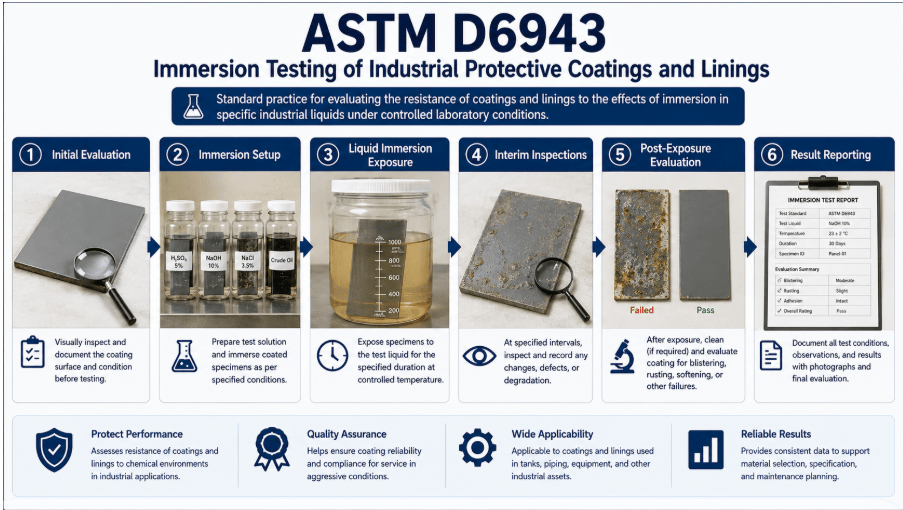
    Coated specimens were exposed to controlled, liquid immersion environments, as per ASTM D6943. Technicians set test parameters, control and manage liquid levels and exposure conditions during the test. Other referenced ASTM documents include C267 and D471.  The following procedural phases are included in the standard: 

    Read more

    Initial Evaluation Technicians inspect prepared specimens, measure dry film thickness (DFT), check surface continuity/holiday detection, and record baseline appearance. 
    Immersion Setup Technicians mount specimens in immersion vessels containing the specified test liquid, ensuring proper spacing and orientation (total or partial immersion). 
    Liquid Immersion Exposure Technicians maintain specified test temperature, pressure, and liquid concentration for the required exposure duration (typically 30, 60, 90, or 180 days). 
    Interim Inspections Analysts periodically remove specimens, rinse surface residues, inspect for immediate film defects (blistering, swelling, discoloration), and return specimens to exposure.
    Post-Exposure Evaluation Analysts conduct final visual evaluations, perform cross-hatch or pull-off adhesion testing, check pencil hardness changes, and evaluate substrate corrosion beneath the film. 
    Result Reporting Laboratories document exposure liquid composition, temperature, duration, visual defect ratings, adhesion values, and comparative baseline data. 

    ASTM D6943Testing Process and Data Collection

    Technicians first measure dry film thickness on representative coated panels, then test to ensure no defects in film coverage. Exposure cell technicians add the test solution (deionized water, crude oil, acid solutions, alkaline solutions) to be tested into the cell, and the specimens are placed inside. During the exposure cycle, the apparatus maintains a constant temperature and fluid level. Temperature logs and liquid chemistry readings are taken by technicians on a regular basis. Panels are removed at certain intervals and at the end of the test period; the changes in blistering (ASTM D714), rusting (ASTM D610), and adhesion retention are reported.

     The image shows industrial protective coating immersion testing by controlled chemical exposure, including Initial Evaluation, Immersion Setup, Liquid Immersion Exposure, Interim Inspections, Post-Exposure Evaluation, and Result Reporting
    ASTM D6943 Immersion Testing of Industrial Protective Coatings and Linings

    Common Challenges and Troubleshooting

    Testing can be affected by variations in immersion conditions, application of the coating, and the condition of the surface. Troubleshooting includes thorough cleaning of the surface, correct application of the coating, and application of the immersion parameters. Standardization of geometries of samples helps minimize inconsistencies.

    ASTM D6943Analysis Results and Interpretation

    The report gives a summary of the physical property changes and visual observations of the coated specimens following exposure to liquids. Analysts compare exposed specimens to control panels and baseline pre-test measurements.

    Read more

    • The lab report details exposure for hours or days and provides the exact chemical composition, concentration, and temperature of the test liquid.
    • The analyst documents visual film defects using standard rating scales such as blister size and frequency (ASTM D714), rusting degree (ASTM D610), cracking, swelling, and discoloration.
    • This testing laboratory reports property changes, such as Pull-off Adhesion Strength (MPa or psi – ASTM D4541), Cross-cut Adhesion rating (ASTM D3359), and changes in film hardness.
    • This report captures the degradation of observed films and the corrosion of the substrates beneath the lining, and compares the results to the project pass/fail criteria instead of giving an overall performance rating. 

    Link to ASTM D6943

    FAQ

    What is the relationship between ASTM D6943 Method B and NACE TM0174?
    The Atlas Cell Test in NACE TM0174 is similar to ASTM D6943 Method B, characterizing lining resistance to chemical media in the presence of a temperature gradient. It typically immerses 66-75% of the coated surface and uses compressed air to ensure uniform temperature
    ASTM D6943 is used to test the chemical resistance, blister resistance, and adhesion retention of the protective linings that engineers apply to storage tanks, process vessels, containment areas, or pipelines that expose them to liquids.
    ASTM D6943 is used to test for visual defects (blistering, cracking, rusting, swelling, discoloration) and for physical properties (pull-off adhesion, cross-hatch adhesion, film hardness, and substrate corrosion) after immersion.

    Updated on September 17, 2026

    Dr Ruchika Yogesh
    About Author
    Dr. Ruchika Yogesh is a serial entrepreneur, material science and AI/ML enthusiast, medicinal chemistry subject matter expert (SME), scientific/medical copyeditor, and a researcher.
    Know More
    Testimonials
    Real results
    Engineers trust us with what matters most
    Start Your Testing
    Project Today
    Define your requirements and get access to
    specialized laboratories ready to deliver results
    Partners with us
    Clients
    Vendors
    Process for testing
    • STEP 01

      You share your testing requirements

    • STEP 02

      You share your sample(s)

    • STEP 03

      We deliver your test reports

    Get your testing done

    Let us know your testing requirements and we will be right back with a solution.

      Let us root for each other. Collaborate to grow, expand, and accelerate our businesses.

      Partner with us

        Discover more from Matestlab

        Subscribe now to keep reading and get access to the full archive.

        Continue reading