ASTM D3359 Standard Test Methods for Rating Adhesion by Tape Test

    What is ASTM D3359? 

    ASTM D3359 is a standard test method for measuring the adhesion of coating films to metallic substrates using and removing pressure-sensitive tape over cuts of the film. The Adhesion of a coating to a substrate is assessed to determine whether the coating is sufficiently adherent to satisfy the user’s application requirements. Does not differentiate between higher levels of adhesion that require more complex measurement methods. Test Method A is intended mostly for job-site use, and Test Method B is more appropriate for laboratory use. The test method is substantially the same as (but not identical to) ISO 2409. 

    Read more

    Get Certified ASTM D3359 Compliance for Coating Adhesion 

    Accredited laboratories provide ASTM D3359 testing services for evaluating coating adhesion to metallic substrates. Services provide detailed analytical reports, adhesion ratings from 0 to 5, test method details, specimen preparation information, and compliance documentation. Technicians test and certify coatings to meet adhesion requirements for protective and decorative coatings. Testing enables manufacturers to confirm the quality of the coating, meet specification requirements, and guarantee product performance.

    What is the Scope of ASTM D3359? 

    ASTM D3359 details methods for determining the adhesion of relatively ductile (pressure-sensitive) coating films to metallic substrates by cutting designs through the coating film and applying and removing the tape. The standard provides guidelines for specimen preparation, cutting patterns, taping, and rating. 

    Read more

    The scope of ASTM D3359 includes:

    • Material types: Coating films with relatively ductile properties applied on metallic substrates.
    • Purpose: To assess how well the coating is attached to the substrate in the user’s application.
    • Properties evaluated: Adhesion rating on a 0 to 5 scale according to the amount of coating peeled off due to tape pull-off.
    • Testing Method: Test Method A (X-cut) for coatings thicker than 125 μm (5 mils); Test Method B (crosshatch) for coatings thinner than 125 μm (5 mils).
    • Testing limitations: Cannot differentiate between higher levels of adhesion, where more complex testing methods are needed. Multi-coat systems can give adhesion failure between coats, where adhesion of the coating system to the substrate is not determined.
    • Results: Adhesion rating (scale of 0 to 5) and compliance documentation will be provided as a result.
    • Use Condition: Test Method A is used in the field primarily; Test Method B is used more in the laboratory.
    • Application: Quality control for coating manufacture, to assess the surface preparation process, to compare different coatings or surface processes, and to verify specification compliance. 

    What are the Uses of ASTM D3359 Testing?

    ASTM D3359 testing helps laboratories determine the adhesion of coating films on metallic substrates. The results are used by manufacturers, engineers, and quality control personnel for quality assurance, material selection, and specification compliance. This standard-

    • Decides whether or not the coating sticks to its surface for the user’s application.
    • Compares the adhesion of various coatings on the same substrate and treatment.
    • Evaluates adhesion between different substrates and surface treatments of a film or covering.
    • Assists with quality control during production of coatings.
    • Ensures that coatings meet specifications and performance.
    • Helps with choosing appropriate coatings for particular applications
    • Quick and easy adhesion test in the field and lab.

    What Materials Can Be Tested Under ASTM D3359? 

    ASTM D3359 applies to organic coatings, such as paints, lacquers, varnishes, epoxies, polyurethanes, and powder coatings on metallic substrates. The precision data is officially set for metallic substrates, but can be provided informally for non-metallic substrates like plastics or wood. 

    Why is ASTM D3359 Important? 

    The best coatings are ineffective if they don’t adhere physically to the substrate they are applied to. ASTM D3359 provides a standardized, low-cost, portable test method for determining adhesion of coatings that can be performed without the need for expensive and complex tensile pull-off equipment. It provides a baseline reference to detect coating adhesion problems early, before structure installation or post-deployment in the field. 

    ASTM D3359 Equipment and Sample Preparation Guide

    ASTM D3359 defines cutting tools, pressure-sensitive tape, and rating guides used for coating adhesion rating. Technicians test representative samples of coated metallic substrates in the laboratory or field to determine adhesion rating. 

    Read more

    Sample and Specimen DetailsTechnicians test representative samples of coated metallic substrates to determine adhesion rating by tape test.
    Specimen PreparationTechnicians ensure the coating is fully cured according to the specified schedule before testing. The surface is cleaned and prepared for cutting.
    Specimen DimensionsASTM D3359 focuses on coating thickness rather than specimen dimensions. Test Method A is used for coatings >125 μm (5 mils); Test Method B for coatings <125 μm (5 mils).
    InstrumentationLaboratories use cutting tools (knife or multi-blade cutter), pressure-sensitive tape, and rating guides to assess adhesion.

    Testing Procedures and Requirements for ASTM D3359

    In this test standard, technicians make cuts to the coating with cutting tools, cover the cuts with pressure-sensitive tape, and peel off the tape to determine the amount of adhesion. The coating thickness and rate of adhesion (on a 1-5 scale) determine the appropriate test method. 

    Read more

    The ASTM D3359 test method comprises the following test procedure. 

    Specimen Preparation & Conditioning Technicians ensure the coating is fully cured and the surface is clean. They determine coating thickness to select the appropriate test method.
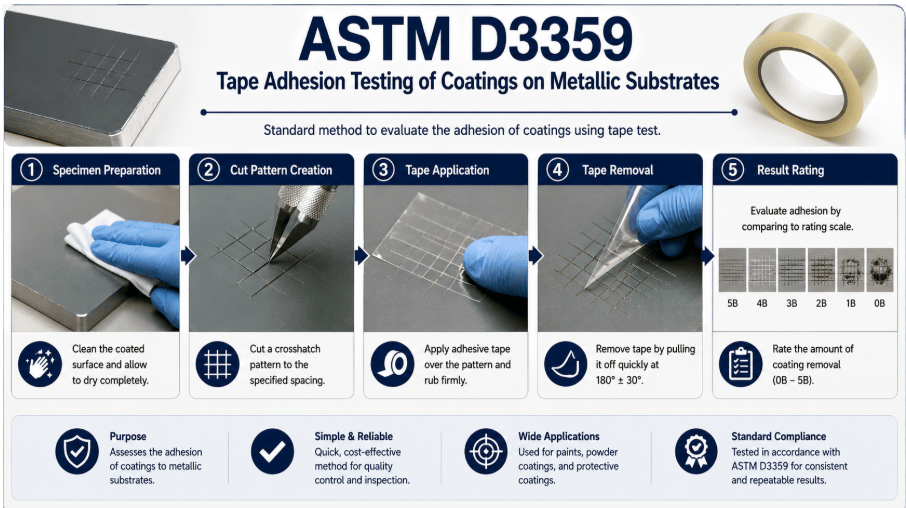
    Cut Pattern Creation For Test Method A, technicians make an X-cut through the film to the substrate. For Test Method B, technicians make a lattice pattern with six or eleven cuts in each direction.
    Tape Application Technicians apply pressure-sensitive tape over the cuts and smooth it into place. 
    Tape Removal Technicians remove the tape by pulling it back at an angle, removing loose coating material.
    Result Rating Technicians rate adhesion on a 0 to 5 scale based on the amount of coating removed, using the rating guide.

    ASTM D3359Testing Process and Data Collection

    To prepare the coated specimen, technicians ensure the coating is fully cured, and the surface is clean. The coating thickness determines whether to use Test Method A or B. The technician cuts an X through the film to the substrate for Test Method A. In Test Method B, the technician cuts in six or eleven rows, or in six or eleven columns. The technician presses the pressure-sensitive tape onto the cuts, then pulls it back at an angle. The lab then rates the adhesion on a 0-5 scale, depending on how much coating is removed. Technicians note the adhesion rating, the test method employed, the specimen identification, and the test conditions.  

    The image shows coating adhesion testing by tape test, including specimen preparation, cut pattern creation, tape application, tape removal, and result rating.
    ASTM D3359 Tape Adhesion Testing of Coatings on Metallic Substrates 

    Common Challenges and Troubleshooting

    Inaccurate ASTM D3359 test results can result from technicians using improper cut patterns, inadequate tape application, or incorrect tape removal. It is important that technicians recognize limitations of all adhesion methods and the limitations of this test method to lower levels of adhesion prior to use. In a multi-coat system, failure is observed between coats; in such cases, technicians do not determine the adhesion of the coating system to the substrate. Results can vary with coating as a function of differences in adherability of the coating surface and the inherent adhesion of the coating. Technicians always prepare specimens to the standard and make sure that technicians apply cut depth and tape appropriately. 

    ASTM D3359 Analysis Results and Interpretation

    The report provides a summary of the tape adhesion test results that technicians performed on the coating films on the metallic substrates.

    Read more

    • The laboratory reports the adhesion rating on a scale of 0 – 5 according to the extent of coating that technicians remove after tape pull-off in the laboratory.
    • Technicians make analysis based on the test method used (Test Method A or B) and the coating thickness.
    • Technicians document the pattern of cutting, taping, and on/off conditions in the report.
    • The report compares the test results with the applicable product specification or customer requirement and records whether the product complies.
    • Technicians compare adhesion ratings to applicable specifications to determine the suitability of the coating for the application.

    The test is not able to detect higher degrees of adhesion; for such levels, more advanced techniques are necessary. In multi-coat systems, the failure of adhesion can be between coats, so technicians do not determine the adhesion of the coating system to the substrate. 

    How are results reported for ASTM D3359? 

    The test reports adhesion ratings as a number from 0 to 5, depending on the amount of coating that the tape has removed after technicians have pulled it off. 

    Link to ASTM D3359

    FAQ

    What is ASTM D3359?
    ASTM D3359 is a standard test method that includes the procedures used to determine the adhesion of coating films to metallic substrates by applying and removing pressure-sensitive tape over cuts in the coating film.

    Updated on September 22, 2026

    Davis Scott
    About Author
    Davis Scott is an Electrical and Electronics Engineer specializing in multidisciplinary validation, quality assurance, and comprehensive electro-mechanical testing.
    Know More
    Testimonials
    Real results
    Engineers trust us with what matters most
    Start Your Testing
    Project Today
    Define your requirements and get access to
    specialized laboratories ready to deliver results
    Partners with us
    Clients
    Vendors
    Process for testing
    • STEP 01

      You share your testing requirements

    • STEP 02

      You share your sample(s)

    • STEP 03

      We deliver your test reports

    Get your testing done

    Let us know your testing requirements and we will be right back with a solution.

      Let us root for each other. Collaborate to grow, expand, and accelerate our businesses.

      Partner with us

        Discover more from Matestlab

        Subscribe now to keep reading and get access to the full archive.

        Continue reading