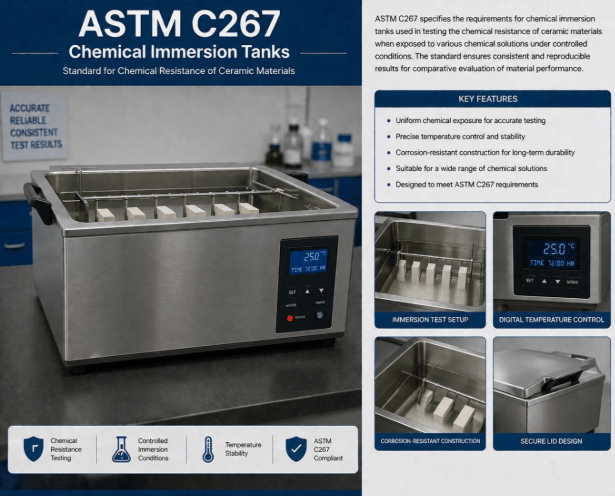
ASTM C267 is a set of standard test methods for evaluating the chemical resistance of mortars, grouts, monolithic surfacings, and polymer concretes. It offers uniform laboratory methods for immersing cured specimens in chemicals and assessing changes in their physical appearance and mechanical properties. The standard has multiple test procedures that determine changes in specimen weight, specimen appearance, test-medium appearance, and compressive strength following exposure to the test medium. Laboratories utilize ASTM C267 to compare material formulations, ensure product quality, and identify construction materials for use in aggressive chemical environments. ASTM C267 contains three test methods that are generally selected based on the aggregate size of the system being tested. Systems with aggregates less than 0.0625 in. (1.6 mm) generally use Test Method A. Test Method B is generally used for systems containing aggregate from 0.0625 to 0.4 in. (1.6 to approximately 10 mm) in size. Test Method C is used for systems containing aggregate larger than 0.4 in. in size.
Get Certified ASTM C267 Chemical Resistance Testing
Chemical-resistant construction materials should exhibit the same performance characteristics in the presence of chemical media that are representative of the service environment. ASTM C267 provides standardized test methods that can be used to help assess chemical resistance and to aid in material selection and development based on expected service conditions.