
ASTM D3410/D3410M Standard Test Method for Compressive Properties of Polymer Matrix Composite Materials with Unsupported Gage Section by Shear Loading

    What is ASTM D3410? 

    ASTM D3410/D3410M is a standard test method for determining the in-plane compressive properties of polymer matrix composite materials reinforced with high-modulus fibers. The technique squeezes the specimen in shear at the interface of the wedge grips instead of loading it directly at the ends. It applies to continuous- and discontinuous-fiber composites with specially orthotropic elastic properties in the test direction. ASTM D3410/D3410M (Standard Test Method for Compressive Properties of Polymer Matrix Composite Materials with Unsupported Gage Section by Shear Loading) method applies to composites made from unidirectional tape, wet-tow placement, cloth, short fiber, and other types. Laboratories can get ultimate compressive strength, ultimate compressive strain, compressive modulus of elasticity, Poisson’s ratio in compression, and transition strain.

    Read more

    Get Certified ASTM D3410 Testing for Reliable Composite Performance 

    Polymer matrix composites should maintain strength and structural integrity under compression loading without failure, excessive deformation, or performance loss. ASTM D3410 offers a controlled way to produce compressive-property data for material specifications, research and development, quality assurance, and structural design and analysis. Lab results may be used for comparing composite materials, assessing manufacturing quality, material qualification, and determining the impact of layup, reinforcement content, void content, conditioning, alignment, and testing environment on compressive response. 
    What is the scope of the ASTM D3410 test standard? 

    ASTM D3410 is a standard method for measuring in-plane compressive properties of polymer matrix composites using high-modulus fibers. The method is based on shear loading via wedge grips and applies to several forms of continuous- and discontinuous-fiber products. This standard-

    Read more

    • Tests in-plane compressive properties and evaluates continuous- and discontinuous-fiber composites.
    • Covers unidirectional tape and wet-tow materials, textile- and fabric-reinforced composites, and short-fiber composite materials.
    • Uses shear loading through wedge-grip interfaces and determines ultimate compressive strength and strain.
    • Determines compressive modulus of elasticity and Poisson’s ratio in compression.

    What are the uses of ASTM D3410 testing? 

    ASTM D3410 testing can be used to characterize the compressive properties of polymer matrix composite materials. Engineers and manufacturers use the resulting data to assess materials for structural applications and compare various composite constructions. This standard-

    • Determines ultimate compressive strength and measures ultimate compressive strain.
    • Determines compressive modulus of elasticity and measures Poisson’s ratio in compression.
    • Supports composite material qualification and research and development.
    • Helps manufacturers perform quality assurance and provide data for structural design and analysis.

    Which materials can be tested under ASTM D3410? 

    ASTM D3410 covers polymer matrix composites with high-modulus fibers. Laboratories can test continuous- or discontinuous-fiber materials made from unidirectional tape, wet-tow placement, textile or fabric reinforcement, short fibers, and similar product forms. Some product forms may require deviations from the standard procedure.

    Why is ASTM D3410 Important? 

    ASTM D3410 provides a controlled procedure for determining compressive properties when the specimen has an unsupported gage section, and the compressive loading is applied through shear at wedge grips. This loading will facilitate the characterization of composite material without the need for traditional end loading in a laboratory. 

    ASTM D3410 Equipment and Sample Preparation Guide

    The laboratory should make a representative composite specimen with the selected material form and test configuration. Technicians should monitor the specimen preparation, conditioning, alignment, and gripping, as these can affect the compressive response being measured.

    Read more

    Sample and Specimen DetailsTechnicians prepare specimens from polymer matrix composites reinforced with continuous or discontinuous high-modulus fibers, including unidirectional tape, wet-tow, textile, and short-fiber forms.
    Specimen PreparationTechnicians prepare the composite according to its material form and layup, condition the specimen as required, and ensure accurate alignment before gripping.
    Specimen DimensionsSpecimen geometry and dimensions depend on the applicable ASTM D3410 test configuration and material form. Laboratories should use the dimensions specified by the selected procedure rather than apply one geometry to all composite types.
    InstrumentationUniversal testing machine, ASTM D3410 shear-loading/wedge-grip fixture, specimen alignment and gripping equipment, dimensional measurement equipment, and environmental conditioning equipment.

    Testing Procedures and Requirements for ASTM D3410 

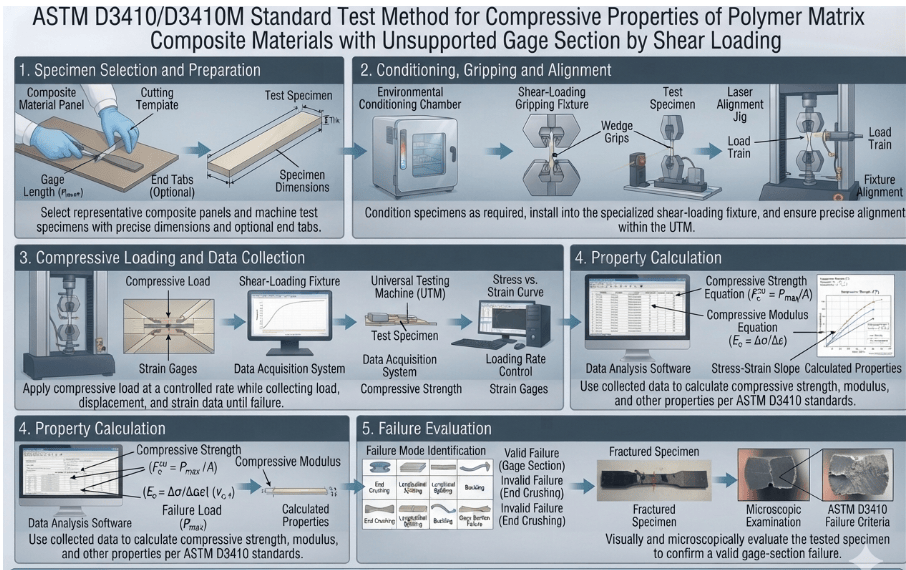
    Before applying compressive loading, ASTM D3410 specifies laboratory control of specimen preparation, conditioning, alignment, gripping, and test speed. The machine applies the compressive force by shear at wedge-grip interfaces. Laboratories then document the specimen response and determine the appropriate compressive properties. Other reference ASTM documents include D695, D792, D883, D2584, D2734, D3171, D3878, D5229, D5379, D5467, D6641, E4, E6, E11, and E111. The procedure for ASTM D3410 is given as:

    Read more

    Specimen Selection and Preparation Technicians select representative composite specimens appropriate for the material form and test direction. They then prepare the specimens according to the selected configuration and control the layup and stacking sequence.
    Conditioning, Gripping and AlignmentAnalysts condition them to the required environmental conditions, position the specimen accurately in the wedge grips, and maintain proper alignment.
    Compressive Loading and Data CollectionTechnicians apply compressive force through shear at the wedge-grip interfaces and record load and specimen deformation throughout the test.
    Property CalculationAnalysts determine compressive strength, strain, modulus, Poisson’s ratio, and transition strain as applicable.
    Failure EvaluationThey record the observed failure behavior and relevant test conditions.

    ASTM D3410 Testing Process and Data Collection

    Technicians first identify the composite material, reinforcement form, layup, and test direction. Next, they prepare representative specimens and condition control specimens before placing them in the shear-loading grips. The operator positions and secures each specimen exactly and applies the prescribed compressive force by using the interfaces of the wedge. The testing machine records load and deformation data throughout the test. These measurements are used to calculate the ultimate compressive strength, ultimate compressive strain, compressive modulus, Poisson’s ratio, and transition strain in the laboratory. It should also mention factors that may affect the compressive response, such as specimen preparation, conditioning, alignment, gripping, test speed, temperature exposure, void content, and reinforcement volume.

     This image depicts a universal testing machine used to determine compression properties per ASTM D3410.
    ASTM D3410 Testing Using Universal Testing Machine

    Common Challenges and Troubleshooting 

    Several factors can affect ASTM D3410 results. Laboratories should carefully control specimen preparation and mechanical test conditions. Common challenges include incorrect specimen alignment, improper wedge-grip installation, inconsistent specimen preparation, incorrect layup, improper conditioning, misalignment during loading, excessive void content, and incorrect test speed. Technicians should check the dimensions, alignment, gripping, conditioning, and operation of equipment before testing.

    ASTM D3410 Analysis Results and Interpretation 

    • ASTM D3410 results are reported based on the composite material, test direction, specimen configuration, and test conditions. 
    • The method measures ultimate compressive strength, ultimate compressive strain, compressive modulus of elasticity, Poisson’s ratio in compression, and transition strain.
    • Analysts report compressive strength in MPa, compressive strain in %, and compressive modulus in GPa or MPa.
    • Engineers also document specimen preparation, conditioning, alignment and gripping, test speed, temperature, void content, and reinforcement volume, which can affect the compressive response.

    Link to ASTM D3410

    Read more

    FAQ

    What is ASTM D3410?
    ASTM D3410/D3410M measures the in-plane compressive properties of polymer matrix composites with high-modulus fibers under shear loading in wedge grips.
    The method can determine the following properties: ultimate compressive strength, ultimate compressive strain, compressive modulus of elasticity, Poisson’s ratio in compression, and transition strain.
    The method transfers compressive force through shear at wedge-grip interfaces rather than conventional end loading.
    Gokula Srinivasan Selvam
    About Author
    Gokula Srinivasan Selvam
    Gokula Srinivasan Selvam is a Material Testing Associate at MaTestLab Inc. and holds a postgraduate degree in Ceramic Engineering from IIT (BHU), Varanasi.
    Testimonials
    Real results
    Engineers trust us with what matters most
    Start Your Testing
    Project Today
    Define your requirements and get access to
    specialized laboratories ready to deliver results
    Partners with us
    Clients
    Vendors
    Process for testing
    • STEP 01

      You share your testing requirements

    • STEP 02

      You share your sample(s)

    • STEP 03

      We deliver your test reports

    Get your testing done

    Let us known your testing requirements and we will be right back with a solution.

      Let us root for each other. Collaborate to grow, expand, and accelerate our businesses.

      Partner with us

        Contact Us

        Discover more from MaTestLab

        Subscribe now to keep reading and get access to the full archive.

        Continue reading