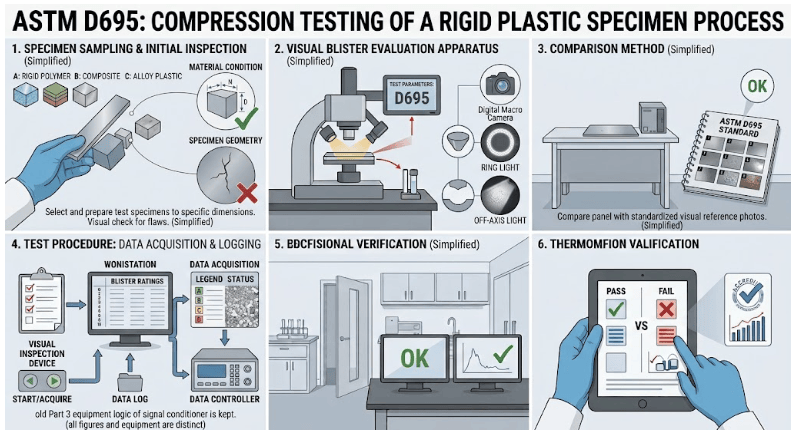
ASTM D695 is used to determine the stress-strain response of rigid plastics to compression loading. The obtained data allows engineers to evaluate material stiffness, strength, and deformation characteristics. The scope includes:
- Material Type: Rigid plastics and suitable rigid plastic compounds.
- Loading: Applies compressive force along the specimen’s longitudinal axis.
- Properties Measured: Compressive stress, strain, modulus, yield behavior, and other applicable compressive characteristics.
- Specimen Geometry: Uses standardized specimen configurations appropriate for compression testing.
- Test Conditions: Testing is performed under controlled loading and environmental conditions.
- Deformation Measurement: Records specimen deformation as compressive force increases.
- Result: Provides quantitative compressive-property data for material evaluation and comparison.
- Applications: Supports material selection, product development, quality control, and engineering design.
What are the uses of ASTM D695 testing?
ASTM D695 describes the procedure for determining the compression response of rigid plastics. The data obtained from this test includes an engineering stress/strain curve, which enables engineers to understand stiffness, strength, and deformation of plastics under compression. Common applications include:
- Material characterization of the compressive response of plastics.
- Product development comparing plastic formulations for injection molding or other manufacturing processes.
- Quality control of various production runs.
- Material selection for precast concrete elements or other cases where components are to be subjected to compression.
- Design evaluation to obtain necessary data for engineering purposes.
- Comparison between different plastic types, compounds, or injection molding processing parameters.
- R&D to examine the effect of different additives on plastics.
Which Materials Can Be Tested According to ASTM D695?
ASTM D695 is applicable to rigid plastics that can be prepared into compression test specimens. The material can be unfilled or reinforced depending upon the application and the production of test specimens that meet the requirements of the standard. So the testing can be performed for a wide variety of thermoplastic and thermosetting plastics. Materials may include:
- Rigid Thermoplastics: Such as rigid engineering and structural thermoplastics.
- Thermosetting Plastics: Rigid plastics formed from thermosetting resin systems.
- Filled Plastics: Materials containing mineral, particulate, or other fillers.
- Reinforced Plastics: Rigid plastics reinforced with suitable fibers or other reinforcement.
- Molded Plastics: Compression or injection-molded rigid plastic materials.
- Cast Plastics: Rigid cast polymer materials that can be prepared into suitable specimens.
- Plastic Compounds: Formulations developed for structural or engineering applications.
Why is ASTM D695 important?
ASTM D695 is significant as most rigid plastic parts are subject to compressive loading in service. Compressive qualities allow engineers to assess whether the test material would be suitable and not deform excessively under applied loads until failure or rupture. Standardized testing allows technicians and analysts to make valid comparisons between multiple materials. The resulting data can support material selection, product design, quality control, and performance evaluation.