ASTM E111 Young’s Modulus, Tangent Modulus, and Chord Modulus

    What is ASTM E111? 

    ASTM E111 is a standard test method for determining Young’s modulus, tangent modulus, and chord modulus of elasticity of materials. It evaluates a material’s ability to withstand deformation under applied loads and helps determine its stiffness, quality, durability, and reliability. Young’s modulus represents the ratio of stress to strain, while tangent modulus and chord modulus are used to measure material stiffness. ASTM E111  (Standard Test Method for Young’s Modulus, Tangent Modulus, and Chord Modulus) also helps evaluate changes and responses of materials to applied loads, allowing their long-term behavior under simulated conditions to be predicted. The test is useful for reliability checks, performance evaluation, specification purposes, laboratory testing, and various industrial applications. 

    Read more

    Get Certified ASTM E111 Testing for Reliable Materials Testing Performance 

    Accredited laboratories perform ASTM E111 tensile testing to determine Young’s modulus, tangent modulus, and chord modulus of structural materials and provide in-depth analytical reports. Certified testing verifies the mechanical performance of materials in structural and engineering applications. Testing enables manufacturers to confirm material stiffness properties, verify compliance with their design specifications, and ensure consistent product quality. Manufacturers should select an ISO/IEC 17025-accredited testing partner to confirm that their materials are suitable for structural use. To determine the modulus in the laboratory, technicians attach extensometers to universal testing machines. The machines use electromechanical or hydraulic systems, and software collects and analyzes the test data.

    What is the Scope of ASTM E111? 

    ASTM E111 specifies the methods for determining Young’s modulus, tangent modulus, and chord modulus of structural materials through uniaxial testing. The standard provides methods for determining the elastic modulus from stress-strain data for specimens tested under tensile or compressive loading. Each modulus type corresponds to the material’s stress-strain characteristics and the relevant design requirements. The scope of ASTM E111 includes-

    Read more

    • Material type: Structural materials including metals, ceramics, polymers, and composites where creep is negligible compared to immediate elastic strain.
    • Purpose: Determination of elastic modulus properties for design calculations, material characterization, and quality control.
    • Properties evaluated: Young’s modulus (for materials following Hooke’s law), tangent modulus (for nonlinear elastic materials), and chord modulus (for strain estimation over specified stress ranges).
    • Testing Method: Uniaxial tension or compression testing using universal testing machines with extensometers or deflectometers for strain measurement.
    • Result: Modulus values expressed in SI units along with stress-strain data and test conditions.
    • Test limitations: The method does not determine initial tangent modulus or secant modulus due to experimental problems establishing the origin of the stress-strain curve. Testing is limited to conditions where creep is negligible.
    • Use conditions: Precise determination of Young’s modulus requires due regard for numerous variables that can affect such determinations. These include specimen characteristics such as orientation of grains relative to the direction of stress, grain size, residual stress, previous strain history, dimensions, and eccentricity; testing conditions such as alignment, speed of testing, temperature, and equipment condition; and interpretation of data .
    • Applications: Material verification, design compliance, quality control, research, and stiffness characterization of structural materials.

    What are the Uses of ASTM E111Testing?

    ASTM E111 provides a test method that helps laboratories determine the elastic modulus of structural materials. Manufacturers, design engineers, and quality control teams use the results for material characterization, design validation, and quality assurance. This standard-

    • Calculates Young’s modulus for materials that obey Hooke’s law under uniaxial loading.
    • Determines the tangent modulus for materials with nonlinear elastic stress-strain characteristics.
    • Estimates strain changes over a range of stresses using the chord modulus.
    • Assists engineers with material characterization for structural design and engineering applications.
    • Helps quality control teams verify material stiffness parameters against specifications.
    • Analyzes metal, ceramic, polymer, and composite materials.
    • Evaluates tensile and compressive modulus properties when these properties differ.

    What Materials Can Be Tested Under AASTM E111? 

    ASTM E111 applies to structural materials that analysts prepare for mechanical testing. The method applies to materials at temperatures and stresses where creep is negligible compared to the strain produced immediately upon loading and to elastic behavior. It is used to evaluate rigid cellular plastics such as EPS, XPS, PU, and phenolic foam to assess tensile strength, adhesion properties, and structural integrity for industry standards of mechanical performance and durability.

    Why is ASTM E111 Important? 

    ASTM E111 provides an accepted test method for determining the elastic modulus of structural materials. Engineers use Young’s modulus as a material property when they design structures that experience uniaxial loading and when the materials follow Hooke’s law. Engineers use the tangent modulus or chord modulus to characterize materials that exhibit nonlinear elastic stress-strain behavior, particularly when they need to determine changes in strain over a specific stress range. Several factors can influence the precise determination of Young’s modulus. These factors include specimen characteristics, such as grain orientation, grain size, previous strain history, dimensions, and eccentricity; testing conditions, such as specimen alignment, testing speed, temperature, and equipment condition; and data interpretation.

    ASTM E111 Equipment and Sample Preparation Guide

    ASTM E1050 specifies an impedance tube with two microphone locations and a digital frequency analysis system. Representative samples of acoustical materials are tested in the laboratory to determine normal incidence sound absorption coefficients and normal specific acoustic impedance ratios. 

    Read more

    Sample and Specimen DetailsTechnicians test representative samples of structural materials in the laboratory to determine elastic modulus by mechanical testing 
    Specimen PreparationTechnicians prepare specimens according to the specific requirements of the material being tested. Proper specimen preparation is essential for accurate results 
    Specimen DimensionsASTM E111 focuses on specimen preparation and testing procedures rather than fixed specimen dimensions. The standard emphasizes proper specimen geometry for the material being tested. 
    InstrumentationLaboratories use an electromechanical or hydraulic universal testing machine capable of applying force in both tensile and compressive directions. Additional equipment includes appropriate specimen grips, extensometers or deflectometers for strain measurement, and data acquisition software.

    Testing Procedures and Requirements for ASTM E111

    This test standard uses a universal testing machine to apply controlled tensile or compressive loading to structural material specimens. Technicians set the required testing speed, temperature, and data acquisition parameters, and the apparatus completes the test. The ASTM E111 test method comprises the following test procedure. 

    Read more

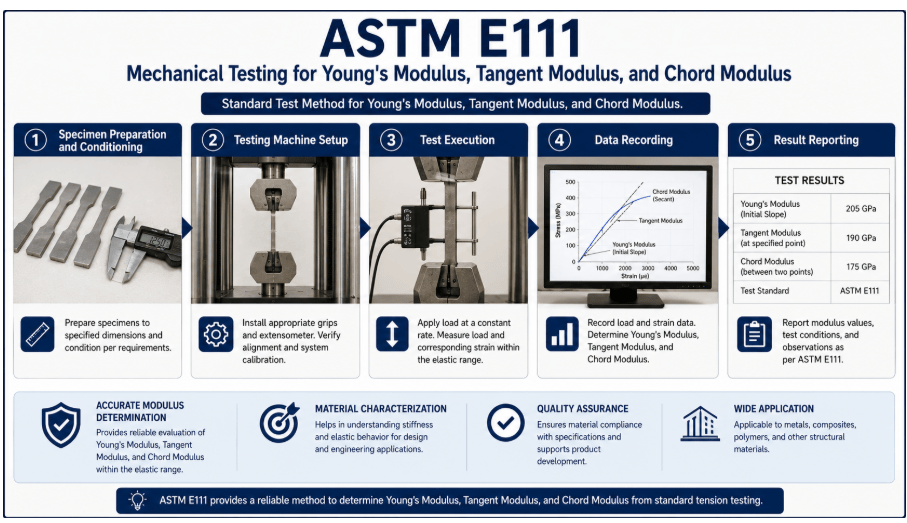
    Specimen Preparation & Conditioning Technicians prepare test samples as described in the standard. They ensure proper specimen geometry and surface finish to accurately determine modulus. 
    Testing Machine Setup Technicians zero the machine, mount the sample into the grips for tension testing, or place the sample on compression platens for compression testing. They clamp the extensometer or deflectometer to measure strain accurately.
    Test Execution Technicians apply the load at a controlled speed that is low enough to avoid thermal effects of adiabatic expansion or contraction and high enough that creep will be negligible.
    Data Recording Technicians record load versus elongation or stress versus strain for tension testing, and load versus displacement for compression testing. 
    Result Reporting Laboratories report Young’s modulus, tangent modulus, or chord modulus values as applicable, along with test conditions and specimen information. 

    ASTM E111Testing Process and Data Collection

    Technicians prepare test specimens according to the standard and set up the universal testing machine. The technician zeroes the machine, installs the sample in the grips, and clamps the extensometer. The technician zeroes the compression machine, places the sample on the compression platens, and mounts the deflectometer. The technician runs the test at a speed low enough to prevent thermal effects but high enough that creep effects are minimal. The technician records load versus elongation or stress versus strain. The lab then analyzes the stress-strain curve to determine the modulus value to be used. Technicians log the moduli, stress-strain results, specimen identification, and test conditions. If strains exceed 0.25%, the technician shall correct for changes in cross-sectional area and gauge length by using the instantaneous cross-section and gauge length instead of the original ones. 

     This infographic shows structural material modulus testing by a universal testing machine, including specimen preparation and conditioning, testing machine setup, test execution, data recording, and result reporting.
    ASTM E111 Mechanical Testing for Young’s Modulus, Tangent Modulus, and Chord Modulus

    Common Challenges and Troubleshooting

    Testing has challenges in specimen alignment and strain capture, which often leads to inaccurate modulus values and unreliable results. To troubleshoot, use precision alignment tools, high-quality extensometers or strain gauges, and regularly calibrate testing equipment.

    ASTM E111 Analysis Results and Interpretation

    This standard also establishes procedures for analyzing and interpreting the results that ASTM E111 generates.

    Read more

    • Engineers use stress-strain analysis results to determine the elastic modulus of the structural material. ASTM E111 provides Young’s modulus, tangent modulus, or chord modulus data that reflects the stiffness characteristics of the material and its elasticity.
    • Young’s modulus is the slope of the stress-strain curve in the region of Hooke’s law for the material. The larger the number, the stiffer and more resistant to elastic deformation.
    • Tangent Modulus is the slope of the stress-strain curve at a particular point of stress or strain. Useful for materials that have a non-linear elastic stress-strain relationship.
    • Chord modulus is the gradient of the secant passing through two points on the stress/strain curve. This value is helpful in determining the change in strain for a given change in stress in that range.
    • The test method will not measure the initial tangent modulus or the secant modulus. These are outside the scope because of the experimental difficulties in determining the source of the stress-strain curve.
    • The analysis also takes into account the stress mode of interest. The value of Young’s modulus in tension will not necessarily be equal to the value in compression, so the analyst shall calculate the value from test data taken under the appropriate state of stress.
    • Laboratories report modulus values in SI units as defined in the standard. The analyst records the testing speed, temperature, and strain range applied.
    • The engineers compare the modulus results with the product specifications or design requirements that are applicable. Engineers use this comparison for evaluating the material’s suitability for the intended use and product quality.

    Link to ASTM E111

    FAQ

    What is ASTM E111?
    ASTM E111 determines Young’s modulus, tangent modulus, and chord modulus of structural materials. The method is limited to materials at temperatures and stresses where creep is negligible compared to immediate elastic strain.
    The test uses an electromechanical or hydraulic universal testing machine capable of applying force in both tensile and compressive directions, along with appropriate specimen grips, extensometers or deflectometers, and data acquisition software. An oven is required for high-temperature testing.
    The determination of the initial tangent modulus and the secant modulus are outside the scope of this test method because of experimental problems associated with the establishment of the origin of the stress-strain curve

    Updated on September 10, 2026

    Malhar Khole
    About Author
    Malhar Khole is a Material Testing Associate at Matestlab Inc. and holds a postgraduate degree in Material Science and Technology from IIT (BHU), Varanasi.
    Know More
    Testimonials
    Real results
    Engineers trust us with what matters most
    Why Choose Matestlab?
    Matestlab is a unified testing services partner based in the USA. Matestlab offers raw material and product testing services through accredited, expert laboratories primarily based in the USA. Matestlab supports physical, thermal, chemical, electrical, mechanical, environmental, and characterization testing needs through its global network of 2200+ accredited testing laboratories. Matestlab's in-house materials science experts curate and design comprehensive testing programs matched to the sample material and specific testing need, with regulatory requirements and confidentiality in mind.

    If you are looking for a managed and trusted testing partner to achieve your research goals, feel free to schedule a meeting with us or send us a request at connect@matestlabs.com to learn more about our services. For a quick quote, call us at (302)244-7710. We are happy to serve you.
    Start Your Testing
    Project Today
    Define your requirements and get access to
    specialized laboratories ready to deliver results
    Partners with us
    Clients
    Vendors
    Process for testing
    • STEP 01

      You share your testing requirements

    • STEP 02

      You share your sample(s)

    • STEP 03

      We deliver your test reports

    Get your testing done

    Let us know your testing requirements and we will be right back with a solution.

      Let us root for each other. Collaborate to grow, expand, and accelerate our businesses.

      Partner with us