

Introduction to Tensile Testing
Tensile testing determines the resistance of materials to tensile or pulling forces. A universal testing machine applies a controlled tensile load or displacement to a sample until the sample is deformed or broken (failure). During testing, the machine measures force and deformation, from which stress and strain are calculated. Tensile testing is an essential technique used for product development, material evaluation, and failure evaluation. Engineers use tensile test results to evaluate materials, verify specifications, and ensure that products perform as intended during service, meet test specifications, and have an adequate life under the conditions for which they may be designed. Industries worldwide use tensile testing as a standard test method for the direct assessment of material performance.
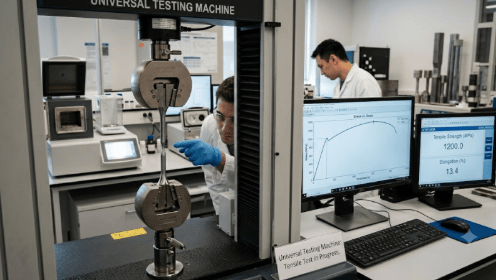
Scope of Tensile Testing
- Tests the mechanical properties of materials in tension.
- Calculates tensile strength, yield strength, modulus, and elongation.
- Assists in material selection and product design.
- Ensures adherence to industry standards & specifications.
- Assists quality control and manufacturing processes.
- Supports the research, development, and failure investigations.
- Tests metals, plastics, composites, rubber, textiles, and other materials.
Principle of Tensile Testing
A tensile test (also known as a tension test) applies uniaxial force to a material specimen to measure its key mechanical properties: tensile strength, yield strength, elastic modulus, and elongation. The tensile test is a method that applies a controlled tensile force to a standard test piece. As the load increases, the material begins to stretch and deform. The testing machine monitors the load and continuous deformations throughout the test, and when the material reaches its yield point, it enters permanent deformation. As loading continues, the material undergoes increasing deformation until fracture occurs. Engineers use sample data to construct a stress-strain curve for proper analysis of the material.

Test Procedure Overview
| Specimen Preparation | Tensile testing specimens for a Universal Testing Machine (UTM) must be carefully prepared so that the material fails in a predictable, controlled area. Most rigid materials require dumbbell- or dogbone-shaped samples. |
| Equipment Setup | Fit appropriate grips and set up testing machine parameters. |
| Specimen Mounting | Secure the specimen in the machine grips and align it properly. |
| Load Application | Apply a controlled rate of tensile loading until failure or to a desired point. |
| Data Collection | Monitor load, displacement, and strain during testing. |
| Result Calculation | Calculate tensile strength, yield strength, modulus, and elongation. |
| Reporting | Document the results and compare them with specifications or requirements. |
Key Properties Measured During Tensile Testing
| Tensile Strength | The maximum stress a material withstands during a tensile test. |
| Yield Strength | Stress at which permanent deformation begins. |
| Elongation | The percentage increase in length of a specimen before fracture. |
| Elastic Modulus | Stiffness and resistance to elastic deformation of a material. |
| Breaking Strength | The stress at the point at which a material fractures. |
| Reduction in Area | Decrease in cross-sectional area following fracture. |
Common Tensile Testing Standards
| Standard | Application |
| ASTM D638 | Tensile properties of plastics |
| ASTM E8/E8M | Tensile testing of metallic materials |
| ASTM D3039 | Tensile properties of composite materials |
| ASTM D412 | Tensile properties of rubber and elastomers |
| ISO 527 | Tensile properties of plastics |
| ISO 6892 | Tensile testing of metallic materials |
Significance of Tensile Testing
Tensile testing provides critical information about material performance and durability. The outcomes help manufacturers confirm the quality of their products, compare materials, and verify compliance with customer and regulatory requirements. The test also enables engineers to detect material restrictions before product introduction. Tensile testing is one of the fundamental methods for generating stress-strain data used in material qualification and engineering design. Accurate tensile statistics can reduce product failure, increase safety, and streamline manufacturing strategy.
Applications of Tensile Testing
- Determines the mechanical properties of metal, plastics, and composite materials.
- Supports material selection for engineering applications. Checks the quality of the products in production.
- Helps in optimizing the product development and design.
- Contributes to failure analysis investigations.
- Evaluates the effects of aging, processing conditions, and environmental exposure on mechanical properties. Supports certification and qualification programs.
- Supports the increasing reliability and durability of manufactured products.
- Helps in the research and development of new materials.


