Introduction to Plastic Material Testing
Plastic materials are widely used in automotive components, packaging, medical devices, electronic devices, construction products, and everyday consumer goods. In labs, people run tests to see how plastics react to mechanical forces, heat, chemicals, moisture, and other environmental exposures, because those properties vary with every use. Material testing gives valuable insights about the strength, rigidity, resilience, and long-term behavior of a plastic. Engineers use these responses to compare different materials and to improve product designs, resolve product failures, and meet product requirements.
Scope of Plastic Material Testing
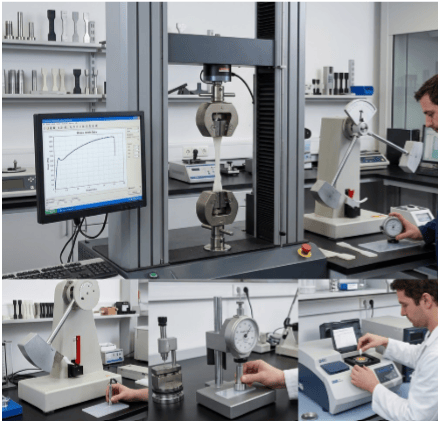
- Tests the mechanical and physical characteristics of plastics.
- Assists in the selection of materials and product development.
- Verifies compliance with industry specifications.
- Enhances product quality and reliability.
- Evaluates resistance to environmental exposure and aging
- Assists in research and failure analysis activities.
- Assists manufacturers in keeping production consistent.
Principle of Plastic Material Testing
Plastic material testing measures specific properties of plastic materials in a controlled laboratory environment. The tests measure a specific property, such as tensile strength, shock resistance, stiffness, density, or thermal properties. Specialized instruments apply forces, temperatures, or environmental conditions and measure the response of materials. Laboratories compare the results with product specifications, industry standards, or historical results. The process determines if the material is appropriate for the intended service and if the material will be produced in a consistent manner.
Top 10 Material Testing Methods for Plastics
| Test Method | What It Measures |
| Differential Scanning Calorimetry (DSC) | Measures the heat flow associated with thermal transitions such as melting, crystallization, and glass transition. |
| Thermogravimetric Analysis (TGA) | Measures changes in sample weight as temperature increases under controlled conditions. |
| Dynamic Mechanical Analysis (DMA) | Measures the mechanical properties of a material under dynamic loading as a function of temperature, time, or frequency. |
| Compression Testing | Measures the behavior of a material when subjected to compressive forces. |
| Tensile Testing (ASTM D638) | Measures tensile strength, tensile modulus, yield strength, and elongation at break of plastic materials. |
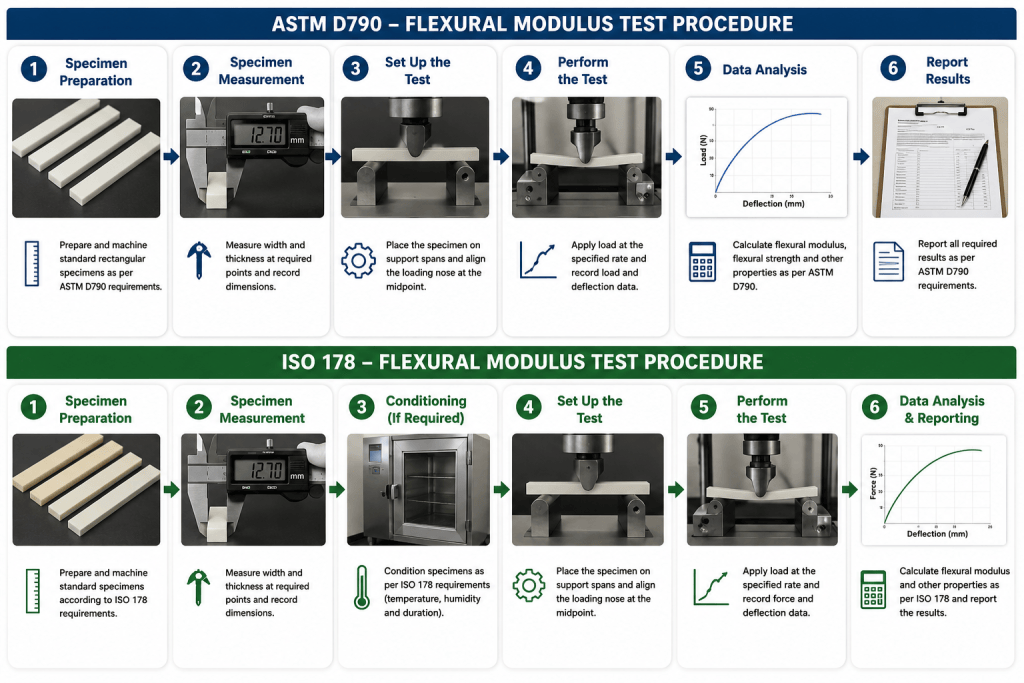
| Flexural Testing (ASTM D790) | Measures the response of a plastic material to bending forces, including flexural strength and flexural modulus. |
| Hardness Testing (ASTM D2240) | Measures a plastic’s resistance to indentation and surface deformation. |
| Heat Deflection Temperature Testing (ASTM D648) | Determines the temperature at which a plastic deforms under a specified load. |
| Vicat Softening Temperature Testing (ASTM D1525) | Measures the temperature at which a plastic begins to soften under a standardized load. |
| Water Absorption Testing (ASTM D570) | Determines the amount of water absorbed by a plastic material during exposure to moisture. |
Significance of Plastic Material Testing
Plastic testing helps ensure certain product safety, durability, and performance. Laboratories use material property data to identify defects, evaluate formulations, verify production quality, and demonstrate regulatory compliance. Testing also minimizes the risk of product failure and aids in the engineering design of materials for applications. Engineers increasingly use standardized testing methods to ensure uniformity from batch to batch and assure customers and regulatory bodies of their products’ reliability.
Applications of Plastic Material Testing
- Assist with the selection and qualification of plastic material.
- Ensures product quality and manufacturing consistency.
- Supports research and development projects.
- Compares the properties of materials in service environments.
- Assists in failure analysis investigations.
- Helps manufacturers comply with industry standards and regulations.
- Gives greater reliability and customer satisfaction in products.
- Works towards continuous improvement and optimization of processes.