

Introduction to Material Testing Laboratories
Material testing laboratories help manufacturers confirm that products perform correctly, meet industry standards, and aid in product development. There are several types of tests performed in laboratories for metals, plastics, composites, ceramics, textiles, coatings, rubber, and other materials. Some are mechanical testing specialists, others are chemical analysis, thermal characterization, environmental testing, or failure analysis. Testing laboratories update themselves to adopt emerging technologies and instrumentation to keep up with recent inventions. Choosing the right testing partner helps organizations reduce risk, enhance product quality, and make informed engineering decisions.
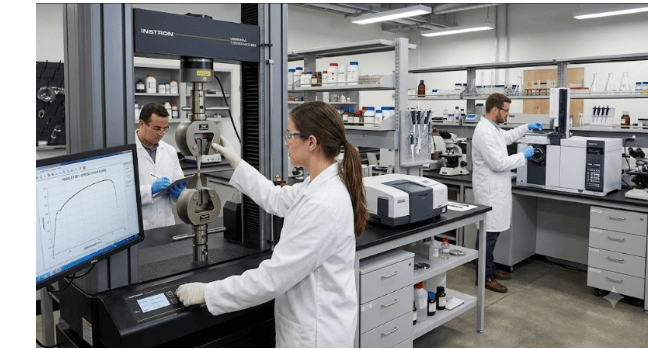
Scope of Material Testing Services
- Verifies material properties and product performance.
- Assists with quality control and the manufacturing process.
- Assists with product development and material selection.
- Ensures adherence to industry standards.
- Supports product and material failure investigations.
- Supports certification and qualification programs.
- Supplies information for research and engineering choices.
Principle of Selecting a Material Testing Lab
Cost is important, but buyers should also evaluate technical capability, accreditation, experience, and service quality. The buyer should assess the laboratory’s technical capabilities, quality systems, experience, and ability to meet project requirements. The risk of incorrect or incomplete testing leads to product failures, selection of the wrong materials, delays in product launches, and increased cost. A dependable laboratory provides data to support product development, manufacturing quality control, certification, and failure investigations. When selecting a material testing lab, there are several key factors to consider.
Key Factors to Consider While Choosing a Material Testing Lab
| Factor | Why it Matters |
| Industry Experience | Provides confidence that the laboratory understands industry-specific requirements, standards, and testing challenges. |
| Equipment Quality | Improves the accuracy, reliability, and repeatability of test results. |
| Technical Expertise | Helps select, execute, and interpret the test. |
| Turnaround Time | Supports project schedules and production deadlines. |
| Reporting Quality | Clearly, accurately, and actionably provides test data. |
| Customer Support | Facilitates communication throughout the testing project. |
Questions to Ask Before Hiring a Material Testing Lab
| Question | Purpose |
| Do you hold relevant laboratory accreditations? | Verifies quality system compliance. |
| Which testing standards do you support? | Confirms testing capability. |
| What industries do you typically serve? | Evaluates industry experience. |
| What is your typical turnaround time? | Helps with project planning. |
| Can you assist with specimen preparation? | Determines available support services. |
| Do you provide an engineering interpretation of results? | Evaluates technical expertise. |
| Can you perform failure analysis investigations? | Assesses advanced capabilities. |
| How do you ensure equipment calibration? | Verifies testing accuracy. |
| What information is included in your reports? | Confirms reporting quality. |
| Can you handle urgent or expedited projects? | Determines schedule flexibility. |
Common Material Testing Services
| Testing Category | Examples |
| Mechanical Testing | Tensile, compression, flexural, impact, and hardness. |
| Thermal Analysis | DSC, TGA, DMA, TMA |
| Chemical Analysis | FTIR, GC-MS, ICP, elemental analysis |
| Environmental Testing | Corrosion, Humidity, UV Exposure, Weathering |
| Failure Analysis | Fractography, root cause investigations, contamination analysis |
| Physical Testing | Examples include density measurement, moisture content determination, and dimensional analysis. |
| Non-Destructive Testing (NDT) | Ultrasonic, radiography, and magnetic particle testing |
Significance of Choosing the Right Testing Lab
Poor-quality laboratory testing can negatively affect engineering decisions, product performance evaluations, and regulatory compliance efforts. The possibility of confusing or incomplete tests can lead to product disasters, incorrect material selection, delayed product launches, and high costs. Reliable laboratory data support product development, quality control, certification activities, and failure investigations. Choosing the right laboratory helps organizations to gain efficiency, minimize risk, and boost their confidence in their products.
Applications of Material Testing Laboratories
- Checks the quality of raw materials before production.
- Assists in product design and material selection processes.
- Ensures adherence to ASTM, ISO, and other applicable industry standards.
- Supplies help with qualification programs for suppliers.
- Assists with certification and regulatory processes.
- Carries out product failure and customer complaint investigations.
- Tests the performance of materials in research and development.
- Confirms that the manufacturing process is consistent.
- Supports the quality assurance and continuous improvement programs.
- Helps manufacturers minimize product failure risk.


