

Introduction
Engineering standards are agreements and documents that outline materials, processes, test methods, design requirements, and acceptance criteria. Engineers, manufacturers, and customers use engineering standards to validate technical requirements. Mechanical engineers use standardized test methods to evaluate material performance under varying operating conditions. Global engineers are responsible for product reliability, good management, and commodity compatibility, which is in accordance with ASTM, ISO, and ASME standards.
Scope of Mechanical Engineering Testing Standards
- Ensure quality assurance and regulatory compliance.
- Normalize the test methods within the mechanical industries.
- Provide an accurate comparison of material performance to aid engineers.
Mechanical Engineering Testing Standards
Mechanical engineering testing standards include tests of stress, strain, hardness, fatigue, deformation, and fracture behavior. These standards are intended to guide laboratories conducting testing in a repeatable, controlled manner to ensure reliable, consistent results.
Testing Procedure Overview
Most engineering testing standards follow these steps:
- Follow the standard to prepare the sample.
- Test the equipment and record the results testing.
- Apply loads, temperatures, or environmental conditions during testing.
- Collect information on the response of materials
- Analyze and report the test results
Major ASTM Standards
Mechanical testing
- ASTM E8/E8M – Tensile tests for metals
- ASTM E18 – Rockwell Hardness Test
- ASTM E10 – Brinell hardness testing of metallic material
- ASTM E23 – Charpy impact test
Thermal and physical testing
- ASTM E1461 – Thermal and Physical Testing
- ASTM C177 – Steady-heat flux measurement
Nondestructive testing
- ASTM E1444 – Magnetic Particle Testing
- ASTM E213 – Sound Transmission Test
Major ISO Standards
Mechanical and Hardness Tests
- ISO 6892 – Tension Tests for Metals
- ISO 6508 – Rockwell Hardness Tests
- ISO 6506 – Brinell Hardness Tests
Surface and Coatings Tests
- ISO 2409 – Cross-Cut Adhesion Test
- ISO 2813 – Gloss Tests
Non-Destructive Tests
- ISO 9712 – Sound Testing
Major ASME Standards
Pressure and Piping Systems
- ASME Boiler and Pressure Vessel Code (BPVC)
- ASME B31: Piping Codes
Engineering Design and Performance
- ASME PTC: Series – Performance Test Codes
- ASME Y14.5: Geometric Dimensioning and Tolerancing
Visual Overview of Mechanical Testing
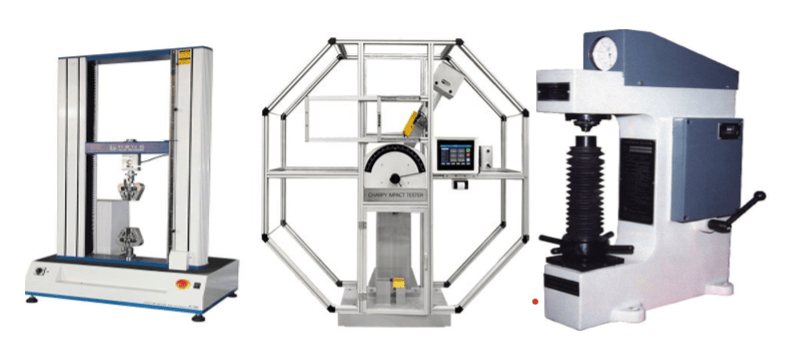
Significance
Test standards help engineers ensure the quality, reliability, and protection of products. These decrease the rate of laboratory errors in testing, increase the uniformity of testing, and enable international certification and trade needs.
Applications
Engineers use mechanical engineering testing standards in:
- The aerospace and automotive sectors.
- Construction and infrastructure
- Manufacturing, metal processing
- Solutions for energy and power generation.
- Energy and power generation solutions.
- Materials research laboratories


