
ASTM D4883 Standard Test Method for Density of Polyethylene by the Ultrasound Technique

    What is ASTM D4883? 

    ASTM D4883 is a standard test method for determining polyethylene density using ultrasound equipment. The technique is based on the propagation of ultrasonic waves in the amorphous and crystalline phases of polyethylene. The relative amounts of these phases affect the measured density and reflect the material’s degree of crystallinity. ASTM D4883 (Standard Test Method for Density of Polyethylene by the Ultrasound Technique) primarily determines the base-resin density because inorganic materials that can increase density in other methods have little or no effect on ultrasonic density. Engineers use this method to monitor physical changes, evaluate sample uniformity, identify polyethylene materials, and support quality control programs.

    Read more

    Get Certified ASTM D4883 Testing for Reliable Polyethylene Density Evaluation 

    Polyethylene density can reveal structural changes, sample uniformity, and resin properties. ASTM D4883 offers a standardized ultrasonic method for measuring this property. Laboratories can use the results for polyethylene identification, quality control, material comparison, and process monitoring. 

    What is the scope of ASTM D4883? 

    ASTM D4883 applies to measuring polyethylene density using ultrasound equipment. The method is based on the correlation of the ultrasonic propagation with the amorphous and crystalline components of polyethylene and thus offers a measure that is related to the base-resin density. This standard-

    • Determines the density of polyethylene using ultrasound. 
    • Compares the density of crystalline and amorphous polyethylene.
    • Provides a measurement that is essentially representative of base-resin density.
    • Supports material identification and uniformity evaluation. 
    • Provides a stated precision of ±0.08% or better.

    What are the uses of ASTM D4883 testing? 

    ASTM D4883 testing helps laboratories determine polyethylene density and evaluate changes in the material’s physical structure. This standard-

    • Determine polyethylene base-resin density and check material uniformity in polyethylene materials.
    • Monitor physical changes in polyethylene and compare polyethylene resin samples.
    • Support quality-control programs and evaluate the influence of crystallinity on density.

    Which Materials Can Be Tested Under ASTM D4883? 

    ASTM D4883 covers polyethylene materials suitable for preparation as test specimens in the laboratory. The method is specific to polyethylene material, and the density is measured using ultrasonic measurement.

    Why is ASTM D4883 Important? 

    ASTM D4883 is a standard method for the measurement of polyethylene density using an ultrasonic approach. Density is useful for polyethylene structure, uniformity, and identification. The method can also distinguish the ultrasonic response of amorphous and crystalline regions, and it is suitable for the evaluation of base-resin density. ASTM reports that the method can achieve a precision of ±0.08% or better.

    ASTM D4883 Equipment and Sample Preparation Guide 

    ASTM D4883 calls for an ultrasound-based density measurement system and the correct formulation of polyethylene specimens. Laboratories prepare molded plaques or cut specimens and condition them before testing. The standard includes specimen size and the use of water-bath and calibration controls.

    Read more

    Sample and Specimen DetailsTechnicians take polyethylene test specimens prepared as molded plaques or cut pieces of polyethylene.
    Specimen PreparationTechnicians mold plaques according to the specified molding procedure or cut specimens from molded plaques, avoiding density changes caused by compressive stress.
    Specimen DimensionsTechnicians prepare specimen dimensions having a length of 80–100 mm, a width of 35–45 mm, and a thickness of 1.5–3 mm.
    InstrumentationUltrasound density measurement equipment, ultrasonic transducers, water bath containing demineralized water, calibration materials, specimen-conditioning equipment, and temperature-control equipment.

    Testing Procedures and Requirements for ASTM D4883

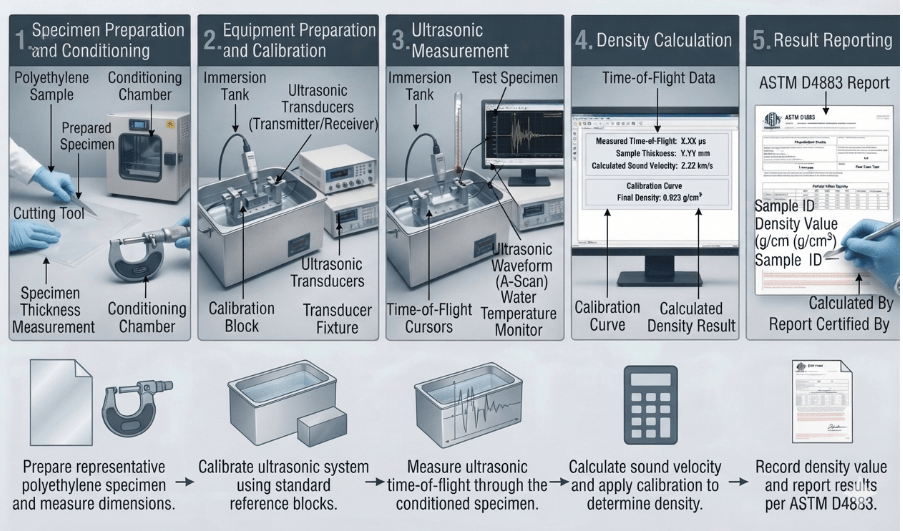
    According to ASTM D4883, laboratories are required to prepare and condition a polyethylene specimen before ultrasonic density measurement. The operator loads the specimen into the measurement system and calculates the density from its ultrasonic response. Other reference ASTM documents include D618, D792, D883, D1248, D1505, D3350, D4703, D4976, E494, E691, and E2935. The testing procedure of ASTM D4883 is given as:

    Read more

    Specimen Preparation and Conditioning Technicians prepare the polyethylene plaque or specimen to the specified dimensions and condition specimens based on the applicable ASTM conditioning procedures.
    Equipment Preparation and Calibration They prepare the ultrasonic equipment, maintain clean demineralized water in the water bath, and calibrate the equipment using suitable polyethylene calibration specimens.
    Ultrasonic and Density MeasurementAnalysts measure the ultrasonic response of the polyethylene specimen and polyethylene density from the ultrasonic measurement.
    Result ReportingEngineers record the density, specimen information, and applicable test conditions.

    ASTM D4883 Testing Process and Data Collection 

    Technicians first prepare representative polyethylene samples and subject them to the appropriate conditions. Technicians then check the ultrasonic equipment, maintain the demineralized-water bath, and calibrate it using appropriate reference materials. The operator then measures the polyethylene specimen’s ultrasonic response and calculates the specimen’s density. Laboratories document the measured density and sample size, conditioning data, equipment description, and test observations.

    This image shows ultrasonic transducers used for density measurement as per ASTM D4883.
    ASTM D4883 Testing Procedure Using Ultrasonic Transducers

    Common Challenges and Troubleshooting 

    The following conditions are necessary for accurate results with ultrasonic density: correct preparation of the specimen; correct calibration of equipment; clean water; and control of test conditions. Typical problems are poor specimen dimensions, densification during cutting, poor specimen conditioning, improperly maintained water, equipment calibration, and improper ultrasonic measurement and temperature fluctuations during testing. The specimens should be carefully prepared, the water bath should be maintained, the operation of the equipment should be done according to the manufacturer’s instructions, and the calibration of the equipment should be checked before testing.

    ASTM D4883 Analysis Results and Interpretation

    • The laboratory reports polyethylene density in g/cm³.
    • Analysts evaluate the measured density as an indicator of the material’s amorphous and crystalline structure and its base-resin density.
    • Analysts record the measured density together with specimen identification and relevant testing conditions.
    • Engineers compare density results among specimens, production batches, or applicable reference values to evaluate material consistency.

    Link to ASTM D4883

    Read more

    FAQ

    What property does ASTM D4883 measure?
    The method measures polyethylene density, primarily representing the base-resin density.
    The length range is 80-100 mm, with a width range of 35-45 mm and a thickness range of 1.5-3 mm. Lab reports the density of polyethylene in what units?
    Malhar Khole
    About Author
    Malhar Khole
    Malhar Khole is a Material Testing Associate at MaTestLab Inc. and holds a postgraduate degree in Material Science and Technology from IIT (BHU), Varanasi.
    Testimonials
    Real results
    Engineers trust us with what matters most
    Start Your Testing
    Project Today
    Define your requirements and get access to
    specialized laboratories ready to deliver results
    Partners with us
    Clients
    Vendors
    Process for testing
    • STEP 01

      You share your testing requirements

    • STEP 02

      You share your sample(s)

    • STEP 03

      We deliver your test reports

    Get your testing done

    Let us known your testing requirements and we will be right back with a solution.

      Let us root for each other. Collaborate to grow, expand, and accelerate our businesses.

      Partner with us

        Contact Us

        Discover more from MaTestLab

        Subscribe now to keep reading and get access to the full archive.

        Continue reading