
ASTM D1248 Standard Specification for Polyethylene Plastics Extrusion Materials for Wire and Cable

    What is ASTM D1248?

    ASTM D1248 describes a standard specification for identifying polyethylene plastics extrusion materials for wire and cable applications. These materials are mainly classified by density and flow rate, and further classified by composition, usage, and other important properties. ASTM D1248 covers polyethylene extrusion materials supplied as powder, granules, or pellets and sets requirements for various types, categories, classes, and grades. Material types are assigned by density, categories by flow rate, and classes and grades provide additional identification based on composition, use, and key material characteristics. Technicians test physical, electrical, thermal, and environmental properties applicable to the material to determine whether it conforms to its classification. ASTM D1248 (Standard Specification for Polyethylene Plastics Extrusion Materials for Wire and Cable) provides a uniform means of identifying polyethylene extrusion materials and comparing commercial lots or shipments. The specification helps the seller and buyer determine whether different commercial lots or shipments conform to the stipulated material requirements.

    Read more

    Get Certified ASTM D1248 Testing for Reliable Polyethylene Material Evaluation

    ASTM D1248 testing provides manufacturers, suppliers, and laboratories with an evaluation protocol for polyethylene extrusion materials used in wire and cable. Laboratory testing can help verify material classifications, compare production lots, monitor production consistency, and confirm applicable specification requirements. ASTM D1248 testing supports material qualification, quality assurance, production control, and supplier verification. The data obtained can be used to identify if polyethylene materials meet applicable type, category, class, and grade requirements.
    What is the Scope of ASTM D1248 Test Standard?

    ASTM D1248 provides a system for identifying polyethylene plastics extrusion materials for wire and cable applications. The specification does not provide specific engineering data for designs; it identifies materials by type, category, class, and grade. Applies to polyethylene material delivered as powder, granules, or pellets. This specification-

    Read more

    • Identifies polyethylene extrusion materials for wire and cable applications.
    • Classifies materials primarily according to density and flow rate.
    • Implements type 0, type I, type II, type III, and type IV for identification by density.
    • Identifies flow-rate-based categories 1, 2, 3, 4, and 5.
    • Issues Classes A, B, C, and D based on composition and use.
    • Provides grades from E1 through E10 for additional key characteristics.
    • Covers polyethylene materials supplied in powder, granules, or pellets.
    • Defines the specifications for the relevant physical, electrical, thermal, and environmental characteristics.
    • Rejects recycled plastics that do not meet the specification.

    What are the Uses of ASTM D1248 Testing?

    ASTM D1248 helps specify polyethylene extrusion materials for wire and cable manufacturing and purchasing. The certification process is consistent and can be applied to lots and shipments produced for commercial sale, based on certain characteristics. The results help users verify material consistency and determine whether a polyethylene material falls within an agreed classification.

    • Polyethylene manufacturers can categorize materials used in wire and cable extrusion.
    • Wire and cable manufacturers can test incoming polyethylene materials.
    • Material suppliers can provide standardized classification information.
    • Quality-control laboratories can compare commercial lots and shipments.
    • Research laboratories can test polyethylene formulations and material properties.
    • Purchasing teams can use classification information when establishing material requirements with suppliers.

    What Materials Can Be Tested Under ASTM D1248?

    ASTM D1248 covers polyethylene plastics for extrusion in wire and cable applications. Materials may be in powder, granule, or pellet form and should be consistent in composition and size, as free from contamination as possible, and produced under good manufacturing practice. The specification does not allow recycled plastics.

    Why is ASTM D1248 Important for Polyethylene Material Evaluation?

    ASTM D1248 is a standard for identifying polyethylene materials for wire and cable extrusion. The main classification characteristics are density and flow rate; other properties relevant to specific applications are dealt with by other classes and grades. Standardized classification facilitates communication and comparison between sellers and buyers of commercial lots based on material requirements.

    ASTM D1248 Equipment and Sample Preparation Guide

    Analysts use representative polyethylene material and prepare specimens to meet the requirements of the applicable property tests. Consistent classification results are achieved by using appropriate specimen preparation and controlled testing conditions.

    Read more

    Specimen DetailsPowder, granules or pellets, of polyethylene plastics for use in wire and cable extrusion.
    Specimen PreparationASTM D1248 covers extrusion materials; there is no single specimen geometry, but dimensions are based on the property being measured and the relevant referenced test method.
    Specimen DimensionsThis standard covers extrusion materials, not a single specimen geometry; instead, dimensions are based on the property being measured and the relevant referenced test method.
    InstrumentationEquipment can include density measurement equipment, melt-flow equipment, tensile-testing systems, electrical-property instruments, thermal testing equipment, environmental stress-crack testing equipment, and carbon-content measurement equipment.

    Testing Procedures and Requirements for Polyethylene Extrusion Materials

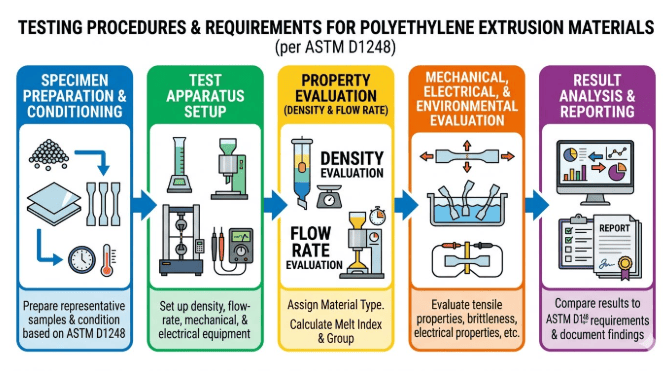
    This standard provides guidelines to identify polyethylene extrusion materials by type, category, class, and grade. Three criteria for reliable evaluation are using representative material, preparing the specimen(s), and testing samples using the procedures that apply to the properties to be determined. The ASTM D1248 test procedure is as follows-

    Read more

    Specimen Preparation and Sample ConditioningTechnicians choose a representative polyethylene extrusion material and prepare samples in accordance with ASTM D1248. Technicians condition prepared specimens based on the needs of specific test methods before evaluating properties.
    Test Apparatus SetupTechnicians set up the necessary density, flow-rate, mechanical, electrical, thermal, and environmental testing equipment.
    Density EvaluationTechnicians assign the polyethylene material to the appropriate material type in the laboratory by measuring its density.
    Flow Rate EvaluationTechnicians calculate the material’s flow rate, known as the “melt index,” to assign it to the appropriate group.
    Physical Property Evaluation and Electrical Property EvaluationAnalysts measure properties such as tensile stress, elongation, brittleness temperature, and environmental stress-crack resistance, as applicable. Technicians test relevant electrical properties, such as dissipation factor, dielectric constant, and volume resistivity.
    Additional Property EvaluationEngineers evaluate properties such as water immersion stability, absorption coefficient, weatherability for colored materials, and carbon content.
    Result AnalysisThe properties measured are compared to the applicable ASTM D1248 type, category, class, and grade requirements.
    Documentation and ReportingLaboratory reports include material identification, specimen information, conditioning information, test results, applicable classification, and ASTM D1248 test information.

    ASTM D1248 Testing Process and Data Collection

    The first step in testing is to obtain a representative sample of polyethylene extrusion material for use in wire and cable. Technicians determine the material shape and ensure specimens meet the properties required by the type, category, class, or grade. Analysts determine density and flow rate as the main classification parameters, and conduct other mechanical, electrical, thermal, and environmental tests as needed. They compare the measured values to the appropriate ASTM D1248 requirements and record the material classification.

     The image shows laboratory equipment evaluating polyethylene extrusion material specimens for wire and cable applications according to ASTM D1248.
    ASTM D1248 Testing of Polyethylene Extrusion Materials for Wire and Cable

    Common Challenges and Troubleshooting

    Non-uniform material composition, contamination, inconsistent specimen preparation, inaccurate density and flow-rate measurements, and lack of control of testing conditions can influence results. Electrical and environmental property measurements may also differ if laboratories do not follow specimen preparation and conditioning requirements. Representative sampling, proper specimen preparation, instrument calibration, and uniform testing conditions can improve classification reliability.

    Analysis Results and Interpretation

    • The test results determine the applicable ASTM D1248 material type and help classify polyethylene based on its density range and flow rate.
    • Engineers use the tensile stress, elongation, and brittleness temperature results to evaluate the mechanical strength, flexibility, and resistance to brittle failure at low temperatures.
    • The test results indicate the polyethylene’s resistance to environmental stress cracking and provide information about its electrical insulation properties through dissipation factor, dielectric constant, and volume resistivity.
    • Engineers use weatherability and water-immersion stability results to assess the effects of environmental exposure on applicable polyethylene properties. Carbon content also helps characterize polyethylene materials containing carbon black.
    • Laboratories compare the measured properties with the requirements of ASTM D1248 to determine the applicable material type, category, class, and grade.
    • Engineers compare results between production lots to monitor polyethylene quality and assess material consistency.

    Link to ASTM D1248

    Read more

    Updated on August 24, 2026

    Gokula Srinivasan Selvam
    About Author
    Gokula Srinivasan Selvam is a Material Testing Associate at Matestlab Inc. and holds a postgraduate degree in Ceramic Engineering from IIT (BHU), Varanasi. His academic background and professional experience are centered on advanced ceramic materials, their processing, characterization, and performance evaluation.
    Know More
    Testimonials
    Real results
    Engineers trust us with what matters most
    Start Your Testing
    Project Today
    Define your requirements and get access to
    specialized laboratories ready to deliver results
    Partners with us
    Clients
    Vendors
    Process for testing
    • STEP 01

      You share your testing requirements

    • STEP 02

      You share your sample(s)

    • STEP 03

      We deliver your test reports

    Get your testing done

    Let us know your testing requirements and we will be right back with a solution.

      Let us root for each other. Collaborate to grow, expand, and accelerate our businesses.

      Partner with us

        Discover more from Matestlab

        Subscribe now to keep reading and get access to the full archive.

        Continue reading