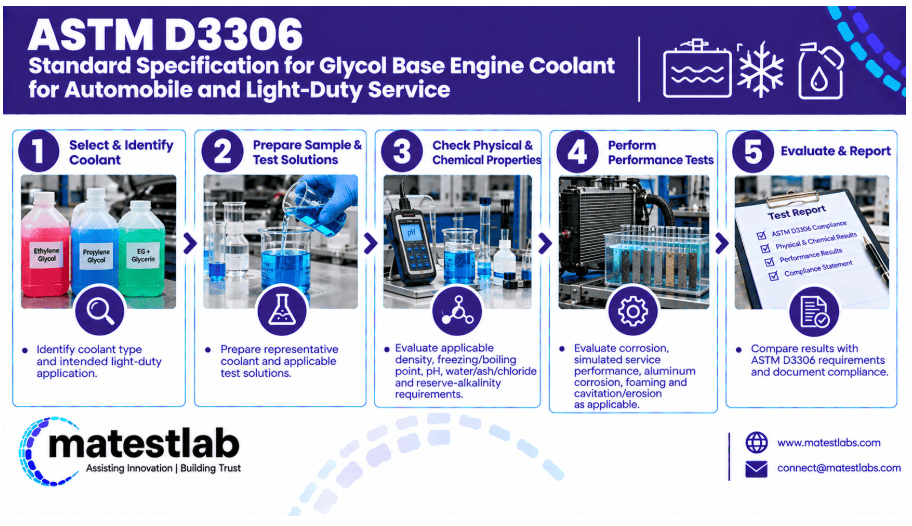
ASTM D3306 Standard Specification for Glycol Base Engine Coolant for Automobile and Light-Duty Service
ASTM D3306 establishes detailed specifications for engine coolants based on ethylene glycol or propylene glycol for use in automobiles and light-duty trucks. It specifies performance and chemical requirements to guarantee the coolant operates satisfactorily under freezing and elevated temperature conditions. It contains specific test methods for corrosion inhibition, freeze protection, pH stability, and compatibility of automotive components. The standard applies to concentrated and prediluted coolants, providing uniform quality in coolant systems operating under various climatic and engine conditions. The standard helps manufacturers meet engine durability requirements while protecting components made of aluminum, copper, solder, steel, cast iron, and brass.
Read More
GET STARTED
ASTM D3306 Introduction
In cars and light-duty engines, the coolant is required to maintain temperature conditions and safeguard against corrosion within the cooling system. ASTM D3306 meets mainly the requirements of glycol-based coolant properties, which include chemical formulation, stability, and performance-related factors. This coolant must transfer heat with reasonable effectiveness, resist freezing, and prevent boiling when the engine is operating under normal conditions. In addition, over time, it must prevent the corrosion of metal engine parts and the formation. ASTM D3306 specifically concerns itself with the chemical compatibility and thermal stability of coolants used in conventional automotive applications, particularly in systems employing aluminum heat exchangers. This was important because contemporary engines operate at much higher temperatures with tighter clearances; therefore, production specifications must be imposed to ensure that the coolant offers adequate and consistent protection throughout the vehicle’s useful service life.
Get Certified ASTM D3306 for Uncompromising Quality and Project Success
ASTM D3306 certification assures that engine coolant formulations are of the right chemical and performance specifications. The compliance gives good heat transfer, corrosion, and compatibility with engine materials. This assists manufacturers in upholding the quality of the products and also provides a safe and dependable operation of the cooling system in the automobiles.
Service Name
Remarks
ASTM D3306 Testing
Contact US
ASTM D3306 Testing Procedures and Requirements
Reserve Alkalinity
Measured by titrating the coolant with standardized acid to a pH of 5.5 to assess buffering capacity.
Corrosion Inhibition
Conducted by immersing multiple metal coupons (e.g., aluminum, copper) in coolant for 336 hours at 88°C.
Freeze Point Determination
Performed using a calibrated cryoscope to measure the temperature at which the coolant solidifies.
Scope of ASTM D3306
Gives specifications of the performance of glycol engine coolants in automobiles and light-duty vehicles.
Protects against important properties like freezing point protection, corrosion resistance, and chemical stability.
Gives instructions on how to conduct tests and assessments on the performance of coolants at normal conditions.
ASTM D3306 Equipment and Sample Preparation
Metal Coupon Test Apparatus
Includes aluminum, solder, brass, cast iron, and copper coupons sized 1.5 in × 0.5 in × 0.125 in.
Cryoscope
Calibrated to measure freezing points to ±0.1°C; coolant sample diluted to 50% concentration with deionized water.
Titration Setup
Includes pH meter, burette, and standardized HCl for reserve alkalinity; sample filtered before testing.
Use of ASTM D3306
This standard is widely applied in the automotive and light truck industries, particularly for internal combustion engines that require glycol-based cooling.
It is also used within the system and validation of O.E.M. coolant products, as well as unique device manufacturer (OEM) coolants and maintenance fluids.
Engine manufacturers use ASTM D3306 compliance to qualify coolant compatibility during product development.
Common Challenges and Troubleshooting in ASTM D3306 Testing
One of the frequent considerations in coolant testing is the impurity of water contamination and/or the ratios of mixing, which might influence the freezing point and anti corrosion capabilities. Mistakes in chemical testing on the wrong measures can also provide flawed results. All these can be reduced by working with purified water when conducting tests, properly preparing the samples, and the laboratory equipment should be properly calibrated to measure the coolant properties accurately.
ASTM D3306 Aggregate Testing Method, Procedure, and Data Measuring
The first stage of testing involves the collection of coolant samples and their physical and chemical analysis with the help of standard laboratory equipment. The major assessments are determination of freezing point, boiling point, corrosion testing of metal samples and chemical composition testing. The data collected covers temperature protection limits, rate of corrosion, pH, and chemical stability indicators. These tests assist in the establishment of compliance with ASTM D3306 coolant.
Analysis Results and Interpretation for ASTM D3306
The results of the tests reveal whether the coolant has sufficient thermal protection and corrosion resistance. An adequately designed coolant will ensure freezing and boiling points are constant and corrosion is avoided in engine parts. Violation of the necessary specifications can indicate that there were difficulties in formulation or contamination at the production stage.
Problem and the Solution of ASTM D3306
Problem: Improperly developed engine coolant may result in overheating, freezing or corrosion of vehicle cooling systems.
Solution: ASTM D3306 has been used to establish standard specifications and tests to guarantee that glycol-based coolants are used to provide reliable temperature and engine protection.
Factors to Consider us to Test for ASTMD3306
Speed
The quality of the results can be determined quickly with the aid of effective laboratory procedures, and testing accuracy is maintained.
Expertise
Skilled technicians will be used to verify the correct chemical analysis and interpretation of data on the coolant performance.
Cost
Affordable testing options assist manufacturers to stay in line with the compliance as well as to guarantee quality coolant usage by vehicles.
Related
FAQ's
Where can I get the astm d3306 tested?
You can share your astm d3306 testing requirements with MaTestLab. MaTestLab has a vast network of material testing laboratories, spread across the USA and Canada. We support your all material testing needs ranging from specific astm d3306 test to various testing techniques.
How much do I need to pay for the astm d3306 test?
Please contact us for a detailed quote for your astm d3306 testing needs. Cost incurred to carry out different astm d3306 testing methodology depends on the type of raw material; number of samples, coupons, or specimens; test conditions, turn around time etc. Costs of some ASTM testing methods start from $100 and the final value depends upon the factors listed above. Please contact us for the best and latest prices.
How many samples are required for astm d3306?
The required number of samples or specimens should comply with the procedure given in the astm d3306 standard. However, the MaTestLab operations team can assist you for your special requirements once you share your testing details with us.
How much discount can I get on the astm d3306 test?
MaTestLab has a vast testing laboratory network, hence we bring you the best testing facilities in a cost-effective way. We offer considerable discounts (15-20%) to our returning customers based on test volume and frequency.
How many days will it take to complete the astm d3306 test?
The turnaround time for astm d3306 test methodology depends upon the test procedure mentioned in the standard test document. However, we at MaTestLab understand your research requirements and hence try to get your test completed within the least possible time.
Where can I get the astm d3306 tested?
You can share your astm d3306 testing requirements with MaTestLab. MaTestLab has a vast network of material testing laboratories, spread across the USA and Canada. We support your all material testing needs ranging from specific astm d3306 test to various testing techniques.
MaTestLab Inc. offers accessible, quick, and affordable material testing, product testing, and failure analysis services. We support your on-demand testing and expert consultation needs with the help of our extensive network of material testing laboratories situated in the US and other parts of the world.
MATERIAL TESTING
We offer destructive and non-destructive tests over a range of mechanical, electrical, chemical, thermal, optical, corrosion, radiation, and biological testing methodologies defined by ASTM, ISO and other organizations.
PRODUCT TESTING
We help you evaluate and ensure your product quality and performance with standard and custom-made testing solutions. All the tests are done at well-equipped testing laboratories using standard testing methods for best output and satisfaction.
FAILURE ANALYSIS
Failure analysis ensures high levels of quality in every manufacturing process. We help you with getting the best failure or root cause analysis to determine the cause of the failure. The results help you identify means to prevent failure recurrences.