ASTM D1293 Test Method for the Evaluation of pH of Water

    What is ASTM D1293? 

    ASTM D1293 is a standard test method for determining water pH using an electrometric method with a glass electrode as the sensor. This standard provides two test methods: Test Method A (precise laboratory measurement) and Test Method B (routine or continuous measurement). Before analyzing a water sample, technicians standardize the measuring instrument using standard reference buffer solutions, and both test methods use the pH scale defined by NIST Standard Reference Materials. The laboratory uses ASTM D1293 (Standard Test Methods for pH of Water) to monitor water quality parameters that influence mineral solubility, scale formation, metal corrosion potential, and the suitability of water for aquatic life. Neither applies to water conductivity levels lower than about 5 µS/cm; however, other methods are available, including ASTM D5128 or D5464. 

    Read more

    Get Certified ASTM D1293 Testing for Reliable Water Quality Verification 

    A basic requirement of water quality for industrial, municipal, and environmental uses is pH measurement because pH is important for water quality, mineral solubility, corrosion potential, and biological suitability. ASTM D1293 testing certifies that a laboratory conducts standard glass electrode testing and calibrates its glass electrode with buffer solutions traceable to the NIST. Accredited laboratory testing is utilized in regulatory compliance, process control, and environmental monitoring programs. The ASTM D1293 test is used at water treatment facilities, manufacturers, and environmental labs to provide accurate pH data for informed decision-making.

    What is the Scope of ASTM D1293? 

    The ASTM D1293 standard gives two test methods for the pH of water as measured by the glass electrode, for different measurement situations. Test Method A refers to precise laboratory measurement, and Test Method B refers to routine or continuous measurement (which can be especially suitable for continuous monitoring applications). The scope of ASTM D1293 includes: 

    Read more

    • Material type: Natural, treated, or process waters suitable for electrometric pH measurement. 
    • Purpose: The measurement of pH to determine water quality, process control, and regulatory compliance.  
    • Properties evaluated: pH; Scale based on NIST Standard Reference Materials. 
    • Testing Method: Electrometric measurement with a glass electrode compared to reference buffer solutions.
    • Result: pH measured on the standard pH scale. 
    • Test Limitations: Both test methods are not sensitive enough to measure pH in water conductivities below about 5µS/cm. 
    • Applications: Municipal water quality monitoring, continuous online pH monitoring, environmental water testing, industrial process water. 

    What are the Uses of ASTM D1293 Testing?

    The ASTM D1293 test assists laboratories and water treatment facilities in measuring the pH of water samples using a standard electrometric method. Water quality professionals and engineers then use these results to make treatment decisions and to ensure regulatory compliance. This standard-

    • Measures the pH with an accurate laboratory measurement as per Test Method A.
    • Facilitates periodic or continuous pH monitoring as per Test Method B.
    • Offers a common reference point for calibrating instruments with NIST-traceable buffer solutions.
    • Helps to determine the scaling and/or corrosive properties of water.
    • Enables the evaluation of the water’s fitness to support aquatic life.
    • Facilitates uniform pH measurement in various laboratories and monitoring programs.

    What Materials Can Be Tested Under ASTM D1293? 

    ASTM D1293 is applicable to samples that are suitable for electrometric measurement with a glass electrode, such as natural waters, treated water supplies, and industrial process waters. The measurement range of this standard is not suitable for low-conductivity water below approximately 5 µS/cm; therefore, the analysts should check the conductivity of the sample before using this method. The precision and bias data for this standard were collected under the condition of buffer solutions, and users are responsible for testing waters of this type to validate the method. 

    Why is ASTM D1293 Important? 

    ASTM D1293 establishes standard methods for measuring a water quality parameter that is influential on mineral solubility, tendencies toward scaling, tendencies toward corrosion, and suitability of water for the support of life. Pure water in equilibrium with air has a pH of approximately 5.5, with the most natural uncontaminated waters ranging from pH 6 to pH 9; any deviation from these ranges is a sign of contamination or the upset of the process. The standard provides uniformity of measurement methods and results interpretation in laboratories. Water treatment plants, water manufacturers, and environmental agencies use this standard to monitor water quality, adjust treatment, and comply with regulations. 

    ASTM D1293 Equipment and Sample Preparation Guide

    ASTM D1293 specifies a pH meter with a glass electrode capable of electrometric measurement, using standard reference buffer solutions for calibration. Technicians collect and prepare representative water samples for pH determination in the laboratory or field. 

    Read more

    Sample and Specimen DetailsRepresentative water samples suitable for electrometric pH measurement, with conductivity above approximately 5 µS/cm; samples include natural, treated, and industrial process waters. 
    Specimen PreparationTechnicians collect the water sample in a clean, non-reactive container and bring it to the required temperature condition, typically close to 25 °C, before measurement to avoid contamination or temperature-related drift. 
    Specimen DimensionsTechnicians use a sample volume sufficient to fully immerse the glass electrode and reference electrode, commonly 50 mL to 100 mL in a laboratory beaker for Test Method A, while Test Method B accommodates continuous flow-through or in-line sample volumes for ongoing monitoring. 
    InstrumentationTechnicians use a pH meter with a glass electrode, standard reference buffer solutions, a reference electrode, and temperature-measuring equipment. 

    Testing Procedures and Requirements for ASTM D1293  

    ASTM D1293 testing is used to determine pH values with precision, following standardized electrometric procedures either with Test Method A (with a minimum of seven standard reference buffer solutions for instrument standardization) or with Test Method B (routine/continuous measurement with two buffers under slightly less restrictive conditions). ASTM D1293 test method consists of the following test procedure:

    Read more

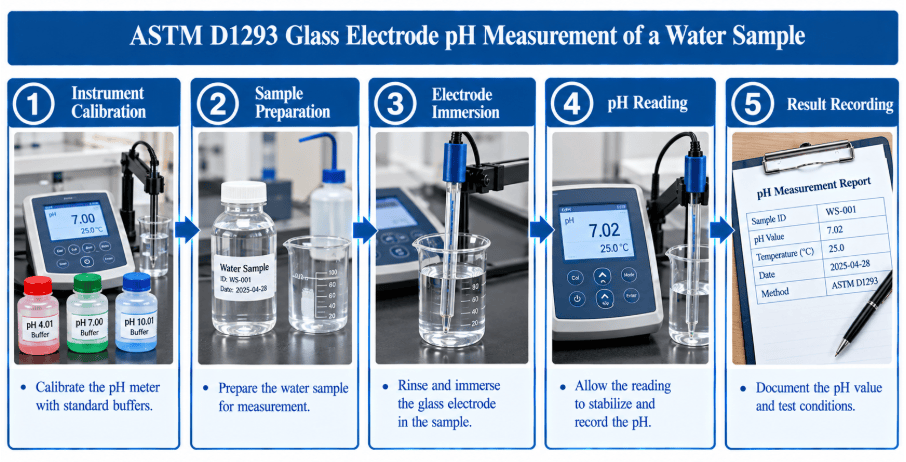
    Instrument Calibration Technicians calibrate the pH meter using the required number of standard reference buffer solutions bracketing the expected sample pH, and they verify the electrode’s response slope against at least two buffer points for Test Method A. 
    Sample Preparation Technicians collect a representative water sample of adequate volume, typically 50 mL to 100 mL, and bring it to the specified temperature condition, generally within a few degrees of 25 °C, before measurement. 
    Electrode Immersion Technicians immerse the glass electrode and reference electrode fully into the water sample to the depth specified by the electrode manufacturer, ensuring stable contact without trapped air bubbles. 
    pH Reading Technicians allow the reading to stabilize, typically over 30 seconds to a few minutes depending on sample equilibration, and record the pH value displayed by the meter. 
    Result Recording Technicians record the pH value to the nearest 0.01 pH unit, along with the sample temperature, calibration buffers, and test method (A or B) used during testing. 

    ASTM D1293 Testing Process and Data Collection

    The testing process starts with the calibration of the pH meter with the necessary standard reference buffer solutions for the selected test method. Technicians collect a representative water sample and bring it to the desired temperature condition. They fully submerge the glass electrode in the sample and wait for the reading to stabilize before recording the pH. Technicians record the sample temperature, the calibration buffers used, and the final pH reading. Laboratories use this information for water quality monitoring, process control, and regulatory reporting.

    The image shows a glass electrode pH meter measuring a water sample as per ASTM D1293
    ASTM D1293 Glass Electrode pH Measurement of a Water Sample

    Common Challenges and Troubleshooting

    Accurate ASTM D1293 results require proper instrument calibration, stable electrode contact, and correct temperature control of the sample. The selection of the wrong buffer or the lack of calibration of the electrode introduces a systematic error in the measurement. Air bubbles cause Unstable or inaccurate readings against the surface of the glass electrode. This standard cannot reliably measure Low-conductivity water samples below approximately 5 µS/cm and requires alternate methods. These are minimized by proper calibration, careful handling of the electrodes, and temperature control. Experienced technicians achieve reliable results through standard procedures and maintaining calibrated instrumentation. 

    ASTM D1293 Analysis Results and Interpretation

    The report summarizes the pH of the water sample tested. Analysts compare this value against expected ranges or regulatory limits for the water type under evaluation.

    Read more

    • The laboratory reports the pH value on the standard pH scale, typically recorded to the nearest 0.01 pH unit.
    • The laboratory records the temperature of the sample at the time of measurement, because the pH is sensitive to temperature and ionic strength.
    • The results show if the water sample is in the normal range of natural uncontaminated water (pH 6 to pH 9) or towards the acid end (pH 5.5 for pure water in equilibrium with air).
    • The laboratory makes measurements and compares the pH to the specification, process control, or regulatory requirements, such as target ranges for drinking water or industrial process water.
    • The laboratory records the calibration buffers used (usually pH 4.00, 7.00, and 10.00 for Test Method A and two buffers for Test Method B) and confirms the electrode slope obtained during calibration.
    • The laboratory documentation indicates the test method used: Test Method A for precise laboratory measurement or Test Method B – routine or continuous measurement.
    • Laboratories rely on consistent calibration, electrode handling, and temperature control to ensure reliable, repeatable measurements in subsequent measurements.
    • The results of the pH analyses are important in determining the corrosion potential, scaling tendency, and the water’s capability to support aquatic life; therefore, treatment or a process adjustment is based on the results of the pH analyses. 

    Link to ASTM D1293 

    FAQ

    In ASTM D1293, what is the difference between Test Method A and Test Method B?
    Test Method A is a laboratory test that is performed with at least two of the seven standard reference buffer solutions, with a requirement for precision, and Test Method B is a test performed under routine or continuous conditions with two buffers, but under less restrictive conditions.
    Both test methods are inadequate for determining the pH of waters with a conductivity less than about 5 µS/cm, and analysts should consult ASTM D5128 or D5464 for such waters.
    pH range for most natural, uncontaminated waters is 6 – 9; pure water in equilibrium with the air has a pH of about 5.5.

    Updated on September 17, 2026

    Pawan Kumar Mali
    About Author
    Pawan Kumar Mali is a Material Testing Associate at Matestlab Inc. and holds an Integrated Dual Degree (B. Tech + M. Tech) in Metallurgical Engineering from IIT (BHU), Varanasi. His academic background and research experience are centered on Physical Metallurgy, Materials Research, and Data Analytics, strengthened through academic research and industry experience.
    Know More
    Testimonials
    Real results
    Engineers trust us with what matters most
    Why Choose Matestlab?
    Matestlab is a unified testing services partner based in the USA. Matestlab offers raw material and product testing services through accredited, expert laboratories primarily based in the USA. Matestlab supports physical, thermal, chemical, electrical, mechanical, environmental, and characterization testing needs through its global network of 2200+ accredited testing laboratories. Matestlab's in-house materials science experts curate and design comprehensive testing programs matched to the sample material and specific testing need, with regulatory requirements and confidentiality in mind.

    If you are looking for a managed and trusted testing partner to achieve your research goals, feel free to schedule a meeting with us or send us a request at connect@matestlabs.com to learn more about our services. For a quick quote, call us at (302)244-7710. We are happy to serve you.
    Start Your Testing
    Project Today
    Define your requirements and get access to
    specialized laboratories ready to deliver results
    Partners with us
    Clients
    Vendors
    Process for testing
    • STEP 01

      You share your testing requirements

    • STEP 02

      You share your sample(s)

    • STEP 03

      We deliver your test reports

    Get your testing done

    Let us know your testing requirements and we will be right back with a solution.

      Let us root for each other. Collaborate to grow, expand, and accelerate our businesses.

      Partner with us