
ASTM D512 Standard Test Methods for Chloride Ion In Water

    What is ASTM D512?

    ASTM D512 describes standard test methods for determining chloride ion in water, wastewater, and brines. The present edition of ASTM D512 (Standard Test Methods for Chloride Ion In Water) includes three analytical methods: mercurimetric titration, silver nitrate titration, and ion-selective electrode measurement. Each method employs a specific analytical technique to measure the chloride concentration in a water sample. Thus, the analyst may use the procedure best suited to the sample, chloride concentration, and interferences. Chloride measurement matters because high concentrations can negatively affect high-pressure boiler systems and stainless steel. Personnel use the results for monitoring cooling towers, wastewater testing, food processing applications, water treatment, and process control in industry.

    Read more

    Get Certified ASTM D512 Testing for Reliable Water Quality Assessment

    Accurate chloride measurement provides water chemistry data that manufacturers, researchers, and engineers use to understand and control process conditions. Thus, laboratories must have calibrated analytical systems, representative samples, adequate equipment, and trained technicians. ASTM D512 offers several methods of analysis so that the laboratory can choose the most appropriate method for the sample. Personnel can use accurate chloride data to assist in corrosion control, cooling-water management, boiler-water monitoring, evaluation of wastewater, and quality control. Laboratory testing also provides clients with consistent data to use in material selection, process optimization, and product development. 
    What is the Scope of the ASTM D512 Test Standard?

    ASTM D512 determines chloride ions in water and brines, with Test Method C also covering wastewater. It includes three methods: mercurimetric titration, silver nitrate titration, and ion-selective electrode measurement. This standard –

    Read more

    • Measures the amount of salt in water.
    • Applies to brines and, for Test Method C, wastewater.
    • Offers three analytical methods for measuring chloride.
    • Carries out mercurimetric titration as Test Method A.
    • Uses silver nitrate titration as Test Method B.
    • Uses an ion-selective electrode as Test Method C.
    • Introduces the SI system as the standard system of measurement.
    • Provides method-specific precision and bias information.
    • Provides a standard chloride analysis procedure for water quality applications.

    What are the Uses of ASTM D512 Testing?

    Laboratories can use ASTM D512 testing to measure chloride concentration in various types of water. Engineers can then use this data to monitor water chemistry, compare samples, and control processes. In addition, ASTM recognizes chloride analysis as a key test for wastewater, high-pressure boiler systems, stainless steel, cooling towers, and food processing waters. This standard –

    • Measures the chloride ion concentration of water samples.
    • Enables industrial water quality management.
    • Assists in monitoring of wastewater (Test Method C).
    • Helps assess conditions that can lead to corrosion.
    • Provides high-pressure boiler-water monitoring.
    • Aids in the estimation of cycles of concentration in cooling-tower applications.
    • Supports processing-water and pickling-solution analysis.
    • Helps compare different water-treatment conditions.
    • Helps with research, quality control, and process development.

    Which materials can be tested under ASTM D512?

    Personnel test water and brine samples according to ASTM D512 and test wastewater samples according to Test Method C. Depending on the sample matrix, the anticipated chloride concentration, and possible interferences, the procedure used in the lab will vary. Common examples are industrial process water, cooling water, boiler water, natural water, wastewater, brines, food-processing water, pickling solutions, and water-treatment samples.

    Why is ASTM D512 Important?

    Chloride ion concentration can help determine water quality and process conditions. High chloride levels may affect boiler systems and stainless steel and cause corrosion and damage to equipment. So, personnel use chloride monitoring for water-treatment decisions, corrosion control, and process management. ASTM D512 also helps determine cycles of concentration for the cooling tower industry and helps obtain uniform data for comparing samples.

    ASTM D512 Equipment and Sample Preparation Guide

    Engineers employ different equipment depending upon the procedure chosen for chloride ion determination in ASTM D512. The type of apparatus, reagents, and measuring system laboratories use depends on the analytical method and the water sample characteristics. Selected equipment supports accurate titration, electrode measurement, sample preparation, and chloride concentration calculations. As such, laboratories can get consistent and reliable analytical results with the correct use of instruments and their calibration.

    Read more

    Sample and Specimen Details Technicians collect representative water samples according to applicable sampling practices, including ASTM D1066 and ASTM D3370. 
    Specimen Preparation Technicians prepare water samples per the selected ASTM D512 procedure and dilute them as needed. 
    Specimen Dimensions ASTM D512 requires no fixed specimen dimensions. The analyst selects the sample volume based on the test method and expected chloride concentration.
    Instrumentation The test uses titration equipment, burets, reagents, indicators, chloride ion-selective electrodes, reference electrodes, & suitable measuring systems.

    Testing Procedures and Requirements for ASTM D512

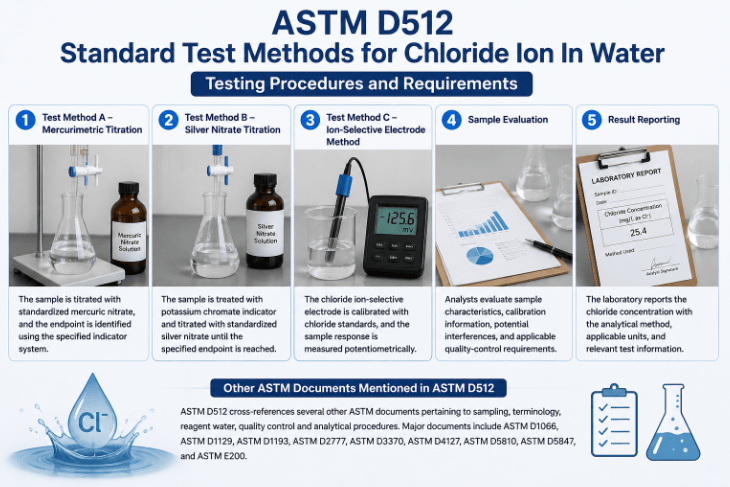
    ASTM D512 includes three procedures for determining chloride ions in water. The sample type and expected chloride level determine which procedure to use. Other referenced ASTM documents include ASTM D1066, ASTM D1129, ASTM D1193, ASTM D2777, ASTM D3370, ASTM D4127, ASTM D5810, ASTM D5847, and ASTM E200.

    Read more

    Test Method A – Mercurimetric Titration Analysts titrate the sample with standardized mercuric nitrate, and the endpoint is identified using the specified indicator system. 
    Test Method B – Silver Nitrate Titration The sample is treated with potassium chromate and titrated with standardized silver nitrate to the specified endpoint. 
    Test Method C – Ion-Selective Electrode Method Analysts calibrate the chloride ion-selective electrode with chloride standards, and the sample is measured potentiometrically. 
    Sample Evaluation Analysts evaluate sample characteristics, calibration information, potential interferences, and applicable quality-control requirements. 
    Result Reporting The laboratory reports the chloride concentration with the analytical method, applicable units, and relevant test information. 

    ASTM D512 Testing Process and Data Collection

    The testing process starts with representative water-sample collection and identification. The analyst then determines the expected chloride concentration and chooses which ASTM D512 procedure to use. Technicians then prepare the sample and reagents, standards, and analytical equipment. In titration methods, the analyst writes down the amount of titrant used and the corresponding endpoint. In the ion-selective electrode method, the laboratory documents the electrode response and the calibration relationship. Then the technicians determine the concentration of chloride and check the results before giving them the report.

     The image shows laboratory equipment used to determine chloride ion in water using titration glassware and a chloride ion-selective electrode.
    ASTM D512 Chloride Ion Testing of Water by Titration and Ion-Selective Electrode Methods

    Common Challenges and Troubleshooting

    To obtain accurate chloride analysis results, one must obtain representative samples, use appropriate reagents, select an appropriate method, and use calibrated equipment. Hence, laboratories should test the sample matrix and possible interferents before testing. Poor standardization, poor endpoint detection, contamination, or incorrect sample preparation can cause errors in titration. Likewise, laboratories must also calibrate the ion-selective electrode test and conduct it under controlled conditions. Using high-quality reagents, maintaining equipment, and applying quality-control procedures improve result reliability.

    ASTM D512 Analysis Results and Interpretation

    ASTM D512 determines chloride ion concentration (SI Units) and typically reports it as mg/l. The report identifies the analytical procedure used, as Methods A, B, and C use different measurement principles.

    Read more

    • The laboratory reports the chloride-ion concentration in mg/L (ppm), with the applicable concentration range depending on the selected test method.
    • The analyst identifies the procedure used, with Methods A and B calculating chloride concentration from titration data and Method C determining chloride concentration using a calibrated chloride ion-selective electrode.
    • The laboratory reviews calibration, reagent, sample-preparation, and quality-control data to verify the reliability of the reported chloride concentration.
    • The analyst interprets the chloride results within the applicable method range, including approximately 8–250 mg/L for Method A and 2–1000 mg/L for Method C, as applicable.
    • The engineer or laboratory uses the results to support water-quality monitoring, corrosion control, cooling-water management, boiler-water evaluation, and process control.

    What Factors Should You Consider for ASTM D512 Testing? 

    The following are factors that can guide manufacturers and researchers to select one laboratory for the chloride ion test. The testing partner should understand the analytical method, sample matrix, reporting requirements, and project schedule to be suitable.

    • Expertise: Expert technicians choose the right ASTM D512 procedure, prepare the sample properly, and control for any interferences, calibration, and quality control.
    • Speed: Testing time depends upon sample number, method selected, preparation and reporting needs. An efficient laboratory helps keep project timelines.
    • Cost: Testing costs vary depending on the sample size, method used, preparation, quality control, and reporting needs. Good method choice aids cost management.
    • Confidentiality: Confidential testing ensures the protection of proprietary formulation, manufacturing processes, research, and product development information. MaTestLab offers personalised solutions for testing that remain confidential.

    Link to ASTM D512

    FAQ

    What is ASTM D512 used for?
    Personnel use ASTM D512 to measure the chloride ion content of water and brine samples. Test Method C also includes wastewater.
    The standards contain mercurimetric titration, silver nitrate titration, and the ion-selective electrode method.
    It determines the amount of chloride ion in water in mg/L.
    Equipment depends on the method used; Titration glassware, indicators, chloride ion-selective electrodes, and measuring systems are all required.
    The standard applies to water and brine samples. Test Method C also includes wastewater.

    Updated on September 2, 2026

    Gokula Srinivasan Selvam
    About Author
    Gokula Srinivasan Selvam is a Material Testing Associate at Matestlab Inc. and holds a postgraduate degree in Ceramic Engineering from IIT (BHU), Varanasi. His academic background and professional experience are centered on advanced ceramic materials, their processing, characterization, and performance evaluation.
    Know More
    Testimonials
    Real results
    Engineers trust us with what matters most
    Start Your Testing
    Project Today
    Define your requirements and get access to
    specialized laboratories ready to deliver results
    Partners with us
    Clients
    Vendors
    Process for testing
    • STEP 01

      You share your testing requirements

    • STEP 02

      You share your sample(s)

    • STEP 03

      We deliver your test reports

    Get your testing done

    Let us know your testing requirements and we will be right back with a solution.

      Let us root for each other. Collaborate to grow, expand, and accelerate our businesses.

      Partner with us

        Discover more from Matestlab

        Subscribe now to keep reading and get access to the full archive.

        Continue reading