ASTM D1122 Test Method for Density and Relative Density of Engine Coolant Concentrates and Engine Coolants by the Hydrometer

    What is ASTM D1122? 

    ASTM D1122 is a standard test method for determining the relative density of engine coolants and engine coolant concentrates. It determines the sample’s buoyancy by floating a calibrated glass hydrometer in a temperature-controlled cylinder. The method assesses dilution accuracy and glycol concentration, compared to a known reference, at a specified test temperature. ASTM D1122 (Standard Test Method for Relative Density of Engine Coolant Concentrates and Engine Coolants By The Hydrometer) is a method used in the laboratory to assess relative density and is useful in production quality control, formulation verification, and development of reliable coolant products. A sample is placed in a container and is cooled to a reference temperature (15.6 °C, 20 °C, or 25 °C), and a reading is obtained on a hydrometer. 

    Read more

    Get Certified ASTM D1122 Testing for Reliable Engine Coolant Quality 

    Manufacturers use relative density testing, which is certified per ASTM D1122, because relative density affects the accuracy of dilution, glycol dosing, and freeze and boil protection in the finished product. A batch of coolant concentrate, before it leaves the plant, is certified to meet the formulation specification. This verification process allows the producer to fine-tune their blends for maximum performance, minimize field failures, and ensure consistent field performance. 

    What is the Scope of ASTM D1122? 

    ASTM D1122 provides the procedure for engine coolants and engine coolant concentrates to be hydrometered to determine their relative density. The method is applicable to glycols, glycerin, heat transfer fluids, engine coolant concentrates, and aqueous engine coolants, and the hydrometer scale and the reference temperature are specific to each fluid and range. The method is used to determine the relative density, as well as to estimate the concentration, freezing point, and boiling point of the glycol (when the type of glycol is known), and provides procedures for sample conditioning, hydrometer flotation, and temperature-controlled reading. 

    Read more

    • Material type: Engine coolant concentrates, aqueous engine coolants, glycols, glycerin, and heat transfer fluids. 
    • Purpose: Evaluation of relative density for quality control and verification of coolant formulation. 
    • Properties evaluated: Relative density (specific gravity) at a specified reference temperature. 
    • Testing Method: Reading on the hydrometer in a temperature-controlled cylinder at 15.6 °C, 20 °C, or 25 °C. 
    • Result: The results include a relative density value (dimensionless) and the reported temperature of the test. 
    • Test Limitations: Requires a well-mixed sample with no bubbles, and results are dependent on the accuracy of the temperature control and the calibration of the hydrometer. 
    • Use conditions: Testing is performed at a controlled laboratory temperature, not at in-service conditions. 
    • Applications: Coolant manufacturing quality control, glycol concentration verification, estimation of freeze/boil point, and heat transfer fluid monitoring.

    What are the Uses of ASTM D1122 Testing?

    ASTM D1122 testing provides laboratories with a method for comparing the relative density and glycol concentration of raw materials and finished coolant products and for engineers to ensure batch consistency and to approximate coolant performance. This standard-

    • Determines the relative density of engine coolant concentrates and finished engine coolants in relation to a fixed reference temperature.
    • Assists manufacturers of coolants with production control testing and formulation verification.
    • Assists in the estimation of the approximate percentage of glycol within a sample where the type of glycol is known.
    • Helps determine the freezing point and the boiling point without conducting a complete freeze-point determination.
    • Collaborates in product development and quality control of batch runs.
    • Helps to select and test automotive and industrial coolant concentrates.

    What Materials Can Be Tested Under ASTM D1122? 

    ASTM D1122 is primarily applicable to automotive and industrial cooling systems that use liquid coolant raw materials and finished coolants. This method is commonly used to test ethylene glycol and propylene glycol-based engine coolant concentrates, prediluted aqueous engine coolants, glycerin, and aqueous glycol heat transfer fluids. All of these fluids contain the fundamental relative density data a manufacturer needs to ensure the consistency of heat transfer fluids and coolant dilution and glycol content.

    Why is ASTM D1122 Important? 

    The significance of ASTM D1122 is that the relative density directly correlates to the freezing point, boiling point, and concentration of glycol in a coolant. A relative density test result outside of specification indicates the batch is under- or over-diluted, which results in the batch not reaching the proper freezing temperature, an insufficient heat transfer rate, or failure to meet the formulation specification. By conducting this test, the manufacturer identifies these issues before the coolant product is sold, avoiding expensive quality problems and assuring field performance. 

    ASTM D1122 Equipment and Sample Preparation Guide

    The ASTM testing method D1122 requires a hydrometer cylinder, a glass calibrated hydrometer for reading relative density, and good temperature control of the sample. Laboratories prepare representative samples with proper cleanliness before testing and evaluation.

    Read more

    Sample and Specimen DetailsTechnicians use representative samples of glycols, glycerin, heat transfer fluids, engine coolant concentrates, or aqueous engine coolants. Samples must be free from air bubbles and at the specified test temperature. 
    Specimen PreparationTechnicians collect samples following applicable practices and ensure the sample is at the specified test temperature (25 °C, 20 °C, or 15.6 °C) 
    Specimen VolumeTechnicians use enough sample to fill the hydrometer cylinder so the hydrometer floats freely, fully immersed, without touching the base or sides. The cylinder size is chosen to match the hydrometer’s length, typically requiring a sample volume of several hundred milliliters. 
    InstrumentationTechnicians use a glass hydrometer (conforming to the applicable ASTM hydrometer specification), hydrometer cylinder, constant-temperature bath (15.6 °C, 20 °C, or 25 °C), and a precision thermometer. 

    Testing Procedures and Requirements for ASTM D1122  

    ASTM D1122 requires testing in a controlled temperature and humidity environment to ensure the hydrometer reading represents the sample’s relative density. The technicians then take the sample to the necessary reference temperature, let it equilibrate with the hydrometer, and then read the hydrometer. The steps of the test procedure are as follows.

    Read more

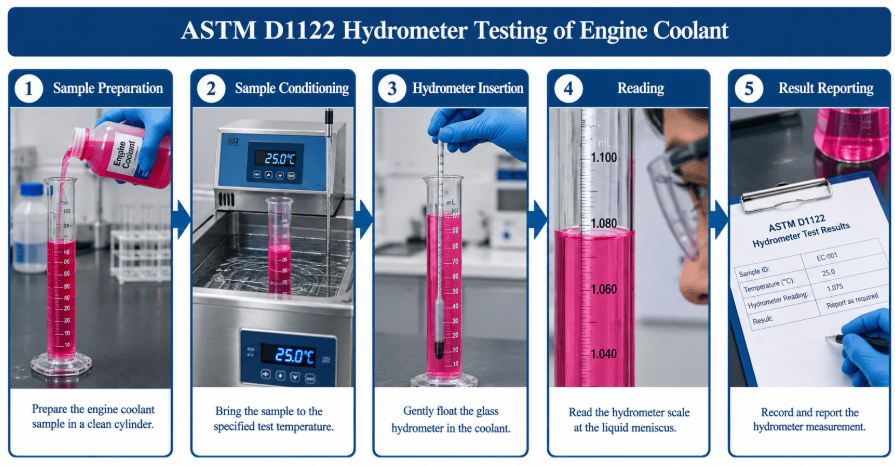
    Sample Preparation Technicians collect representative samples and ensure they are at the specified test temperature (25 °C, 20 °C, or 15.6 °C).
    Sample Conditioning Technicians bring the representative sample to the specified reference temperature in a controlled bath before testing. 
    Hydrometer Insertion Technicians lower the calibrated hydrometer into the cylinder and allow it to float freely without touching the sides. 
    Reading Technicians record the relative density value at the point where the liquid surface intersects the hydrometer stem. 
    Result Reporting Laboratories report the relative density value, test temperature, hydrometer scale range used, and relevant sample observations. 

    ASTM D1122 Testing Process and Data Collection

    The analyst selects a representative sample of the coolant/concentrate and defines the set reference test temperature. The technician then conditions the sample in a constant temperature bath and removes any entrained air. The operator places the hydrometer in the cylinder and allows it to rest before taking the reading, then records the relative density. Analysts then make comparisons of the batch data to specifications of the raw materials or finished product. 

     The image depicts a laboratory technician reading a glass hydrometer floated in a temperature-controlled cylinder of engine coolant per ASTM D1122.
    ASTM D1122 Hydrometer Testing of Engine Coolant

    Common Challenges and Troubleshooting

    Accurate ASTM D1122 results require stable temperature control, clean cylinders, and calibrated hydrometers. When the reading is distorted, it is most likely due to air entrapment, unstable sample temperature, or the hydrometer touching the cylinder wall. Technicians minimize these errors by inspecting hydrometer calibration and temperature monitoring systems before testing, and laboratories get the best results when they sample, condition, and evaluate samples the same way each time. 

    ASTM D1122 Analysis Results and Interpretation

    The report summarizes the relative density measured at the reference temperature set, the value measured, test temperature, and the hydrometer scale used.

    Read more

    • The laboratory reports relative density as a dimensionless value at the specified reference temperature, such as 15.6 °C, 20 °C, or 25 °C, as applicable.
    • The technician records the measured relative density, test temperature in °C, reference temperature, and hydrometer scale used during the evaluation.
    • The analyst interprets the reported relative density as a single measurement.
    • Analysts use calibrated hydrometers, consistent sample conditioning, and controlled bath temperatures to support accurate and repeatable measurements.
    • Engineers compare relative density results obtained under equivalent conditions with applicable specifications, reference values, or quality-control requirements.

    Link to ASTM D1122 

    FAQ

    What equipment is needed to perform ASTM D1122 testing?
    The ASTM D1122 test involves a hydrometer cylinder, a calibrated glass hydrometer, a constant-temperature bath, and a precision thermometer to provide the sample with the specified reference temperature.
    The test time will vary primarily with the time required for the sample to reach the desired reference temperature in the bath; the hydrometer reading is taken rapidly after the sample reaches the desired temperature.
    No, ASTM D1122 only provides data for relative density, and the glycol type is determined separately in order to be able to convert the relative density to an estimated percent glycol, freezing point, or boiling point.

    Updated on September 19, 2026

    Gokula Srinivasan Selvam
    About Author
    Gokula Srinivasan Selvam is a Material Testing Associate at Matestlab Inc. and holds a postgraduate degree in Ceramic Engineering from IIT (BHU), Varanasi. His academic background and professional experience are centered on advanced ceramic materials, their processing, characterization, and performance evaluation.
    Know More
    Testimonials
    Real results
    Engineers trust us with what matters most
    Why Choose Matestlab?
    Matestlab is a unified testing services partner based in the USA. Matestlab offers raw material and product testing services through accredited, expert laboratories primarily based in the USA. Matestlab supports physical, thermal, chemical, electrical, mechanical, environmental, and characterization testing needs through its global network of 2200+ accredited testing laboratories. Matestlab's in-house materials science experts curate and design comprehensive testing programs matched to the sample material and specific testing need, with regulatory requirements and confidentiality in mind.

    If you are looking for a managed and trusted testing partner to achieve your research goals, feel free to schedule a meeting with us or send us a request at connect@matestlabs.com to learn more about our services. For a quick quote, call us at (302)244-7710. We are happy to serve you.
    Start Your Testing
    Project Today
    Define your requirements and get access to
    specialized laboratories ready to deliver results
    Partners with us
    Clients
    Vendors
    Process for testing
    • STEP 01

      You share your testing requirements

    • STEP 02

      You share your sample(s)

    • STEP 03

      We deliver your test reports

    Get your testing done

    Let us know your testing requirements and we will be right back with a solution.

      Let us root for each other. Collaborate to grow, expand, and accelerate our businesses.

      Partner with us