ASTM D3013 Standard Specification for Epoxy Molding Compounds

    What is ASTM D3013? 

    ASTM D3013 covers requirements for identifying, quality-controlling, and procuring epoxy thermosetting molding compounds. These compounds consist of epoxy resins and curing agents, combined with fillers, reinforcements, colorants, and other chemical agents. The specification categorizes epoxy molding compounds by physical properties and, when special requirements apply, subdivides them into dielectric and flame-retardant classes. ASTM D3013 (Standard Specification for Epoxy Molding Compounds) identifies, controls quality, and supports procurement of epoxy thermosetting molding compounds. It determines properties like water absorption, flexural strength, impact resistance, tensile strength, deflection temperature, permittivity, dissipation factor, dielectric strength, arc resistance, and flammability.

    Read more

    Get Certified ASTM D3013 for Reliable Epoxy Molding Compounds 

    Epoxy molding compounds require consistent physical, mechanical, thermal, and electrical properties to perform reliably in their intended applications. ASTM D3013 establishes a standard to guide manufacturers and laboratories in assessing these characteristics and comparing commercial lots. Laboratories can use this resulting data to support quality control, material identification, product development, purchasing decisions, and comparison of epoxy molding compounds. Manufacturers can also use the classification system to identify compounds according to their specified property ranges and special dielectric or flame-retardant requirements. 
    What is the scope of the ASTM D3013 specification?

    ASTM D3013 covers requirements for epoxy thermosetting molding compounds in an unreacted or partially reacted condition. It establishes a classification system based on physical properties and provides additional classifications for special dielectric properties or flame-resistance requirements. The ASTM D3013 standard-

    Read more

    • Covers epoxy thermosetting molding compounds and applies to mixtures of epoxy resins and curing agents, including fillers, reinforcements, colorants, and other chemical agents.
    • Provides requirements for material identification and quality control. 
    • Classifies compounds into grades based on physical properties.
    • Provides dielectric D classes for special electrical requirements and flame-retardant F classes.
    • Evaluates water absorption, flexural strength, impact resistance, tensile strength, and deflection temperature.
    • Determines permittivity, dissipation factor, dielectric strength, arc resistance, and flammability if applicable.

    What are the uses of the ASTM D3013 specification?

    ASTM D3013 testing helps manufacturers and laboratories characterize epoxy molding compounds according to their physical, mechanical, thermal, and electrical properties. The classification system also helps manufacturers establish substantial similarity between different commercial lots or shipments. This testing-

    • Determines water absorption of epoxy molding compounds, flexural strength, Izod impact resistance, and tensile strength.
    • Evaluates deflection temperature under load. Permittivity and dissipation factor, and dry and wet dielectric strength.
    • Measures arc resistance and flammability and supports quality control of epoxy molding compounds.
    • Helps classify compounds according to specified property ranges.

    Which materials can be tested under ASTM D3013?

    ASTM D3013 covers epoxy thermosetting molding compounds consisting of mixtures or blends of epoxy resins and curing agents. The compounds can contain fillers, reinforcements, colorants, and other chemical agents.

    Why is ASTM D3013 Important?

    ASTM D3013 classifies and tests epoxy molding compounds. Engineers can use the measured data to identify materials, maintain quality between production lots, and communicate material characteristics to purchasers.

    ASTM D3013 Equipment and Sample Preparation Guide

    ASTM D3013 uses different equipment for each required property. Technicians prepare representative specimens using transfer or compression molding and select the applicable equipment for the property being evaluated.

    Read more

    Sample and Specimen DetailsLaboratories test epoxy thermosetting molding compounds containing epoxy resin, curing agents, fillers, reinforcements, colorants, or other chemical agents.
    Specimen PreparationTechnicians prepare representative specimens using transfer or compression molding, as applicable.
    Specimen Dimensions 51 × 3.2 mm disks for water absorption, 6.4 × 12.7 × 127 mm bars for flexural testing, 12.7 × 12.7 × 63.5 mm specimens for Izod impact, Type I (3.2 ± 0.4 mm) for tensile testing, and 102 × 3.2 mm disks are used for dielectric tests.
    Instrumentation Transfer or compression molding equipment, water-absorption equipment, flexural testing machines, Izod impact testers, tensile testing machines, deflection-temperature apparatuses, dielectric testing equipment, permittivity/dissipation-factor equipment, arc-resistance apparatuses, and flammability testing equipment.

    Testing Procedures and Requirements for ASTM D3013

    According to ASTM D3013, laboratories must prepare molded specimens and determine selected properties for the chosen grade or class. The laboratory determines the applicable properties using the referenced ASTM test methods. Other reference ASTM documents include D149, D150, D256, D570, D618, D638, D648, D790, D883, D1896, D2863, and D3892. Laboratories must follow the designated testing protocols and criteria for ASTM D3014, outlined as follows:

    Read more

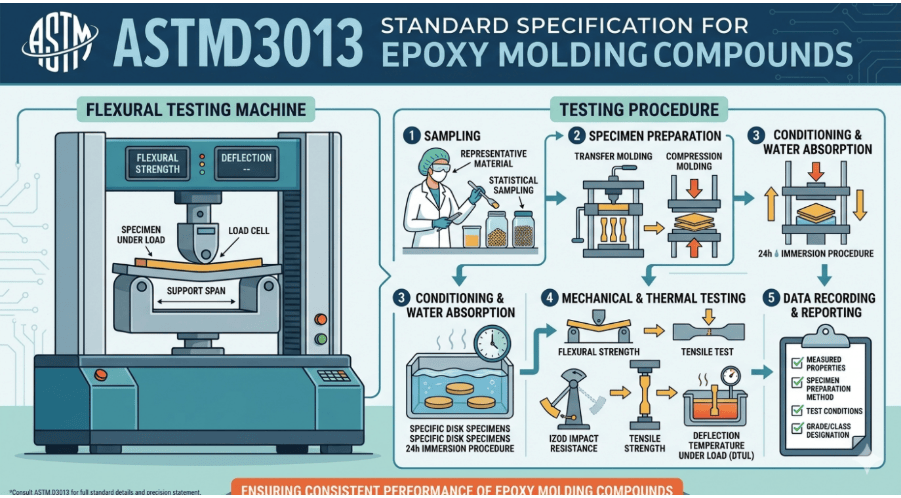
    Sampling and Specimen MoldingTechnicians select representative material from the batch or lot using appropriate statistical sampling procedures and prepare specimens using transfer or compression molding based on the applicable test.
    Conditioning and Water AbsorptionThen, they condition the specimens and measure water absorption using specific disk specimens and a 24-hour immersion procedure. 
    Mechanical and Thermal TestingAnalysts determine flexural strength, Izod impact resistance, and tensile strength using the applicable procedure and deflection temperature under load.
    Result ReportingAnalysts record measured properties, specimen preparation methods, test conditions, and applicable grade or class designation.

    ASTM D3013 Testing Process and Data Collection

    Analysts first identify the epoxy molding compound batch or lot and establish the desired characteristics for the grade or class. ASTM D3013 treats a batch or lot as a unit of manufacture and requires adequate statistical sampling. Technicians then mold the specimens by transfer or compression molding, record the sample preparation method, condition the specimens as required, and perform the selected physical, mechanical, thermal, and electrical tests. The laboratory collects data on water absorption, flexural strength, impact resistance, tensile strength, deflection temperature, permittivity, dissipation factor, dielectric strength, arc resistance, and flammability.

    This image depicts a universal testing machine used for flexural testing as per ASTM D3013.
    ASTM D3013 Universal Testing Machine

    Common Challenges and Troubleshooting

    Accurate and reliable results require consistent specimen molding, proper conditioning, suitable equipment, and controlled test conditions. Variation in specimen preparation can affect the measured physical, mechanical, thermal, and electrical properties. Common challenges include inconsistent specimen molding, incorrect specimen dimensions, improper conditioning, Variation in resin, incorrect test-method selection, improper temperature control, and equipment calibration errors. Technicians should confirm specimen dimensions, molding conditions, equipment calibration, conditioning conditions, and specified grade or class before testing.

    ASTM D3013 Analysis Results and Interpretation

    • The specification assesses water absorption, flexural strength, impact resistance, tensile strength, deflection temperature, permittivity, dissipation factor, dielectric strength, arc resistance, and flammability.
    • Laboratory results include water absorption (MPa), flexural strength (MPa), impact resistance (J/m notch), tensile strength (MPa), arc resistance (s), and deflection temperature (℃).
    • Laboratories compare the measured values with the applicable grade and class limits to determine whether the epoxy molding compound meets the specified requirements.

    Link to ASTM D3013

    Read more

    FAQ

    Where can I get the astm d3013 tested?
    You can share your astm d3013 testing requirements with MaTestLab. MaTestLab has a vast network of material testing laboratories, spread across the USA and Canada. We support your all material testing needs ranging from specific astm d3013 test to various testing techniques.
    Please contact us for a detailed quote for your astm d3013 testing needs. Cost incurred to carry out different astm d3013 testing methodology depends on the type of raw material; number of samples, coupons, or specimens; test conditions, turn around time etc. Costs of some ASTM testing methods start from $100 and the final value depends upon the factors listed above. Please contact us for the best and latest prices.
    The required number of samples or specimens should comply with the procedure given in the astm d3013 standard. However, the MaTestLab operations team can assist you for your special requirements once you share your testing details with us.
    MaTestLab has a vast testing laboratory network, hence we bring you the best testing facilities in a cost-effective way. We offer considerable discounts (15-20%) to our returning customers based on test volume and frequency.
    The turnaround time for astm d3013 test methodology depends upon the test procedure mentioned in the standard test document. However, we at MaTestLab understand your research requirements and hence try to get your test completed within the least possible time.
    Dr Ruchika Yogesh
    About Author
    Dr Ruchika Yogesh
    Dr. Ruchika Yogesh is an entrepreneur, science and AI/ML enthusiast, medicinal chemistry subject matter expert (SME), scientific/medical copyeditor, and an independent researcher.
    Testimonials
    Real results
    Engineers trust us with what matters most
    Start Your Testing
    Project Today
    Define your requirements and get access to
    specialized laboratories ready to deliver results
    Partners with us
    Clients
    Vendors
    Process for testing
    • STEP 01

      You share your testing requirements

    • STEP 02

      You share your sample(s)

    • STEP 03

      We deliver your test reports

    Get your testing done

    Let us known your testing requirements and we will be right back with a solution.

      Let us root for each other. Collaborate to grow, expand, and accelerate our businesses.

      Partner with us

        Contact Us

        Discover more from MaTestLab

        Subscribe now to keep reading and get access to the full archive.

        Continue reading