
ASTM D3012 Standard Test Method for Thermal-Oxidative Stability of Polypropylene Using a Specimen Rotator Within an Oven

    What is ASTM D3012?

    ASTM D3012 provides a standard test method for estimating molded polypropylene’s resistance to accelerated thermal aging in air. The method involves exposing polypropylene specimens to high temperature in a forced-draft oven fitted with a uniaxial or biaxial rotating specimen holder. The laboratory determines thermal-oxidative stability by visually monitoring the specimens and recording the time to failure. Failure occurs when the specimen exhibits localized crazing, cracking, holes, crumbling, discoloration, or all the above. ASTM D3012 (Thermal-Oxidative Stability of Polypropylene Using a Specimen Rotator Within an Oven) also permits laboratories to test the same material at multiple temperatures and use the Arrhenius relation to estimate the life-temperature relationship. The standard suggests temperatures from 100 to 150 °C at 10 °C intervals for this type of evaluation.

    Read more

    Get Certified ASTM D3012 Testing for Reliable Polypropylene Thermal-Oxidative Stability

    Polypropylene may degrade when exposed to high temperatures and air for prolonged periods. ASTM D3012 offers a controlled accelerated-aging method that enables laboratories to compare the thermal durability of polypropylene materials under severe conditions. Laboratories use time-to-failure results to compare materials, support quality control, develop formulations, conduct thermal-aging studies, and estimate life-temperature relationships. ASTM D3012 provides a test method for estimating molded polypropylene’s resistance to accelerated thermal aging in air.
    What is the scope of the ASTM D3012 test standard?

    ASTM D3012 is a test for the resistance of molded polypropylene to accelerated aging in air at elevated temperatures. It employs a forced-draft oven and a spinning specimen holder to provide uniform exposure to the specimen. This ASTM D3012 standard-

    Read more

    • Evaluates the thermal-oxidative stability of molded polypropylene. 
    • Accelerates aging at elevated temperatures in air and uses a forced-draft mechanical-convection oven.
    • Uses a biaxial or uniaxial rotating specimen holder to determine thermal-aging performance from the time to visual failure.
    • Identifies failure through crazing, cracking, holes, crumbling, discoloration, or combinations of these conditions.
    • Allows testing at multiple temperatures to estimate the life-temperature relationship.

    What are the uses of ASTM D3012 testing?

    ASTM D3012 testing enables laboratories to compare the thermal-oxidative endurance of polypropylene under controlled accelerated-aging conditions. Manufacturers can use the results to evaluate how different polypropylene materials respond to prolonged exposure to elevated temperatures and air. This testing-

    • Determines the time to thermal-oxidative failure of polypropylene and compares the thermal endurance of different polypropylene materials.
    • Supports polypropylene formulation, material development, and thermal-aging quality control.
    • Determines the effect of high temperature on the stability of polypropylene and provides data for estimating life-temperature relationships.
    • Facilitates Arrhenius analysis when different laboratories test the same material at various temperatures.

    Which materials can be tested under ASTM D3012? 

    ASTM D3012 covers molded polypropylene. Technicians can prepare specimens from powders, granules, pellets, or other homogeneous molding materials by compression molding or injection molding.

    Why is ASTM D3012 important? 

    ASTM D3012 provides a controlled accelerated-aging approach for comparing the thermal-oxidative stability of polypropylene. The rotating specimen technique improves the chances of uniformity of specimen exposure and minimizes oven temperature differences.

    ASTM D3012 Equipment and Sample Preparation Guide 

    ASTM D3012 calls for controlled thermal exposure, specimen rotation, proper temperature control, and molded polypropylene specimens. The standard specifies equipment for preparing the specimens and maintaining consistent oven conditions.

    Read more

    Sample and Specimen DetailsLaboratories prepare specimens from polypropylene powders, granules, pellets, or any other homogeneous molding material.
    Specimen PreparationTechnicians prepare specimens on compression-molded or injection-molded plaques. Controlled temperature and proper parting sheets are employed during the molding process.
    Specimen DimensionsThe standard uses specimens approximately 50 × 10 × 1.00 mm. A compression-molded or injection-molded plaque can provide the required specimens.
    InstrumentationForced-draft mechanical-convection oven, biaxial or uniaxial specimen rotator, temperature measurement system, molding press or injection molding unit, suitable mold, cutting die, air-velocity meter, anemometer, and specimen clips.

    Testing Procedures and Requirements for ASTM D3012

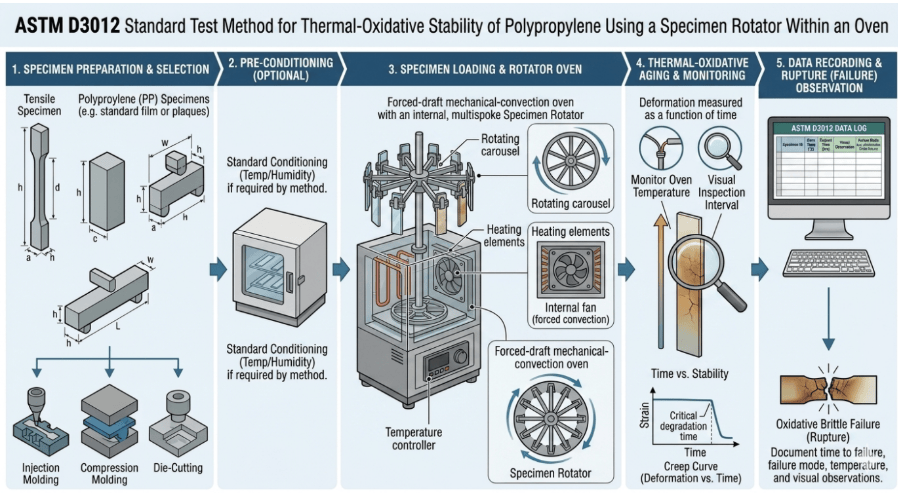
    ASTM D3012 accelerates polypropylene aging by placing molded samples into a forced-draft oven at an elevated temperature with a spinning specimen holder. Technicians then inspect the samples and note the time at which the first recognizable signs of failure occur. Other reference ASTM documents include D618, D883, D3641, D4101, D5374, E77, E220, E608, E644, E691, E1137, and E2251. The testing procedures and requirements for ASTM D3012 are given as-

    Read more

    Specimen Preparation and ConditioningLaboratories prepare polypropylene specimens by compression molding or injection molding and condition them according to applicable testing requirements.
    Oven Preparation and Specimen Installation Technicians set forced-draft ovens to selected test temperatures, check temperature control and air circulation, and place the specimens in the biaxial or uniaxial rotating specimen holder.
    Thermal Aging and Visual ExaminationThen, they expose the rotating specimens to heated air inside the oven and periodically inspect them for localized crazing, cracking, holes, crumbling, discoloration, or combinations of these conditions.
    Time-to-Failure MeasurementAnalysts record the number of days from the start of exposure until the specimen exhibits the first specified visual failure.
    Life-Temperature EvaluationEngineers analyze the time-to-failure data using the Arrhenius relationship when testing occurs at multiple temperatures.

    ASTM D3012 Testing Process and Data Collection

    Technicians first choose a representative polypropylene material and prepare the required molded specimens. Technicians can use compression molding or injection molding to produce specimens with specified geometry, place them in the rotating holder using uniaxial and biaxial holders, and heat them under a controlled forced-draft oven. Technicians then visually observe the specimens during the aging period and record when the first crazing, cracking, holes, crumbling, discoloration, or other specified failure condition occurs. The laboratory measures the number of days to failure. When laboratories test the same polypropylene at several temperatures, they can collect time-to-failure data for each temperature and use the data to estimate the material’s life-temperature relationship.

    This image depicts a forced-draft mechanical-convection oven used to measure thermal-oxidative stability of polypropylene according to ASTM D3012.
    ASTM D3012 Forced-draft Mechanical-Convection Oven

    Common Challenges and Troubleshooting

    To get reliable ASTM D3012 results, it is important to have consistent sample preparation, controlled oven conditions, uniform air movement, proper temperature control, and uniform visual examination. Common challenges include inconsistent specimen thickness, improper specimen molding, inaccurate oven temperature, uneven air circulation, incorrect specimen rotation, poor temperature measurement, and incorrect recording of the time to failure. Before testing, technicians should check the oven temperature, air velocity, specimen size, rotation system, and temperature-measurement instruments.

    ASTM D3012 Analysis Results and Interpretation

    • Laboratories report ASTM D3012 results based on the aging temperature, specimen configuration, exposure conditions, and failure point observed in the labs.
    • Laboratories report results for failure in days (d) and temperature in ºC.
    • When laboratories test the same polypropylene at multiple temperatures, they can plot the logarithm of time to failure against the reciprocal of absolute temperature in kelvins (K) to evaluate the life-temperature relationship using the Arrhenius relation.
    • A longer time to failure means higher resistance to the extreme thermal-oxidative aging conditions of the test.

    Link to ASTM D3012

    Read more

    Updated on August 26, 2026

    Rohit Dhembare
    About Author
    Rohit Dhembare is an Operations Associate at Matestlab Inc., holds a postgraduate degree in Organic Chemistry and is trained in Materials Science testing techniques.
    Know More
    Testimonials
    Real results
    Engineers trust us with what matters most
    Start Your Testing
    Project Today
    Define your requirements and get access to
    specialized laboratories ready to deliver results
    Partners with us
    Clients
    Vendors
    Process for testing
    • STEP 01

      You share your testing requirements

    • STEP 02

      You share your sample(s)

    • STEP 03

      We deliver your test reports

    Get your testing done

    Let us know your testing requirements and we will be right back with a solution.

      Let us root for each other. Collaborate to grow, expand, and accelerate our businesses.

      Partner with us

        Discover more from Matestlab

        Subscribe now to keep reading and get access to the full archive.

        Continue reading