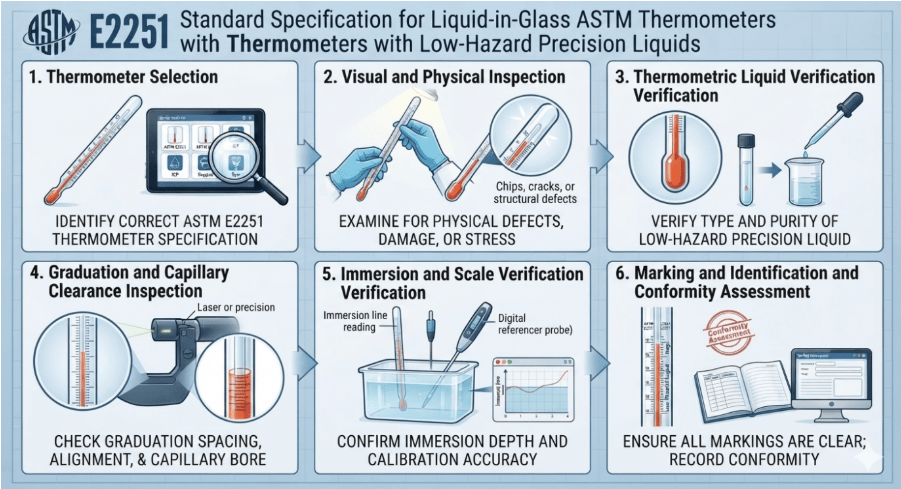
ASTM E2251 covers liquid-in-glass thermometers with low-hazard thermometric liquids. It covers thermometers graduated in Celsius or Fahrenheit and includes the ASTM thermometer types listed in Table 1. The specification also establishes technical requirements for the thermometric liquids and conformity tests in Annex A1.
The specification has a significant influence on physical and identification characteristics such as the glass bulb, thermometer stem, capillary clearances, graduation lines, immersion markings, inscriptions, and case information.
The scope of ASTM E2251 includes:
- Material: Covers liquid-in-glass ASTM thermometers manufactured with suitable thermometer tubing, glass bulbs, low-hazard thermometric liquids, and suitable inert filling gas.
- Objective: Establishes the construction and performance specifications of ASTM thermometers for use in precision temperature measurement.
- Property measurement: Measures temperature within the specified range of each approved thermometer in degrees Celsius or degrees Fahrenheit.
- Method: Establishes conformity using specified thermometer construction, graduation, capillary clearance, immersion, identification, and thermometric-liquid requirements.
- Results: To provide an ASTM-conforming thermometer having a desired temperature range, graduation interval, immersion condition, and maximum permissible scale error.
- Test limitations: The specification does not address every possible application or safety concern. Individual ASTM test methods determine whether a particular thermometer is suitable for their intended use.
- Environmental conditions: Users must select and operate the thermometer within its specified temperature range and immersion condition and establish appropriate safety, health, and environmental practices.
- Applications: Supports ASTM laboratory and industrial methods that specify approved liquid-in-glass ASTM thermometers, including precision, bomb calorimeter, cloud and pour, density-wide-range, kinematic-viscosity, oxidation-stability, Reid-vapor-pressure, solidification-point, and tank applications.
What are the uses of ASTM E2251 testing?
ASTM E2251 is useful for laboratories and manufacturers requiring liquid-in-glass thermometers with controlled construction and temperature-measurement properties. The approved thermometer types can serve ASTM methods and other applications when the thermometer’s range and design suit the intended use. This standard-
- Specifies liquid-in-glass thermometers containing low-hazard thermometric liquids.
- Supports thermometers graduated in Celsius and Fahrenheit.
- Defines requirements for the construction of thermometers and capillary clearances.
- Controls the appearance, permanence, width, and positioning of graduation lines.
- Specifies immersion-line requirements for partial-immersion thermometers.
- Establishes identification and marking requirements.
- Supports thermometer verification and calibration activities.
- Provides approved thermometer types for use in ASTM test methods.
What materials are tested in ASTM E2251?
ASTM E2251 does not test a material or determine a material property. Instead, it specifies the construction and performance characteristics of liquid-in-glass thermometers. The thermometers contain a low-hazard thermometric liquid, a glass bulb, suitable thermometer tubing, and nitrogen or another suitable inert filling gas.
Why is ASTM E2251 important?
ASTM E2251 provides uniform criteria for liquid-in-glass ASTM thermometers for laboratory and industrial methods. Standardized construction, graduations, capillary clearances, immersion markings, and identification help laboratories select thermometers that provide the characteristics required by applicable ASTM procedures.