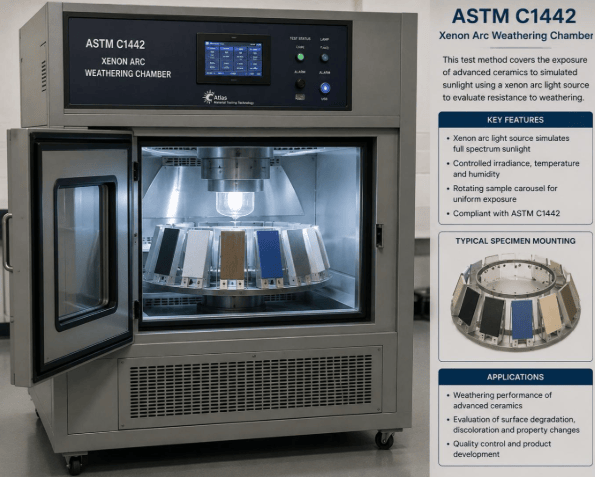
ASTM C1442 provides uniform laboratory procedures for assessing the degradation of sealants with artificial weathering equipment because of exposure to actinic radiation, high temperature, and moisture. The practice provides standardized exposure procedures for comparing sealant durability under accelerated laboratory weathering conditions.
- Covers artificial weathering of sealants.
- Evaluates the effects of light, heat, and moisture.
- Contains light exposure using a filtered xenon arc lamp.
- Contains UV fluorescent exposure.
- Includes exposure to open-flame carbon-arc equipment.
- Allows comparison of the durability of sealant formulations.
- Establishes standardized laboratory weathering procedures.
What are the Uses of ASTM C1442 Testing?
ASTM C1442 provides standardized procedures for exposing sealants to controlled artificial weathering conditions, including ultraviolet radiation, heat, and moisture. Weathering resistance is evaluated afterward using appropriate ASTM sealant test methods. This practice provides accelerated laboratory weathering exposure for comparing sealant formulations before evaluating their properties with appropriate ASTM test methods.
- Tests the weathering resistance performance of sealants.
- Evaluates the impact of humidity, temperature, and UV exposure.
- Compares the durability of different sealant formulations.
- Assists in product development and material qualification.
- Helps with quality control and performance verification.
- Conducts accelerated weathering tests to evaluate sealant performance.
- Enables research and prediction of service life.
What Materials can be Tested Under ASTM C1442?
ASTM C1442 covers construction sealants such as silicone, polyurethane, acrylic, polysulfide, and other elastomeric sealants for use in construction, glazing, and joint sealing.
Why is ASTM C1442 Important?
ASTM C1442 establishes a standard method for accelerated weathering of sealants. It helps manufacturers forecast the long-term outdoor performance of their products, enhance product durability, and ensure consistency before field installation.
Common Challenges and Troubleshooting
The reliability of weathering evaluations remains a concern unless the technician prepares the specimens, calibrates the weathering equipment, and monitors the weathering conditions. Common issues include uneven UV light intensity, temperature fluctuations, incorrect moisture cycles, specimen contamination, exposure time issues, and calibration errors. The repeatability of artificial weathering exposure can be enhanced by routine equipment maintenance, standard exposure procedures, calibration, and proper specimen preparation. The exposure conditions used in the weathering procedure selected are documented in the laboratory, and the results of the accompanying ASTM test methods for sealant properties are reported after weathering.
ASTM C1442 Testing Process and Data Collection
Testing begins with preparation, curing, and conditioning of representative sealant specimens according to the applicable ASTM sealant test method before artificial weathering exposure. Technicians expose the specimens in the selected artificial weathering apparatus using the exposure cycle specified for the chosen weathering method. Laboratory personnel evaluate the specimens after weathering exposure using the appropriate ASTM sealant property test methods specified for the property being assessed. Laboratories document the exposure conditions specified by the selected weathering procedure and report the results of the companion ASTM sealant property test methods performed after exposure.