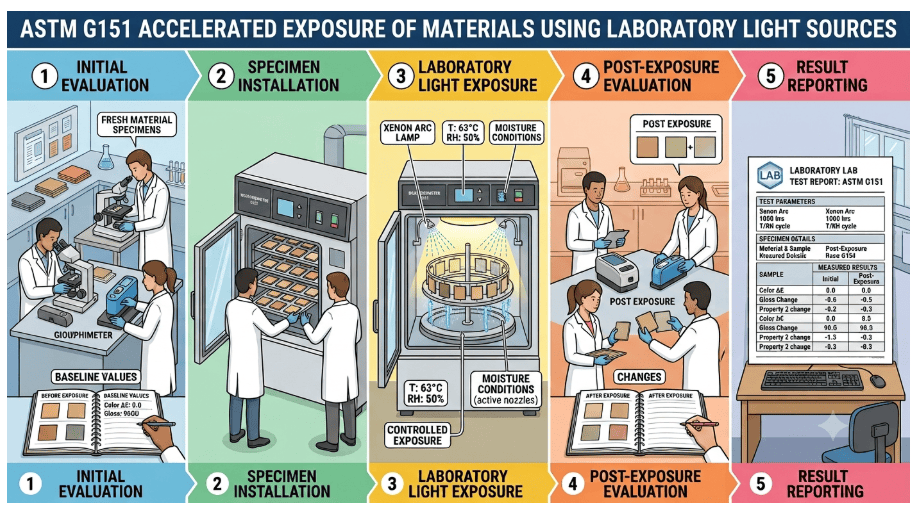
ASTM G151 establishes general procedures for exposing nonmetallic materials to accelerated laboratory light sources to evaluate and compare their performance under controlled exposure conditions. It covers controlling and evaluating exposure conditions, including irradiance, temperature, humidity, moisture, and light/dark cycles, as applicable. The specific exposure conditions depend on the material, laboratory light source, and applicable test method. The primary purpose of ASTM G151 is to provide consistent accelerated exposure conditions for evaluating and comparing the relative performance of nonmetallic materials. Results are most appropriately used for relative performance comparisons, particularly when test materials and control materials are exposed under the same conditions.
The scope of ASTM G151 includes:
- Material type: Nonmetallic materials exposed to laboratory light sources.
- Purpose: Accelerated exposure testing and comparison of material performance.
- Properties evaluated: Physical, mechanical, appearance changes, or other applicable properties after exposure.
- Testing method: Exposure conditions are controlled according to the applicable laboratory light source and test requirements, including irradiance, temperature, humidity, and moisture where applicable.
- Results: Results may be expressed using exposure time or radiant exposure required to produce a specified change in a characteristic property.
- Test limitations: ASTM G151 does not fully simulate actual outdoor conditions.
- Use conditions: Exposure conditions may include controlled light, temperature, humidity, water, and light/dark cycles, depending on the test.
- Applications: Material performance comparison, quality control, accelerated weathering evaluation, and assessment against control materials.
What are the Uses of ASTM G151 Testing?
ASTM G151 testing helps laboratories evaluate the behavior of nonmetallic materials under controlled accelerated exposure conditions. This test method-
- Compares the relative durability of materials.
- Evaluates differences between material formulations.
- Checks the consistency of different production batches against a control material.
- Studies changes in selected material properties after exposure.
- Supports material selection and product development.
- Establishes controlled conditions for accelerated weathering studies.
- Evaluates the effects of laboratory light, temperature, and moisture.
- Supports quality-control programs.
Which materials can be tested under ASTM G151?
The standard tests materials, including plastics, paints, coatings, rubber, and composites, under accelerated weathering to determine their resistance to UV in outdoor exposure where UV stability is critical to aesthetic and functional integrity. ASTM G151 applies to nonmetallic materials that can be prepared as suitable test specimens. The specimen dimensions typically depend on the applicable property test method and the type of material or article being evaluated.
Why is ASTM G151 important?
ASTM G151 is important in the long-term assessment of nonmetallic materials’ performance in simulated environments. ASTM G151 provides general procedures and equipment requirements for accelerated exposure of nonmetallic materials using laboratory light sources. It helps laboratories conduct controlled exposure tests and compare material performance. It guides product development, ensuring compliance with quality standards and regulations to support material durability and customer satisfaction.