

Introduction to Package Drop and Concentrated Impact Testing
ASTM D4169 (Standard Practice for Performance Testing of Shipping Containers and Systems) outlines laboratory tests to determine the capability of the packaged products to resist distribution hazards. The standard consists of multiple levels of assurance and transport cycles that emulate transport situations during warehousing, handling, and shipment. Two of the main tests performed on packages include package drop testing and concentrated impact testing, which are important factors to consider when evaluating product safety and package durability. The drop test is performed to investigate the performance of a package if it is accidentally dropped during loading or unloading or manual handling. The concentrated impact test, however, is used to assess a package’s ability to withstand concentrated or pointed forces when it is being stacked or transported. The manufacturers can pinpoint areas for packaging weaknesses, as well as enhance cushioning design, container strength, and general shipping dependability using this process.
ASTM D4169 also complements other related standards, such as ASTM D5276 (free-fall drop test) and ASTM D6344 (concentrated impact evaluation). These standards when combined, ensure a safer and more reliable package distribution systems in different sectors.
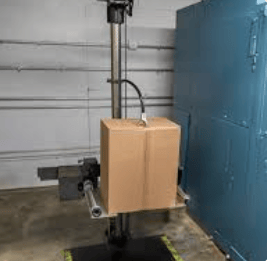
Scope of ASTM D4169 Package Testing
- Sets up lab distribution testing procedures for shipping containers and systems
- Represents risks associated with transport and storage
- Assesses package integrity and product protection ability
- Suitable for consumer goods, industrial products, electronics, and medical devices
- Assists with package design validation and quality assurance program.
- Assists in minimizing product damage during transport, handling, and storage facilities
Principle of Package Drop and Concentrated Impact Testing
The principle of package drop and concentrated impact testing is to replicate the physical hazards packages experience during transportation and distribution. Mechanical stress is applied to the shipping container and packaged product under laboratory conditions, controlled drop heights, and impact conditions. The outcomes of these observations reveal flaws in their packaging, structural problems, cushioning issues, or damage to the product during actual handling or shipment.
Drop testing measures the shock energy absorbed by the package when it is dropped onto a hard surface. Concentrated impact testing, however, focuses on the localized force applied by a specific impactor to see how well the package can withstand puncture, crushing or localized deformation. These assessments help make sure that packaging systems keep products safe during the distribution process.
Test Procedure Overview of ASTM D4169
ASTM D4169 provides several sequences of distribution tests that simulate actual transport and handling conditions. Technicians choose the right distribution cycle and assurance level, depending on the product type, shipping environment, and handling risks before testing. Controlled drop and concentrated impact tests are then performed on the packaged samples under predetermined laboratory conditions, which evaluate the package’s durability and protection of the product.
| Test Parameter | Description |
| Sample Preparation | Technicians prepare shipping containers with actual or simulated products having the intended weight, configuration, and packaging components. Samples remain conditioned according to specified environmental requirements before testing begins. |
| Drop Test | The technician releases a loaded package from a particular height from a predetermined face, edge, or corner with free-fall equipment. The test gauges the shock resistance, cushioning performance, and package integrity following impact. |
| Concentrated Impact Test | A concentrated impactor applies localized force to selected areas of the package by simulating external impacts from protruding objects or concentrated loading conditions that may arise during transport and stacking in the real world. |
| Equipment Used | Testing commonly uses free-fall drop testers, impact testing apparatus, conditioning chambers, and inspection tools to assess structural damage and product protection performance. |
| Evaluation Criteria | Inspectors examine packaging deformation, seal integrity, cushioning displacement, punctures, and product condition after testing to determine compliance with performance requirements. |
Significance of ASTM D4169 Package Testing
The ASTM D4169 package testing helps manufacturers to design their packaging systems to effectively protect the product during complex distribution channels. This standard is meant to minimize the potential for damage, complaint and loss of product during transit by identifying the weaknesses of packaging prior to it being commercialized. Moreover, it optimizes packaging material, packaging cushioning efficiency and packaging structure to improve packaging optimization.
The testing practice also assists companies in meeting quality requirements for transportation and maintaining the integrity of the products during the supply chain. This means that organizations can boost their shipping confidence, decrease replacement costs, and boost customer satisfaction.
Applications
Many industries use the ASTM D4169 testing to validate shipping container performance risks during transport. It is used by the electronics industry to protect sensitive electronics from damage on a global shipping scale. Packaging systems evaluated in medical and pharmaceutical companies are for the safe and sterile transportation of products.
Furthermore, consumer goods companies use the standard to minimize damage during transportation in retail stores and warehouses. These tests can also be used in the automotive, aerospace, and industrial equipment industries to ensure package durability for heavy or fragile products. As a result, ASTM D4169 is a critical packaging test used in many industries that require reliable protection during transportation.


