

Introduction to Material Test Reports
A material test report is a report giving the result of the laboratory testing of a material, component, or product. They are prepared in laboratories following procedures for different tests, such as tensile, hardness, impact, thermal analysis, chemical characterization, and environmental exposure. The report is a formal record of the testing process and the results. It helps manufacturers check product quality, prove compliance with customer orders, and helps with certification programs. Engineers use the information to decide which materials can be used, to understand why materials fail, and to compare materials. The test report is an important document to understand, as it helps the researchers interpret the results properly.
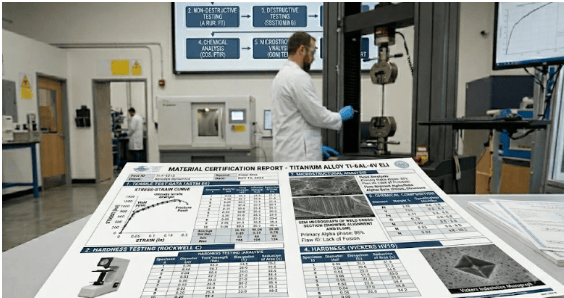
Scope of Material Test Reports
- Provides documented evidence of material testing results.
- Documents laboratory testing procedures and results.
- Provides information that may support corrective actions when necessary.
- Helps to choose materials and create products.
- Assists quality control and manufacturing decisions.
- Ensures a traceable record of testing activities.
- Supports certifications and regulations compliance.
- Helps with failure analysis and engineering investigations.
Principle of Material Test Reporting
A material test report contains information on the testing conditions and describes the test results in a structured format. Laboratories use standardized methods where results are accurate, repeatable, and traceable. Key elements of the report include sample identification, test methods, test conditions, measured values, observations, and conclusions. Engineers check these portions to ensure they meet performance criteria and specifications.
Key Sections of a Material Test Report
| Section | Purpose |
| Sample Identification | Describes the material, product, batch number, or specimen tested. |
| Test Standard | Identifies the ASTM, ISO, or other standard used during testing. |
| Test Conditions | Documents temperature, humidity, loading rate, and other testing parameters. |
| Equipment Information | Lists the instruments or testing machines used for the evaluation. |
| Results Table | Presents measured values and calculated properties. |
| Graphs and Charts | Visualizes material behavior, such as stress-strain or thermal analysis curves. |
| Observations | Records notable findings during testing. |
| Conclusion or Summary | Explains the overall outcome of the test. |
| Acceptance Criteria | Defines the requirements against which results are evaluated. |
How to Read a Material Test Report
| Step | What to Review |
| 1. Verify Sample Information | Ensure the report is for the correct material, batch, or product. |
| 2. Check the Test Standard | Verify that the lab performed the test in accordance with the required ASTM, ISO, or industry standard. |
| 3. Review Test Conditions | Verify that testing occurred under appropriate environmental and operating conditions. |
| 4. Examine the Results | Compare reported values with acceptance criteria, specifications, or customer requirements. |
| 5. Analyze Graphs and Data | Review charts and curves for additional insight into material behavior. |
| 6. Read Laboratory Observations | Look for comments regarding defects, abnormalities, or unusual behavior. |
| 7. Review the Conclusion | Determine whether the material met the test objectives and requirements. |
Common Results Found in Material Test Reports
| Test Type | Common Results Reported |
| Tensile Testing | Tensile strength, yield strength, modulus, and elongation at break |
| Hardness Testing | Hardness value (Shore, Rockwell, Brinell, Vickers) |
| Impact Testing | Impact energy and toughness |
| DSC Analysis | Glass transition temperature, melting temperature, crystallization temperature |
| TGA Analysis | Weight loss, decomposition temperature, residue content |
| FTIR Analysis | Material identification, contamination analysis, and functional group characterization |
| Compression Testing | Compressive strength and modulus |
| Water Absorption Testing | Percentage of water absorbed |
Significance of Understanding Test Reports
Material test reports provide documented evidence that supports engineering and business decisions. Good interpretation ensures manufacturers validate the product, identify possible problems, and confirm compliance with specifications. Engineers also use the record to check the material, weight, and value of the test, as well as the performance of the manufactured products in real conditions. Incorrect interpretation may cause defective material, product failure, struggles with regulations, and extra costs. Thus, it is important for anyone associated with material evaluation and quality assurance to be familiar with the structure and contents of a test report.
Applications of Material Test Reports
- Support quality control and product release decisions.
- Document results for certification and regulatory requirements.
- Support engineers in the product design process and development.
- Support supplier qualification and incoming material inspection.
- Investigate product failures and performance issues.
Quick Checklist When Reviewing a Material Test Report
Before accepting a test report, verify:
- The correct material and sample identification, testing conditions, and equipment relevant to the test.
- The appropriate ASTM or ISO test standard.
- Recorded measurements and acceptance criteria.
- Verify that reported values include the correct units of measurement.
- Any laboratory observations or deviations.
- Conclusion and compliance status.


