

Introduction to ASTM D638 and ISO 527
ASTM D638 and ISO 527 are two commonly used methods for determining tensile strength, modulus, elongation, and other key properties of plastics. ASTM D638 is the standard method for North American tensile testing, and ISO 527 is used in Europe and internationally. Both standards are useful to labs, manufacturers, and researchers in determining material properties, comparing different plastic formulations, and verifying product consistency.
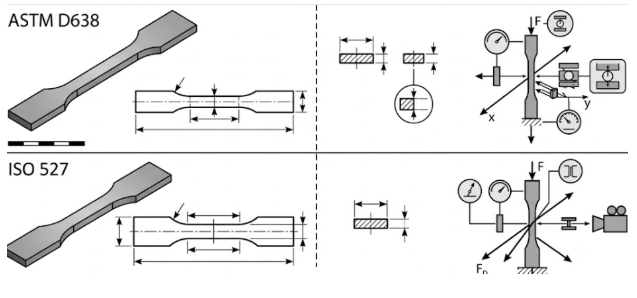
Scope of ASTM D638 and ISO 527
- Measure properties of plastic materials under tension.
- Determine tensile strength, tensile modulus, and elongation.
- To support material selection and product development.
- Ensure that products meet the required specifications.
- Characterize the tensile properties of thermoplastic and thermosetting materials.
- Help conduct research, quality control, and certification.
- Establish uniform data for comparison of plastic materials.
Principle of ASTM D638 and ISO 527
ASTM D638 and ISO 527 measure tensile properties of materials by applying a controlled tensile load or deformation rate to a standardized specimen. The testing machine measures the load and deformation of the test piece during testing and can calculate the tensile strength, modulus, yield properties, and elongation. The main differences are in specimen geometry and testing conditions. The ASTM D638 includes multiple types of dog-bone specimens based on material thickness and application. ISO 527 also uses dog-bone specimens, with dimensions and gauge lengths that differ from those of ASTM. Furthermore, ISO 527 places greater emphasis on precise strain measurement, particularly during modulus determination.
Test Procedure Overview of ASTM D638 and ISO 527
| Test method | ASTM D638 | ISO 527 |
| Instrumentation | Uses a universal testing machine (UTM) with appropriate grips and extensometers. | Uses a universal testing machine with calibrated extensometers and specified measurement systems. |
| Sample Preparation | Uses ASTM-defined dog-bone specimens molded or machined from plastic materials. | Uses ISO-defined dog-bone specimens prepared according to ISO dimensional requirements. |
| Measurement Process | Applies tensile force at specified crosshead speeds until failure or designated endpoints. | Applies tensile force under ISO-defined strain rates and testing conditions. |
| Strain Measurement | May use extensometers depending on the property being measured. | Frequently requires precise extensometer measurements to determine modulus. |
| Result Obtained | Reports tensile strength, yield strength, modulus, and elongation. | Reports tensile strength, tensile stress at yield, modulus, and elongation values. |
Key Differences Between ASTM D638 and ISO 527
| Features | ASTM D638 | ISO 527 |
| Specimen Geometry | Type I, II, III, IV, and V specimens. | Type 1A, 1B, 5A, etc. |
| Specimen Dimensions | Different gauge lengths and dimensions | Different dimensions and gauge lengths from ASTM |
| Strain Measurement Requirements | Less restrictive in some cases | Greater emphasis on extensometer-based measurements |
| Reporting Format | ASTM terminology and calculations | ISO terminology and calculations |
| Industry Usage | Common in U.S. product specifications | Common in international specifications |
| Gauge Length | 50 mm gauge length for many specimens. | 50 mm or 75 mm gauge lengths depending on specimen type. |
Significance of ASTM D638 and ISO 527
Both standards include important information for characterizing plastic materials. Tensile test data serve a wide variety of purposes, including material comparisons, formulation troubleshooting, production quality control, and product design and engineering. ASTM D638 is commonly specified in North American markets, while ISO 527 is frequently specified in international markets. Differences between these standards help laboratories to correctly interpret test data and prevent direct comparisons between standards when specimen geometry and testing conditions vary. Many organizations test materials they manufacture following both the standards to meet customer requirements and global regulatory requirements.
Applications of ASTM D638 and ISO 527
ASTM D638 Applications
- Determines tensile characteristics of engineering plastics.
- Assists in material qualification and product development.
- Carries out quality control duties for molded plastic items.
- Assists in failure analysis and research studies.
- Applicable to the automotive, electrical, and consumer goods industries.
ISO 527 Applications
- Supports material comparison and worldwide certification programs.
- Screens thermoplastics and thermosets for quality.
- Assists in research and development work.
- Used in the packaging, automotive, construction, and industrial applications globally.


